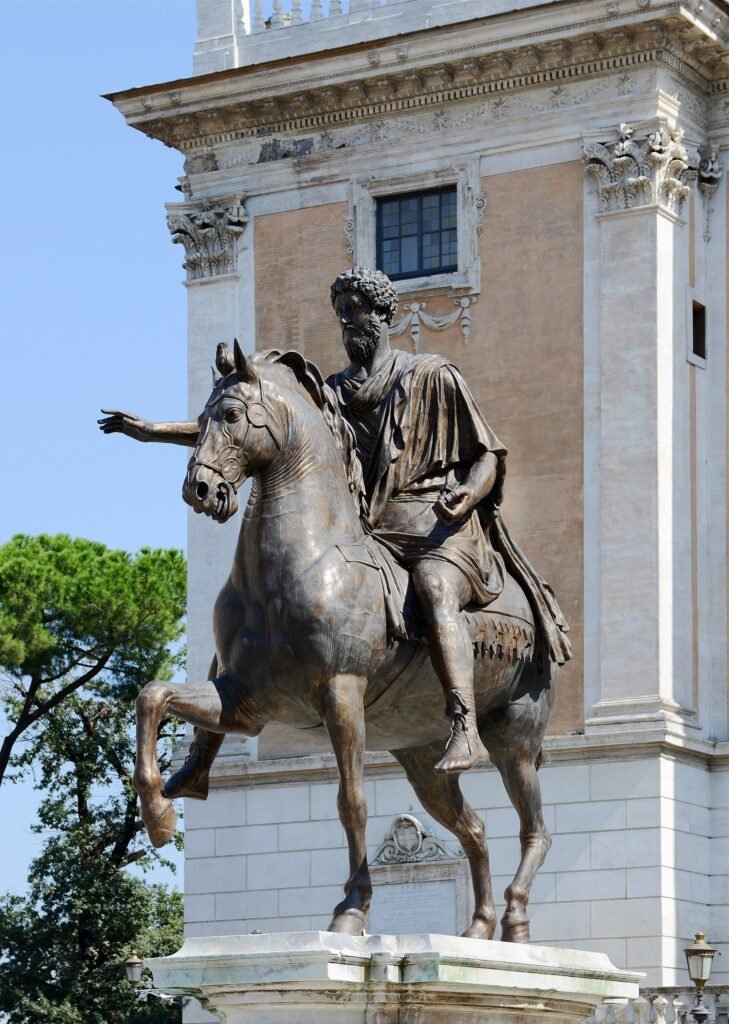
The Meditations is a collection of private reflections written in Greek by the Roman emperor Marcus Aurelius, who ruled from 161 to 180 CE, in which he reminds himself how to live by the principles of Stoic philosophy. It is divided into twelve books, and at least part of it was written during the last years of his military campaigns. Scholars generally agree that he wrote it for his own moral improvement, not for readers.
Background and creation of the Meditations
Marcus was born in 121 CE and educated extensively in rhetoric and philosophy. He succeeded his adoptive father Antoninus Pius as emperor in 161 and reigned until his death in 180. His rule was troubled by attacks from Germany, rebellions in northern Italy and Egypt, and an outbreak of plague.
His chief philosophical influence was Stoicism. In the first book of the Meditations he thanks his Stoic teachers Rusticus, Apollonius and Sextus, and among Stoic writers he singles out Epictetus. In a letter to his rhetoric teacher Fronto, written between 145 and 147, he describes reading the Greek Stoic Aristo of Chios and feeling both joy and shame at his own shortcomings. After that reading he decided he would never again argue both sides of a question as rhetorical training required.
The book seems to have had no title that we know of in antiquity. The name Meditations comes from a modern editor, Casaubon. The earliest references to the work are Byzantine: a dictionary of about 900 calls it a guide or directing text, and the tenth-century bishop Arethas calls it the writings to himself.
Structure and content of the Meditations
Book I differs from the rest. In it Marcus acknowledges relatives and teachers for the examples of virtue or the useful lessons they gave him, and he ends by thanking the gods for providing such examples. Outside that book the arrangement is hard to make out. Scholars cannot tell whether the order of the books and chapters follows the order of events in his life, a topical plan, or breaks in his thought.
Marcus returns again and again to subjects that must have come from his own experience, such as the nearness of death and his irritation with the faults of the people around him. The style is often a string of short commands to himself, such as erase impressions or do nothing at random. He describes his notes as supports, records and rules.
Because he wrote for himself, he refers to events in his life without giving details that would let an outsider identify them, and he uses technical Stoic terms without explanation. He also collects sayings from thinkers outside the Stoic school, including Epicurus, Heraclitus, Homer and Plato.
The book also shows his political outlook. He thanks his adoptive brother Severus for knowledge of Brutus, Cato and other Romans who opposed one-man rule, and he warns himself not to become Caesarified, meaning a dictator in the manner of Julius Caesar.
Themes and interpretation of the Meditations
Marcus wanted to live by Stoic doctrines. These include the claim that the world is governed by providence, that happiness lies in virtue, which is wholly in one’s own power, and that one should not be angry at associates but regard them as siblings who share the same divine origin. On this view only virtue is good and only vice is bad, and the things people normally worry about, such as wealth, status or health, are indifferent to happiness.
Two recurring ideas concern duty and acceptance. The first is justice, understood as acting for the sake of the human community. The second is piety, understood as welcoming whatever happens as part of the whole. Marcus sometimes states the physical question as an alternative, providence or atoms, and draws practical conclusions that hold either way.
Scholars therefore recommend reading individual passages as exercises. When Marcus says something, he is not always stating a settled belief. One passage lists ten prescriptions against anger, a failing that is especially damaging in the powerful, and another invokes the Stoic idea of eternal recurrence to remind himself how small mortal things are. The useful question is what moral and psychological effect he is trying to produce in himself.
Modern interpreters offer frameworks for the whole. Pierre Hadot organized the thoughts around three disciplines of desire, impulse and assent, which become the rules of accepting events, acting justly and judging with care. Christopher Gill found four strands: an ethical ideal, acceptance of death and change, reason, and sociality. These themes belong to the wider subject of ethics.
Reception and legacy of the Meditations
Marcus is one of the most quotable of philosophers, because his short, vivid sentences lift easily out of the text. The same quality frustrates readers who want a system. Reading him can feel like reading the maxims given to the character Polonius in Hamlet.
The book is valued as a rare record of Stoicism as someone tried to practice it. Epictetus had advised students to write down and rehearse the responses they ought to make to situations so that those responses would be ready when needed. Marcus’s notes look like an example of that practice, although no other private notebook of the kind survives from antiquity.
Because the Meditations was never a finished work for publication, its gaps and repetitions are part of its character. Its difficulties are philosophical as well as practical. Marcus had to apply a demanding doctrine while running an empire, fighting wars and facing the deaths of people he loved. Understanding those struggles has improved scholars’ understanding of Stoicism itself.
English translations are widely available, and an edition can be read free of charge online through Project Gutenberg. The work remains a common starting point for readers who want to meet Stoic ideas in a practical setting.
More in Philosophy
Key facts
- Marcus Aurelius was born in 121 CE, succeeded Antoninus Pius as emperor in 161 and reigned until his death in 180.1
- At least part of the Meditations was written during the last years of his military campaigns.1
- The work is written in Greek and is divided into twelve books.12
- The title Meditations comes from a modern editor, Casaubon, and the earliest references call it the writings to himself.1
- Scholars generally agree that Marcus wrote it for his own moral improvement.1
- Book I thanks relatives, teachers and the gods for examples of virtue.1
Related concepts
Quick checkWhy did Marcus Aurelius write the Meditations?Show answer
Most scholars think he wrote for his own moral improvement, to remind himself of the Stoic principles he wanted to live by.
Sources
- 1. Stanford Encyclopedia of Philosophy, Marcus Aurelius, https://plato.stanford.edu/entries/marcus-aurelius/
- 2. Project Gutenberg, Meditations by Marcus Aurelius (ebook 2680), https://www.gutenberg.org/ebooks/2680
Editorially reviewed by Specialty Digest Editorial TeamLast reviewed November 5, 2026Researched and drafted with AI assistanceReport an issue