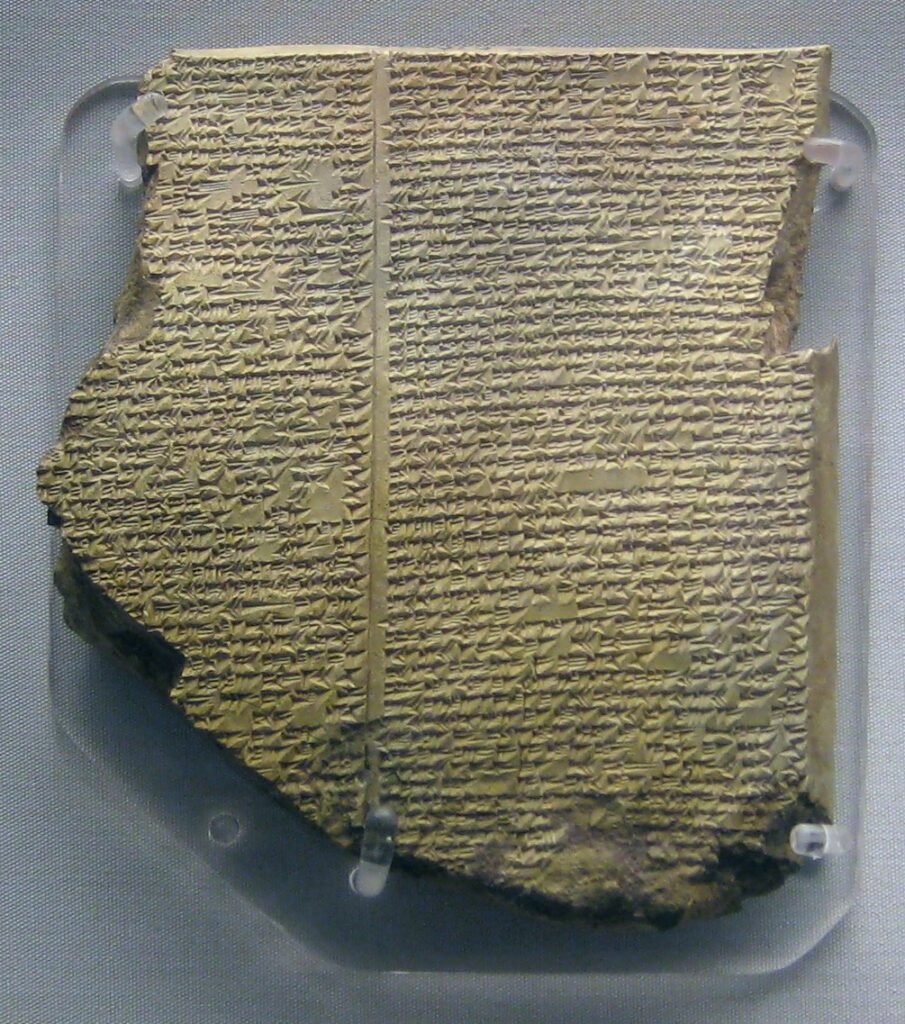
The Epic of Gilgamesh is an ancient Mesopotamian poem about King Gilgamesh of Uruk and his unsuccessful search for immortality. Composed in Akkadian and written on clay tablets, it is considered by many to be the world’s oldest great epic poem. Its best-known surviving form dates to the first millennium BCE, but its roots go back to earlier Sumerian poems about the same hero.
Background and creation of the epic
The story is set in early dynastic Uruk, around 2600 BCE. Some scholars believe Gilgamesh was a real king of the third millennium BCE, and he was later honored as a demigod and as a deity of the underworld. The poem itself is anonymous.
Only fragments survive of the earliest Akkadian version, the Old Babylonian one, which was produced shortly after 2000 BCE and drew on three much earlier Sumerian poems about Gilgamesh. A longer Akkadian text, called the standard version, survives on first-millennium BCE tablets from Nineveh, Assur, Sultantepe, Babylon and Uruk and is usually copied on 12 tablets. Retellings in prose were also written in the Hittite and Hurrian languages.
Traditional scholarship holds that the poem began in oral tradition, as the Homeric poems did, and that is why it came to be called an epic. Some experts prefer the neutral word poem, but the traditional title helps distinguish it from the older Sumerian songs.
Discovery of the Gilgamesh tablets
The best-known tablets came from the library of Ashurbanipal, an Assyrian king of the seventh century BCE, at Nineveh near modern Mosul in Iraq. Hormuzd Rassam recovered thousands of tablets there in the 1850s, and they were sent to the British Museum. Few people could read the cuneiform script, so many tablets stayed in storage.
George Smith, born in London in 1840, taught himself the script during lunch breaks at the museum and was hired in 1861 to organize the collection. In November 1872 he noticed a fragment, now numbered K.3375, that described a great flood, with a ship coming to rest on a mountain and a dove sent out to find land. He recognized a version of the flood story told in the Book of Genesis.
The find caused a public sensation. A London newspaper, the Daily Telegraph, offered to fund an expedition so that Smith could search for missing pieces, and he published translations in the 1870s, notably The Chaldean Account of Genesis. The standard modern scholarly edition is Andrew George’s two-volume Babylonian Gilgamesh Epic, published in 2003.
Fragments are now held by many museums, including the British Museum in London and the Sulaymaniyah Museum in Iraq.
Summary of the epic
The story begins in Uruk, where Gilgamesh rules as a tyrannical king. The gods create Enkidu, a wild man, to rival him, but Enkidu is brought into human society through an encounter with a woman and then becomes Gilgamesh’s close friend.
Together they kill Humbaba, the fierce guardian of the Cedar Forest, and bring back valuable timber. Gilgamesh refuses the goddess Ishtar, who in revenge sends the Bull of Heaven. The two heroes kill the bull as well. The gods, angered by both killings, decree that Enkidu must die.
Gilgamesh mourns his friend deeply. He sets out on a hard search to learn about the limits of human mortality and to find Utnapishtim, the only man granted eternal life. Utnapishtim tells him the story of a great flood that destroyed humanity. Gilgamesh finally accepts that he cannot gain immortality and returns to Uruk, where the spirit of Enkidu describes the state of the dead.
Themes and interpretation of the epic
The central theme is mortality. Gilgamesh begins as a king who overpowers others and ends as a man who has come to terms with death, and the poem treats that change as the real achievement of his travels.
A second theme is friendship and grief. The bond between Gilgamesh and Enkidu drives the plot, and Enkidu’s death is what starts the search for eternal life. The poem has been celebrated since its first modern translations for the lasting relevance of its portrait of a restless, sometimes violent hero who struggles for peace and belonging and who fears death.
A third theme is the relationship between people and gods. The gods can create, punish and destroy, while humans, even a king who is partly divine, must live within limits.
Scholars also compare the epic with later texts. A tablet in the standard version contains a flood account in which Utnapishtim plays a role like Noah’s. The creation of Enkidu from soil parallels the creation story in Genesis, and the pessimistic Book of Ecclesiastes seems to echo the poem’s view of how short life is. These parallels are part of why the epic matters in the study of the Bible and its setting.
Reception and legacy of the epic
Smith’s translations showed that the flood story existed in Mesopotamian writing long before the Bible was compiled, which moved the story’s origins much further back in history. For modern readers the poem became a key witness to the literary life of ancient Iraq and to the history of poetry.
The epic has been translated into about two dozen languages. Recent English versions include Sophus Helle’s 2021 translation, and literary historian Michael Schmidt published a study of the poem’s life in 2019. Its scenes are shown in ancient art as well, such as an eighth-century BCE relief of Gilgamesh holding a lion.
The poem was also carried across borders in ancient times. Prose retellings were written in the Hittite and Hurrian languages, which shows that the story circulated well beyond Mesopotamia.
Today the epic is read as both literature and evidence. It is a story of friendship, loss and the search for meaning, and it is a source for scholars studying Mesopotamian religion, kingship and the transmission of stories across languages and centuries.
More in Literature
Key facts
- The epic is set in early dynastic Uruk, around 2600 BCE, and is named for its hero, King Gilgamesh.1
- The earliest Akkadian version dates to shortly after 2000 BCE and draws on three earlier Sumerian poems.1
- The standard version is usually copied on 12 tablets found at Nineveh and other first-millennium BCE sites.1
- George Smith identified the flood fragment, now numbered K.3375, in November 1872.2
- The Nineveh library belonged to the Assyrian king Ashurbanipal in the seventh century BCE.2
- Tablet fragments are held by many museums, including the British Museum and the Sulaymaniyah Museum.1
Related concepts
Quick checkWho first translated part of the Epic of Gilgamesh in modern times?Show answer
George Smith of the British Museum, who deciphered a flood tablet from Nineveh in 1872.
Sources
- 1. Biblical Archaeology Society, The Epic of Gilgamesh, https://www.biblicalarchaeology.org/daily/the-epic-of-gilgamesh/
- 2. National Geographic, Discovering Gilgamesh, the World's First Action Hero, https://www.nationalgeographic.com/history/history-magazine/article/history-gilgamesh-epic-discovery
Editorially reviewed by Specialty Digest Editorial TeamLast reviewed November 5, 2026Researched and drafted with AI assistanceReport an issue