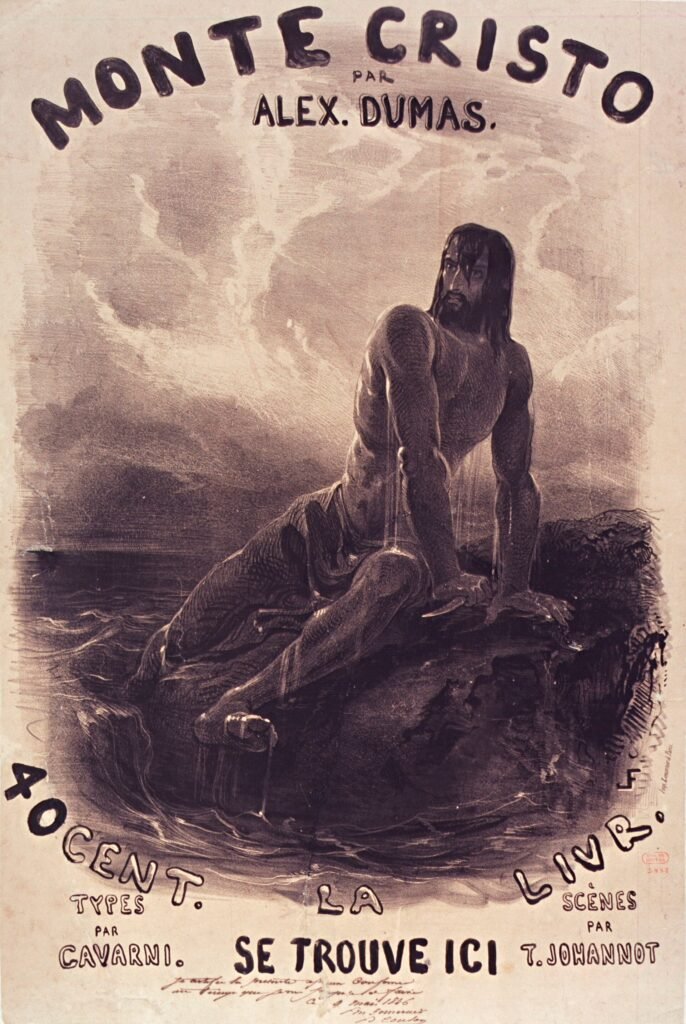
The Count of Monte Cristo is a French adventure novel by Alexandre Dumas, written with the collaborator Auguste Maquet and serialized from 1844 to 1846. It tells how Edmond Dantès, a young sailor falsely accused of treason, spends fourteen years in prison, escapes, finds a hidden treasure and returns to France under a new identity to punish the men who betrayed him.
Background and creation of The Count of Monte Cristo
Alexandre Dumas (1802 to 1870) was one of the most productive French writers of his century, and he often worked with assistants. Auguste Maquet (1813 to 1888) collaborated with him on The Count of Monte Cristo. According to a PBS account, Maquet handled historical research and initial plot outlines, after which Dumas developed the characters, wrote the dialogue and shaped the pacing.
Maquet’s role was often left out of original publications, which led to disputes over credit. Legal records confirm his hand in 18 Dumas novels, including The Three Musketeers, and he eventually won royalties in court, although he was never officially recognized as a co-author.
The story first appeared as a serial in the Paris newspaper Journal des Débats between 1844 and 1846. Serialization was a common way to reach a wide audience in nineteenth-century France, and the form favored cliffhangers, reversals and long-running mysteries. The English edition on Project Gutenberg divides the whole into 117 chapters across several volumes.
Dumas’s own family history left traces in the book. His father, Thomas-Alexandre Dumas, was born to a French plantation owner and an enslaved woman, became France’s first Black general at age 31, and was later imprisoned in Italy and left in poverty. PBS notes that these experiences helped shape the novel’s concern with imprisonment, betrayal and the corrupting power of the aristocracy.
The prison at the center of the plot was real. The Château d’If, a sixteenth-century fortress on an island off Marseille, became a state prison in 1580 and held inmates for about three hundred years, among them political opponents, Protestant Huguenots and ordinary criminals. Conditions were sharply unequal, with wealthier prisoners able to pay for better rooms.
Plot of The Count of Monte Cristo
The novel opens on 24 February 1815, when the ship Pharaon returns to Marseille. Its young mate, Dantès, is about to be promoted to captain and to marry Mercédès. Three men resent him for different reasons: the ship’s accountant Danglars, the rival suitor Fernand, and a neighbor named Caderousse. They conspire to denounce him, and Dantès is caught up in a letter connected with Napoleon’s exile on Elba.
The deputy prosecutor Villefort realizes that the letter implicates his own father, so he protects himself by sending the innocent sailor to the Château d’If without a trial. In the next cell Dantès meets the Abbé Faria, an older prisoner who educates him and tells him of a treasure buried on the island of Monte Cristo. After Faria dies, Dantès escapes by taking the dead man’s place in the burial sack, reaches the island and finds the treasure.
Years later he returns to Paris as the wealthy Count of Monte Cristo. Danglars has become a banker, Fernand a nobleman, and Villefort a powerful prosecutor. Using disguises, borrowed names and an immense fortune, Dantès arranges for each man’s past crimes to catch up with him, while he rewards the few who stayed loyal, such as the shipowner Morrel. The plan carries consequences for innocent people as well, and the Count’s confidence that he is serving justice begins to waver.
The book ends with a letter to Morrel’s family that sums up human wisdom in two words, “wait and hope.”
Themes in The Count of Monte Cristo
The central tension is between justice and revenge. Dantès begins by seeing himself as an instrument of providence, yet the story keeps showing how a plan of retribution can harm people who had no part in the original wrong. The novel is therefore as much a study of the limits of vengeance as a celebration of it.
Mercy and forgiveness offset that darker thread. The Abbé Faria teaches restraint as well as science and languages, and the Count’s last gestures are generous rather than punishing. Transformation is a related theme. Education and money turn a sailor into a figure who moves easily among Parisian aristocrats, which suggests that status depends on knowledge and resources, not only on birth.
The book also offers a portrait of French public life after 1815. Royalists, Bonapartists and ambitious bankers compete for power, and personal betrayals turn out to be tied to politics. Dumas shows a society in which wealth, position and information can protect the guilty and crush the innocent.
Patience is the quieter theme. Dantès spends fourteen years in prison and years more preparing his plan, and the closing message treats waiting as a form of hope rather than passivity. The novel’s own pace, with long stretches of slow preparation followed by swift reversals, reflects that idea.
Reception and legacy of The Count of Monte Cristo
The serial made Dumas’s name even larger, and the book has stayed in print ever since. It has been translated into nearly 100 languages, and its title now works as shorthand for a patient, elaborate revenge. It has been adapted for film, television, the stage and comics many times, with each adaptation changing the ending or the balance between vengeance and mercy.
The Château d’If, which Dumas made famous, has since become a tourist attraction, and visitors are shown a cell associated with the fictional Dantès. The collaboration with Maquet remains a subject of discussion among historians of literature, who see it as a case study in how popular fiction was produced in the age of the newspaper serial.
More in Literature
Key facts
- The Count of Monte Cristo was written by Alexandre Dumas with Auguste Maquet and serialized between 1844 and 1846.1
- The serial appeared in the French newspaper Journal des Débats.2
- Maquet handled research and plot outlines, and legal records confirm his hand in 18 Dumas novels.2
- The Château d'If became a state prison in 1580 and held inmates for about 300 years.2
- The novel opens on 24 February 1815 at Marseille.3
- It has been translated into nearly 100 languages.2
Related concepts
Quick checkWho wrote The Count of Monte Cristo, and when did it appear?Show answer
Alexandre Dumas wrote it with Auguste Maquet, and it was serialized from 1844 to 1846.
Sources
- Project Gutenberg, The Count of Monte Cristo by Alexandre Dumas and Auguste Maquet (ebook 1184), https://www.gutenberg.org/ebooks/1184
- PBS Masterpiece, 6 Fascinating Facts about The Count of Monte Cristo, https://www.pbs.org/wgbh/masterpiece/specialfeatures/6-fascinating-facts-about-the-count-of-monte-cristo
- Project Gutenberg, full text of The Count of Monte Cristo (table of contents and opening chapter), https://www.gutenberg.org/cache/epub/1184/pg1184.txt
Editorially reviewed by Specialty Digest Editorial TeamLast reviewed November 5, 2026Researched and drafted with AI assistanceReport an issue