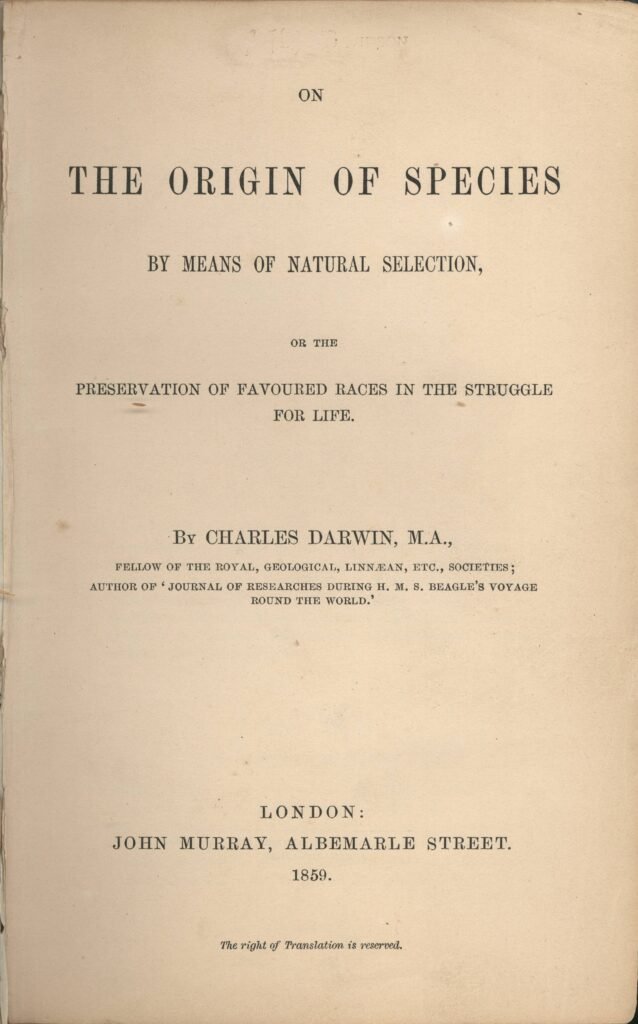
On the Origin of Species is a scientific book by the English naturalist Charles Darwin, published in London on 24 November 1859. It presents the case that species are not fixed but change over generations, and that the main mechanism of change is natural selection. It is regarded as the founding work of evolutionary biology.
Background and creation of On the Origin of Species
Darwin spent more than twenty years developing his ideas before the book appeared. His observations on the voyage of HMS Beagle, his study of domestic animals and plants, and his reading of the economist Thomas Malthus on population all shaped his theory. By 1844 he had written a sketch of the argument, which he mentions in the introduction, but he delayed publication while he gathered more evidence.
The decision to publish was prompted by a rival. Alfred Russel Wallace, who was studying the natural history of the Malay Archipelago, reached almost the same conclusions and sent Darwin a memoir on the subject in 1858. Darwin’s friends Charles Lyell and Joseph Hooker arranged for Wallace’s memoir to be read at the Linnean Society together with extracts from Darwin’s own manuscripts. Darwin then wrote a condensed version of his planned larger book and called it an abstract.
The full title was On the Origin of Species by Means of Natural Selection, or the Preservation of Favoured Races in the Struggle for Life. The publisher was John Murray. According to the University of Reading, the 1,250 copies of the first impression were sold out on the first day, and the book went through six further editions during Darwin’s lifetime. A misprint of the word species on one page distinguishes that first impression from later ones.
Content of On the Origin of Species
The book opens with evidence from domestic breeding. Darwin shows how breeders produce striking differences in pigeons, dogs and crops by selecting which individuals reproduce, and he argues that nature can act in a comparable way on a far longer timescale. He then considers variation among wild species and the blurred line between a variety and a species.
The central chapters cover the struggle for existence and natural selection. Darwin uses struggle in a broad sense, including dependence of one being on another and success in leaving offspring, not only direct fighting. Because many more individuals are born than can survive, those with helpful variations are more likely to survive and reproduce. Over time this process shapes the traits of a population.
Later chapters address the objections Darwin expected. He discusses how complex organs and instincts could arise gradually, why hybrid animals are often sterile, and why the fossil record is incomplete. He then surveys geographic distribution, the similarities of embryos and the shared structure of limbs in different animals, which he reads as evidence of descent from common ancestors. He avoided the word evolution and preferred the phrase descent with modification.
Chapters on geographic distribution use islands as test cases. The plants and animals of oceanic islands tend to resemble those of the nearest mainland rather than those of similar-looking islands elsewhere, which fits descent from colonists better than the idea that each species was created separately for its place.
The closing paragraph describes an entangled bank of living things shaped by laws acting around us, and it ends with the thought that endless forms most beautiful have been evolved. The book says little about human origins, observing only that light would be thrown on the subject.
Themes and interpretation of On the Origin of Species
The book’s main contribution is an explanation for adaptation that needs no designer: variation, inheritance and differential survival can by themselves produce organisms that fit their surroundings. Darwin did not know the mechanism of heredity, so he could not explain how variation was passed on. That gap was filled only in the twentieth century, when his theory was combined with the genetics founded on Gregor Mendel’s work.
Darwin also made a methodological case. He argued that a wide range of observations, from fossils to the distribution of island species, make sense together under one hypothesis. This unifying power, more than any single proof, persuaded many scientists.
Reception and legacy of On the Origin of Species
The book met with shock, admiration and astonishment. The first review, published in the Athenaeum on 19 November 1859, mocked the idea that humans descend from monkeys and predicted that the book’s influence would stay within universities and churches. That forecast proved wrong, because interest quickly extended far beyond science.
Supporters such as Thomas Henry Huxley defended the theory in public, while other scientists and clergy objected on scientific or religious grounds. A celebrated debate at Oxford in 1860 became a symbol of the clash. Over the following decades, evidence from fossils, genetics and later molecular biology strengthened the case for common descent.
Darwin revised the book repeatedly, answering critics and refining the argument. In later editions he adopted the phrase survival of the fittest, which he took from the philosopher Herbert Spencer. He applied his ideas to humans in The Descent of Man in 1871.
Today the book is the starting point for the modern theory of evolution, which informs medicine, agriculture and conservation. Its effect on culture was just as large, since it changed how people thought about the place of humans in nature and fed long arguments about science and religion that continue in some places today. Libraries such as the University of Reading preserve first-edition copies in the original green cloth as treasured objects of scientific history.
More in Biology
Key facts
- On the Origin of Species by Charles Darwin was published on 24 November 1859.1
- The publisher was John Murray of London, and the 1,250 copies of the first impression sold out on the first day.1
- The full title is On the Origin of Species by Means of Natural Selection, or the Preservation of Favoured Races in the Struggle for Life.2
- Darwin mentions a sketch of his theory from 1844 and a memoir sent by Alfred Russel Wallace.3
- The first review appeared in the Athenaeum on 19 November 1859.1
- Darwin called the book an abstract of a larger planned work.3
Related concepts
Quick checkWhen was On the Origin of Species published, and who wrote it?Show answer
Charles Darwin wrote it, and it was published on 24 November 1859.
Sources
- University of Reading Special Collections, In the spotlight: Darwin's On the Origin of the Species (by Erika Delbecque), https://collections.reading.ac.uk/special-collections/?p=7988
- Project Gutenberg, On the Origin of Species by Charles Darwin (ebook 1228, first edition of 1859), https://www.gutenberg.org/ebooks/1228
- Project Gutenberg, full text of the 1859 edition (introduction and chapters), https://www.gutenberg.org/cache/epub/1228/pg1228.txt
Editorially reviewed by Specialty Digest Editorial TeamLast reviewed November 5, 2026Researched and drafted with AI assistanceReport an issue