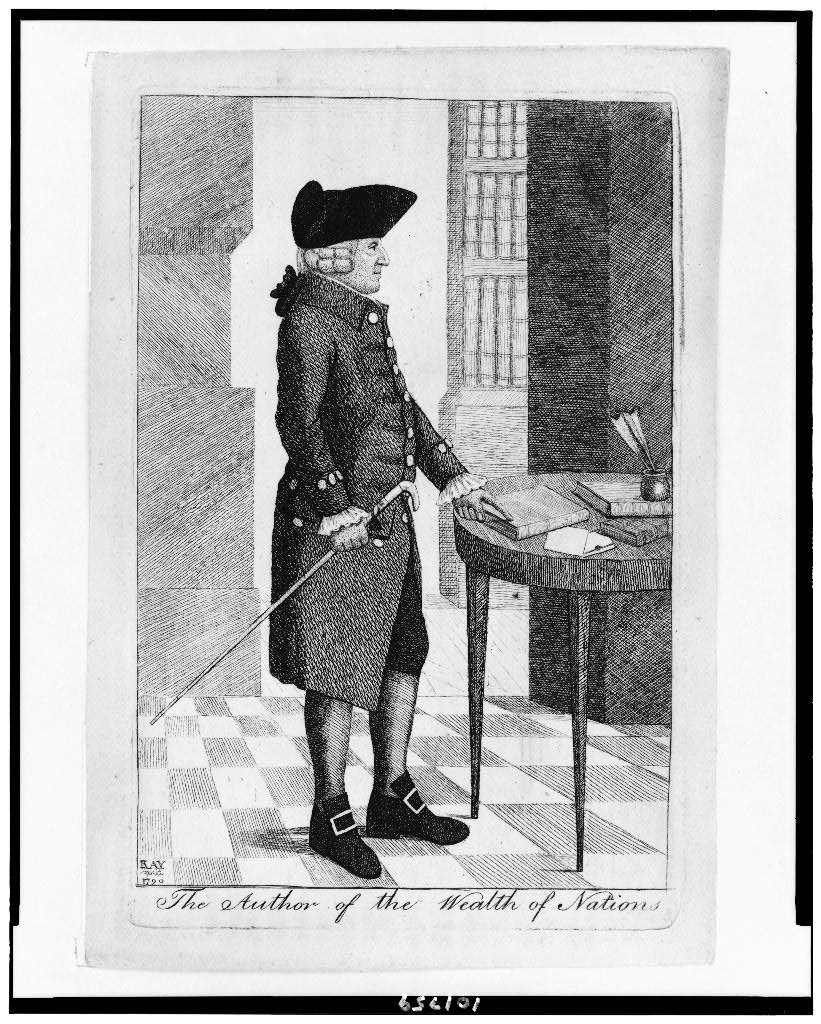
The Wealth of Nations is a book on economics by the Scottish philosopher Adam Smith, published in 1776 under the full title An Inquiry into the Nature and Causes of the Wealth of Nations. It explains how a country’s prosperity grows from the productivity of its labor, the division of work and trade, and it argues against government restrictions on commerce. It is widely treated as a founding text of modern economics.
Background and creation of The Wealth of Nations
Adam Smith, who taught moral philosophy at the University of Glasgow, was a moral philosopher before he was an economist, and his economic writing grew out of a broader study of human society. He spent roughly a decade preparing the book. The Stanford Encyclopedia of Philosophy notes that his political views can be pieced together from both his Theory of Moral Sentiments and The Wealth of Nations, as well as from student notes of his lectures on jurisprudence from 1762 to 1763. A central thread is a strong faith in the judgments of ordinary people, which he set against schemes imposed by philosophers and officials.
The book appeared in 1776 in London, at a time when Britain was expanding its trade and beginning to industrialize. Smith was reacting to the mercantile system, the dominant view that a nation became rich by hoarding gold and silver and by exporting more than it imported. He wanted to shift attention from the accumulation of money to the production of goods and services.
Structure and contents of The Wealth of Nations
The work has five books. Book I examines the causes of improvement in the productive powers of labor and how the product is distributed among workers, landowners and owners of capital. Book II concerns stock, meaning capital, and how it is accumulated and used. Book III looks at how wealth developed differently in different countries, Book IV surveys systems of political economy, and Book V deals with the revenue of the state.
The first chapter is the most famous. Smith argues that the greatest improvements in the productive power of labor come from dividing work into specialized tasks. His example is a pin factory: one worker making pins alone could produce perhaps twenty a day, but ten workers sharing roughly eighteen separate operations could make about 48,000. Specialization raises output, and it depends on the size of the market, which is why he then discusses trade.
Smith’s explanation of why people exchange is equally well known. He observes that a butcher, brewer or baker supplies dinner because of self-interest, not kindness, and that society runs on exchanges in which each party seeks an advantage. In another passage he describes the real price of anything as the toil and trouble of acquiring it, an idea that influenced later labor theories of value.
Book III offers a short history of how wealth developed in Europe. Smith argues that the natural order of growth runs from agriculture to manufacturing to foreign trade, and that European policy had often reversed that order by favoring towns and merchants over the countryside.
Book IV attacks the mercantile system, including tariffs and import bans designed to protect domestic producers. Smith argues that such restrictions raise prices for consumers and enrich a few favored merchants. Book V sets out the duties of the state, including defense, justice and certain public works, and examines how governments should raise their revenue.
Key ideas in The Wealth of Nations
The phrase “invisible hand” is the book’s best-known image, though Smith uses it only briefly. He suggests that individuals pursuing their own gain are often led, as if by an invisible hand, to promote the wider good of society. Some readers treat the passage as a defense of free markets, while others point out that Smith also warned against monopolies and the political influence of merchants.
Smith did not argue for the absence of government. He expected the state to maintain defense and courts, and he supported public works and education that private enterprise would not supply. His main point was that governments often did more harm than good when they tried to direct the details of trade.
Smith also saw a cost to specialization. He warned that a worker confined to a few simple operations all day may lose mental alertness and initiative, and he argued that governments should therefore support the education of ordinary people. This concern is a reminder that the book is about human welfare as much as about output.
Reception and legacy of The Wealth of Nations
The book sold well and went through several editions during Smith’s lifetime. It quickly became a major reference for economists, politicians and reformers. Later classical economists such as David Ricardo and Thomas Malthus built on its themes of value, rent and population, often with variations. It influenced debates over free trade in the nineteenth century, including the repeal of grain protection in Britain, and it remains cited in arguments about markets and regulation.
The text has also been simplified. Quotations about self-interest and the invisible hand are often taken out of context, and historians remind readers that Smith wrote at the beginning of the Industrial Revolution, before modern corporations, central banks or income taxes. Reading the full text shows a thinker who admired markets but kept moral concerns, the interests of workers and suspicion of concentrated power in view.
Modern economists generally treat the book as the start of a tradition rather than a settled doctrine, since later work refined or rejected many of its specific claims about value, rent and wages. Its lasting contribution is the question it asked: what makes some societies richer than others, and how much should rulers interfere with the choices of producers and consumers.
More in Economics
Key facts
- The Wealth of Nations was published in London in 1776 by the Scottish economist and moral philosopher Adam Smith.23
- Its full title is An Inquiry into the Nature and Causes of the Wealth of Nations.3
- The book has five books, and Book I begins with the division of labor.3
- Smith illustrated the division of labor with the example of pin making.2
- Smith's political views can be drawn from The Wealth of Nations, The Theory of Moral Sentiments and student notes from his lectures on jurisprudence in 1762 to 1763.1
- Book IV criticizes the mercantile system and restraints on imports.3
Related concepts
Quick checkWho wrote The Wealth of Nations, and when was it published?Show answer
Adam Smith wrote it, and it was published in 1776.
Sources
- Stanford Encyclopedia of Philosophy, Adam Smith's Moral and Political Philosophy (by Samuel Fleischacker), https://plato.stanford.edu/entries/smith-moral-political/
- History of Information, Adam Smith Publishes An Inquiry into the Nature and Causes of the Wealth of Nations, https://historyofinformation.com/detail.php?entryid=2155
- Project Gutenberg, An Inquiry into the Nature and Causes of the Wealth of Nations by Adam Smith (ebook 3300, contents and Book I), https://www.gutenberg.org/ebooks/3300
Editorially reviewed by Specialty Digest Editorial TeamLast reviewed November 5, 2026Researched and drafted with AI assistanceReport an issue