The Aleutian Islands campaign was a World War II campaign fought from June 3, 1942, to August 15, 1943, on and around the Aleutian Islands of the Territory of Alaska. It is the only World War II campaign fought on North American soil. Japan occupied the islands of Kiska and Attu in June 1942, and United States and Canadian forces retook them in 1943. The campaign also led to the evacuation and internment of Unangax̂ (Aleut) civilians [1].
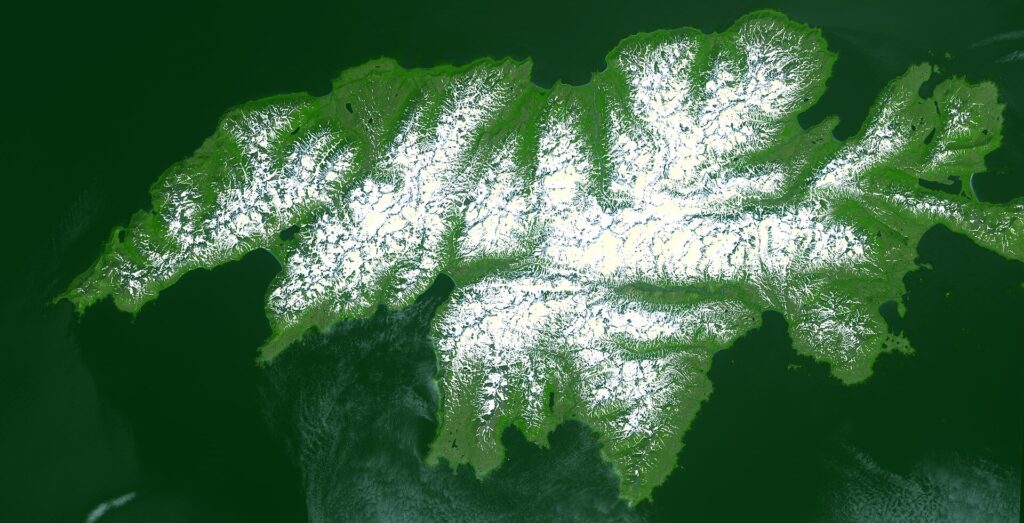
| Dates | June 3, 1942 to August 15, 1943 |
|---|---|
| Location | Aleutian Islands, Territory of Alaska |
| Japanese occupation | Kiska (June 6, 1942) and Attu (June 7, 1942) |
| Battle of Attu | May to June 1943; about 2,351 Japanese dead counted |
| Kiska landing | August 15, 1943; about 34,426 Allied troops |
| Allied commander in Alaska | Simon Bolivar Buckner Jr. |
| Redress | Aleut Restitution Act of 1988 |
Background
The Aleutian Islands form a long chain extending west from the Alaska Peninsula toward Russia. In 1942, the United States maintained bases there, including at Dutch Harbor. Historians disagree about Japan’s motives for the invasion. Some argue it was a diversion for the Battle of Midway, while others see it as an attempt to protect Japan’s northern flank [1].
Dutch Harbor Attack
On June 3 and 4, 1942, carrier-based Japanese aircraft attacked the United States base at Dutch Harbor. The first raid caused little damage, but the second set oil tanks burning and damaged the hospital and a barracks ship [1].
Japanese Occupation
Japanese forces seized Kiska on June 6, 1942, and Attu on June 7. The occupation of American territory shocked the public in the United States [1]. Because the islands were remote and the weather was severe, both sides faced extraordinary difficulties in supplying and operating there.
The Battle of Attu
American forces launched Operation Landcrab on May 11, 1943. The battle ended with a final Japanese banzai charge on May 29, after which about 2,351 Japanese dead were counted and only 28 Japanese soldiers were taken prisoner. American casualties totaled 3,829, including 549 killed and 1,148 wounded, plus about 1,200 cold-weather injuries, 614 from disease and 318 from other causes [1].
The Recapture of Kiska
On August 15, 1943, about 34,426 Canadian and American troops landed on Kiska and found no opposition, since the Japanese had apparently withdrawn on the night of July 28. Allied casualties totaled 313, from friendly fire, accidents, booby traps, disease and frostbite [1].
Overall Losses
The infobox lists total United States and allied casualties of 1,482 killed, 640 missing, 3,416 wounded and 8 captured, with 225 aircraft destroyed and three warships sunk. Japanese losses were 4,350 killed, 28 captured and seven warships and nine cargo or transport ships sunk [1].
Evacuation of the Unangax̂
After the attacks on Dutch Harbor, American authorities evacuated the Unangax̂ (Aleut) people, often with less than 24 hours’ notice. More than 880 people were embarked on military transports and taken to camps in Southeast Alaska. Of the 831 relocated there, 85 died from poor conditions. Men from the Pribilof Islands were compelled to return for seal harvesting at low pay, and residents were not allowed home until 1944 and 1945, when many found their homes looted or damaged [1].
The Aleut Restitution Act of 1988 acknowledged the failure of the government to provide adequate care, providing $12,000 to each survivor and establishing a $5 million trust fund [1].
Commander and Legacy
Lieutenant General Simon Bolivar Buckner Jr. commanded Alaska’s defenses. In a statement following the campaign he said that the forces had “made a fortress of our last frontier” [1]. Today, remains of the war, including bunkers, runways and wreckage, can still be found on many islands, and parts of the area are protected as historic sites.
Weather and Terrain
Fog, storms and williwaw winds made the Aleutians one of the most difficult theaters of the war. Aircraft often could not fly, ships risked grounding in poor visibility, and soldiers on Attu suffered widespread cold-weather injuries; nearly 1,200 Americans were injured by the cold alone [1]. The environment shaped tactics and contributed to casualties on both sides.
Why the Campaign Mattered
The campaign removed the Japanese presence from American soil and secured the northern Pacific approach to the continent. It also led to a major buildup of military infrastructure in Alaska, including airfields and bases, that remained important during the Cold War [1]. The experience is remembered in parts of the Aleutians through historic sites and museums.
Canadian Participation
Canadian troops took part in the landing on Kiska on August 15, 1943, alongside American forces, making the operation one of the combined efforts of the two countries in the Pacific theater [1].
Memory and Remembrance
The Unangax̂ evacuation and the restitution law of 1988 are central to how the campaign is remembered in Alaska, alongside the battles themselves. Descendants and communities continue to preserve the history of the islands and of the people who were displaced [1].
Aftermath for the Islands
After 1943 the Aleutians remained a military zone for years, and the islands were later reduced in strategic importance as the war moved west. Some villages were never resettled, while others slowly rebuilt. The war left lasting physical traces, including airstrips, bunkers and unexploded ordnance on some islands, which continue to influence how land is used and visited [1].
Historical Debate
Historians still discuss the strategic purpose of the Japanese occupation and the effectiveness of the American response, especially the decision to send a very large force to Kiska that found the island empty. The episode is often cited as an example of the difficulty of fighting in extreme conditions with limited intelligence [1].
Sites to Remember
Attu and Kiska are today part of the Alaska Maritime National Wildlife Refuge, and the Aleutian World War II National Historic Area on Unalaska preserves sites connected with the Dutch Harbor attack and the defense of the islands [1].
FAQs
When was the Aleutian Islands campaign? From June 3, 1942, to August 15, 1943.
Which islands did Japan occupy? Kiska and Attu, in June 1942.
What happened at Kiska in 1943? Allied troops landed on August 15, 1943, and found the island abandoned.
What was the Battle of Attu? A May 1943 battle in which American forces retook the island from Japan.
What happened to the Aleut people during the war? They were evacuated from many villages to camps in Southeast Alaska, and the 1988 Aleut Restitution Act later acknowledged the government’s failures.
Sources
Key facts
Quick checkWhich two Aleutian islands did Japan occupy in 1942?Show answer
Kiska and Attu
Sources
- Wikipedia. Aleutian Islands campaign. 2026 (accessed 2026-11-12)
Editorially reviewed by Specialty Digest Editorial TeamLast reviewed November 12, 2026Researched and drafted with AI assistanceReport an issue