The Unangax̂, also known as the Aleut, are the Indigenous people of the Aleutian Islands, the Pribilof Islands and the western Alaska Peninsula. Skilled sea hunters who built swift skin kayaks and lived in semisubterranean houses, they developed a rich culture of basketry, carved hats and waterproof gut parkas. The 2020 census counted 13,805 people who identified as Aleut, and the people and their language, Unangam Tunuu, survive today through strong revitalization efforts [1][2].
| Names | Unangax̂ (Unangan, Unangas); Aleut is a Russian-derived term |
|---|---|
| Homeland | Aleutian Islands, Pribilof Islands and western Alaska Peninsula |
| Population (2020 census) | 13,805 identified as Aleut |
| Language | Unangam Tunuu, in the Eskaleut family |
| Federally recognized tribes | 13 in the Aleut region |
| Regional corporation | Aleut Corporation |
| Religion | Mainly Russian Orthodox |
Names and Language
The term Aleut comes from Russian and was applied to the people of the Aleutian Islands and, for a time, to their eastern neighbors in the Kodiak Archipelago. The people call themselves Unangan or Unangas, words that mean “people,” and Unangax̂ in the Aleut language. Britannica notes that many people on Kodiak Island prefer the names Alutiiq or Sugpiat [1][2].
Unangam Tunuu belongs to the Eskaleut family and has three dialects: Eastern Aleut, Atkan and Attuan, which is now extinct. It was written in Cyrillic beginning in 1829 and in Latin script from 1870. About 150 speakers remain in the United States, and the Pribilof Islands have the most active speakers. Most elders speak it, but fluency is rare among younger people, and the Aleutian Pribilof Islands Association runs a language program [1].
Homeland and Population
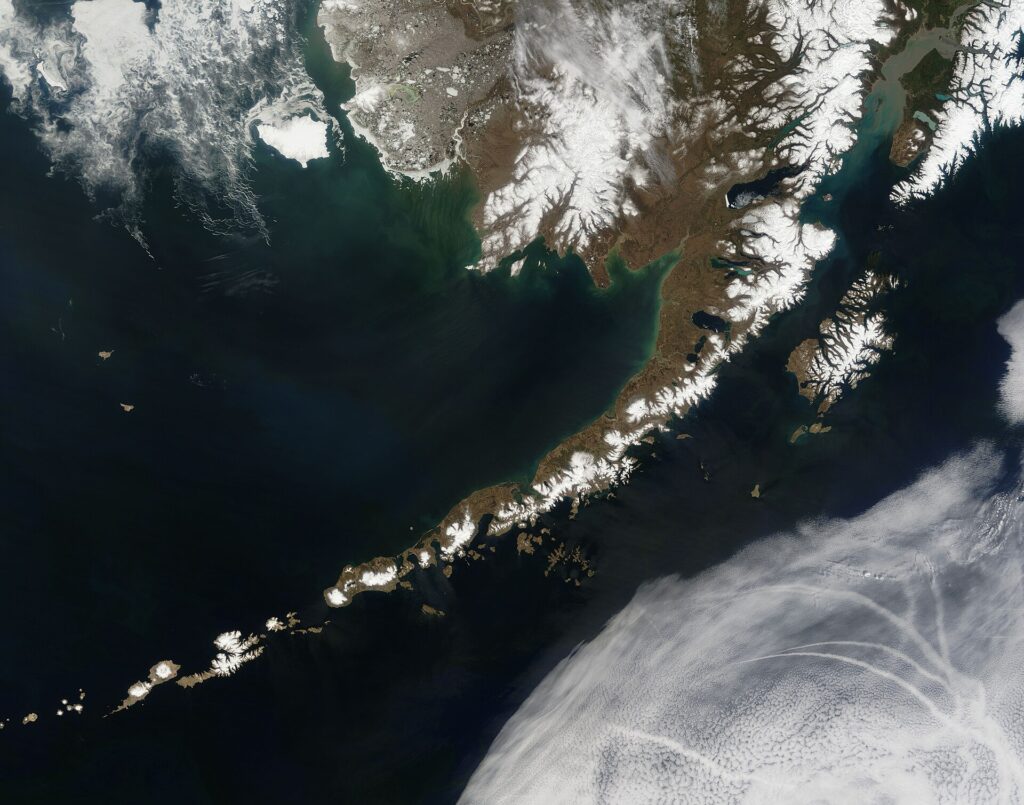
The Aleutian Islands lie between the North Pacific Ocean and the Bering Sea, politically divided between Alaska and Russia’s Kamchatka region. Historically the Unangan range also included the Shumagin Islands and the western Alaska Peninsula, and some families were relocated to the Commander Islands in Russia and to the Pribilof Islands in Alaska, both of which remain majority Aleut [1].
About 25,000 Unangan lived in the islands at first contact. Disease and disruption left perhaps one-tenth of that, with about 3,000 recorded in 1885 and 1,491 in the 1910 census. The 2000 census counted 11,941 people who identified as Aleut, and the 2020 census counted 13,805. In Alaska there are 13 federally recognized Aleut tribes [1][2].
Traditional Life
The Paleo-Aleuts reached the Aleutian Islands from the Alaskan mainland about 2000 BCE. Villages stood on the seashore near fresh water, with a good boat landing and protection from surprise attack. They were usually made up of related families living in extended households, with kinship traced through the mother. A chief, usually a skilled hunter, might govern several villages or a whole island, and his authority rested on wisdom, experience and consensus rather than force [2].
Men hunted seals, sea otters, whales and sea lions, and sometimes walrus, caribou and bears, while women gathered fish, birds, mollusks and wild plants such as berries. Homes were well-insulated semisubterranean dwellings, called barabara, roofed with driftwood, thatched with grass and covered with earth, and several families shared one house [1][2].
Boats and Arts
The Unangan built one-man and two-man skin kayaks, called baidarkas, and large open skin boats called umiaks or baidaras for travel and trade. A one-man baidarka was about 16 feet long and 20 inches wide. Ornate wooden hunting hats were decorated with sea lion whiskers, feathers and walrus ivory, and sculptors such as Andrew Gronholdt of the Shumagin Islands helped revive the bentwood hunting visor. Women wove fine grass baskets with a technique known as false embroidery, and Anfesia Shapsnikoff was recognized by the State of Alaska for her revival work [1][2].
Waterproof gut parkas were another specialty, and one parka took the skins of about 40 tufted puffins and 60 horned puffins. Stone, bone and ivory were made into containers, needles, awls and oil lamps, and masks, carvings and ivory jewelry rounded out the art tradition [1][2].
Russian Contact and the Fur Trade
Russians first encountered the Unangan in 1741, when Vitus Bering’s expedition reached the Aleutian Islands. Russian trading companies, drawn by sea otter and fox furs, tied Unangan labor to the fur trade, and by the 1830s traditional lifeways had been heavily disrupted. Over the next century the Aleut population fell from about 25,000 to about 2,000 [1][2]. In the 1820s the Russian-American Company resettled some families on the Commander and Pribilof Islands, and the Aleutian Islands passed to the United States in the Alaska Purchase of 1867 [1].
Russian Orthodox Faith
Russian Orthodox missionaries arrived in Kodiak in 1794, and many Unangan became Orthodox Christians. Most Orthodox congregations in Alaska are majority Alaska Native today. Prominent figures include Saint Peter the Aleut, remembered as a martyr, Father Jacob Netsvetov (1802 to 1864), a priest, and Olga Michael (1916 to 1979), who was canonized in 2023 [1].
World War II
In June 1942, Japanese forces occupied the islands of Kiska and Attu. About 41 Attu islanders were taken to Hokkaido, and roughly half of them died during captivity. The United States moved about 800 more Aleuts from the western chain and the Pribilofs to camps in southeast Alaska, where about 75 died. Congress passed the Aleutian and Pribilof Islands Restitution Act in 1988, and in June 2017 the federal government formally apologized for the wartime evacuation and internment [1].
Revitalization and Notable Aleut
In the late twentieth century the Unangax̂ revitalized their language, crafts and subsistence hunting and gathering, and they became more politically active [2]. Organizations such as the Aleut Corporation, the Aleut International Association and the Aleutian Pribilof Islands Association represent Unangax̂ communities [1]. Notable Aleut include sculptor John Hoover (1919 to 2011), businessman and legislator Carl E. Moses (1929 to 2014), and educator and kayak builder Sergie Sovoroff (1901 to 1989) [1].
Resistance and Resettlement
Relations with the Russian traders were not always peaceful. In 1784 the Aleuts on Amchitka revolted against Russian traders. Later, in the 1820s, the Russian-American Company moved Aleut families to the Commander Islands and the Pribilof Islands, creating communities that remain majority Aleut today. Britannica also notes that the Unangax̂ dialects are mutually intelligible and that the people are closely related to the Inuit in language and culture, a link that reflects their shared origins in the Bering Sea region [1][2]. After the sale of Alaska to the United States in 1867, gold discoveries elsewhere in Alaska brought prospectors to the region in the late nineteenth century, and the islands later became a front line in World War II [1][2].
FAQs
What does Unangax̂ mean? It is the people’s name for themselves in Unangam Tunuu, related to Unangan and Unangas, words that mean “people.”
Where do the Aleut live? On the Aleutian Islands, the Pribilof Islands and the western Alaska Peninsula, with a smaller population in the Commander Islands of Russia.
How many Aleut are there? The 2020 census counted 13,805 people who identified as Aleut.
What is a barabara? A semisubterranean house roofed with driftwood, thatched with grass and covered with earth.
What is a baidarka? A small one-person or two-person skin kayak used for hunting sea mammals.
Sources
More in Anthropology
Key facts
Quick checkWhat language do the Unangax̂ speak?Show answer
Unangam Tunuu
Sources
Editorially reviewed by Specialty Digest Editorial TeamLast reviewed November 11, 2026Researched and drafted with AI assistanceReport an issue