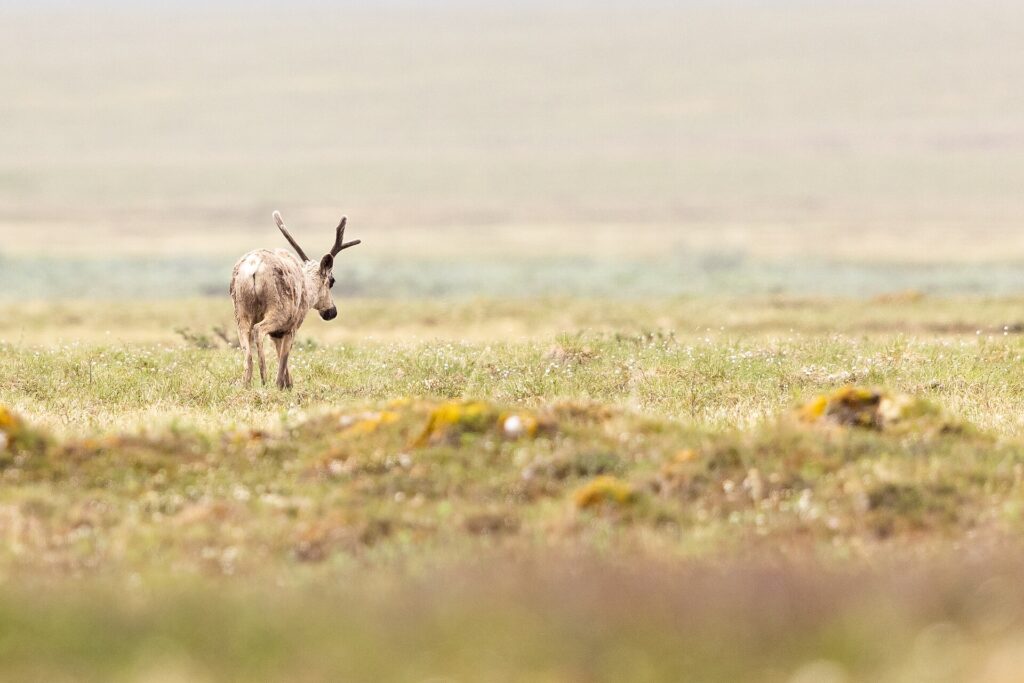
The caribou (Rangifer tarandus) is a medium-sized deer found across northern Alaska, where more than 30 herds roam from the Arctic tundra to the mountains of the south. Seven herds contain most of the state’s caribou, and many of them are now shrinking or not growing. The Porcupine herd, the largest, makes some of the longest land migrations of any mammal [1][2].
| Scientific name | Rangifer tarandus |
|---|---|
| Alaska herds | More than 30; seven hold most animals |
| Porcupine herd (recent) | About 143,000 (down from 218,000) |
| Central Arctic herd (recent) | About 26,600 |
| Adult male weight | Typically 159–182 kg |
| Adult female weight | 80–120 kg |
| Annual migration | Up to 5,000 km in some populations |
Description
Females are about 162 to 205 centimeters long and weigh 80 to 120 kilograms, while males are 180 to 214 centimeters long and usually weigh 159 to 182 kilograms. Both sexes grow antlers in most populations, which is unusual among deer; males start growing antlers in March or April, females in May or June, and males shed theirs after the rut while females keep them until calving [2].
Diet
In winter, lichens are the staple, especially reindeer lichen, and caribou are the only large mammal able to metabolize lichen. In warmer months they also eat willow and birch leaves, sedges and grasses [2].
Herds and Ranges
Alaska has more than 30 herds, and seven contain most of the state’s caribou. Barren-ground caribou in Arctic Alaska and northern Canada are migratory, summering on the tundra and wintering in the taiga [1][2]. The Porcupine herd summers in the northern Yukon mountains and coastal plains and winters in the boreal forests of Alaska and the Yukon, and its migrations are among the longest of any mammal. Grant’s caribou, a sedentary subspecies, lives on the western Alaska Peninsula, and Stone’s caribou lives in the mountains of southern Alaska [2].
Migration
Some North American populations travel up to 5,000 kilometers a year, and during migration they normally cover 19 to 55 kilometers a day. Woodland caribou in the boreal forest are largely sedentary [2].
Calving
Mating runs from late September to early November and gestation lasts 228 to 234 days. Calves are born in May or June, weigh about 6 kilograms, can graze after about 45 days and keep suckling until the following autumn [2].
Predators
Gray wolves are the most effective natural predator of adults, golden eagles prey heavily on calves on the calving grounds, wolverines take newborns, and brown and polar bears mainly target calves and sick animals. Humans are also a major predator in many areas [2].
Population Trends
Several Alaska herds are in decline. The Porcupine herd fell by about 75,000, from 218,000 to 143,000 animals, a drop of more than 30 percent from its peak eight years earlier, and biologists expect a few more years of decline before it stabilizes. The Central Arctic herd stands at about 26,600, a decline of more than 20 percent, with calf and cow survival both down. The Alaska Department of Fish and Game announced a drastic decrease in the Western Arctic herd in December. A department biologist said there is clearly no smoking gun, and nutrition and predators are both possible factors, with calf survival a major driver. Across the Arctic, herds have declined 65 percent over three decades, according to NOAA’s 2024 Arctic Report Card [1].
Hunting and Communities
The Porcupine herd is hunted only by residents of Arctic Village and fly-in hunters. Central Arctic hunters include residents of Nuiqsut, Anaktuvuk Pass and Wiseman, plus some Alaskans who drive up the Dalton Highway from Fairbanks [1].
FAQs
How many caribou herds are in Alaska? More than 30, with seven holding most of the state’s caribou.
What is the largest caribou herd in Alaska? The Porcupine herd, recently about 143,000 animals.
What do caribou eat? Lichens in winter, plus willow, birch leaves, sedges and grasses in warmer months.
Why are caribou herds declining? Biologists have found no single cause; nutrition, predators and low calf survival are possible factors.
Do female caribou have antlers? Yes, in most populations, which is unusual among deer.
Sources
More in Biology
Key facts
Quick checkHow many caribou herds does Alaska have?Show answer
More than 30
Sources
- Alaska Public Media. Several Alaska caribou herds are now in decline. 2026 (accessed 2026-11-12)
- Wikipedia. Caribou. 2026 (accessed 2026-11-12)
Editorially reviewed by Specialty Digest Editorial TeamLast reviewed November 12, 2026Researched and drafted with AI assistanceReport an issue