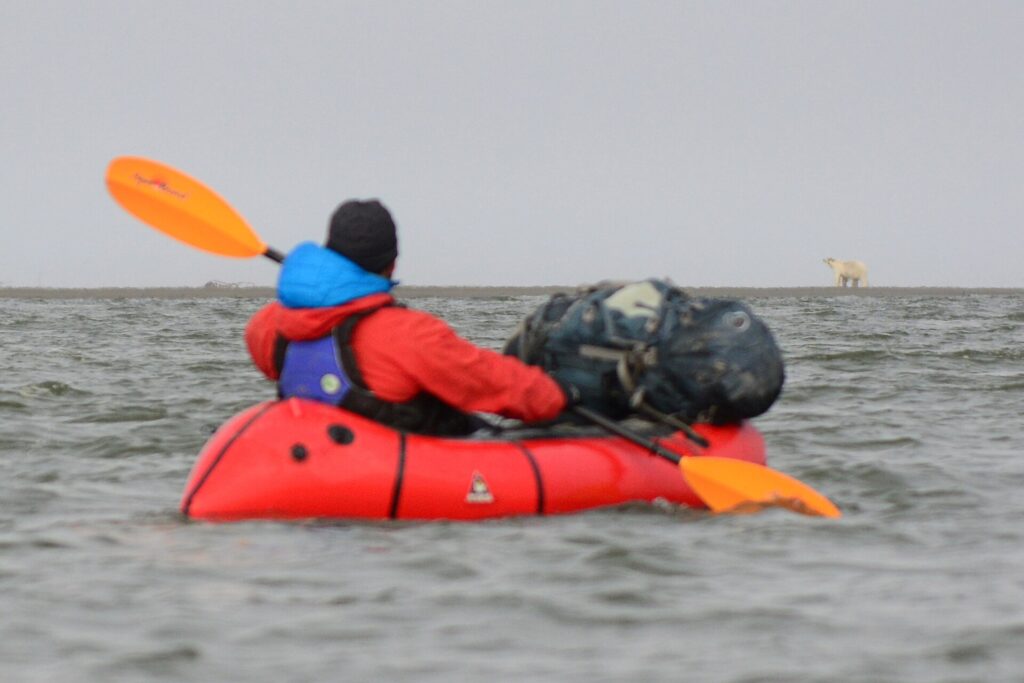
The polar bear (Ursus maritimus) is the largest land carnivore and the only bear classified as a marine mammal, and it lives along the Arctic coast of Alaska. Two subpopulations occur in the state: the Chukchi Sea population, shared with Russia, and the Southern Beaufort Sea population, shared with Canada. The species is listed as threatened under the U.S. Endangered Species Act because of the loss of its sea ice habitat [1][2][3].
| Scientific name | Ursus maritimus |
|---|---|
| Alaska populations | Chukchi Sea; Southern Beaufort Sea |
| Chukchi Sea estimate | About 3,000 bears (2018 study) |
| Adult male weight | 300–800 kg |
| Adult female weight | 150–300 kg |
| U.S. status | Threatened (Endangered Species Act, 2008) |
| Global population | About 26,000 in 19 subpopulations |
Description
Adult males are 200 to 250 centimeters long and weigh 300 to 800 kilograms, while females are 180 to 200 centimeters long and weigh 150 to 300 kilograms. The largest bear on record, at 1,002 kilograms, was a male shot in Kotzebue Sound, Alaska, in 1960 [3]. A layer of fat 5 to 10 centimeters thick, black skin that absorbs heat and hollow guard hairs that trap warmth help the bears survive Arctic cold, and large hairy paws help on snow and ice [3].
Diet and Hunting
Polar bears are the most carnivorous of the bears. Ringed seals are the most commonly taken prey, along with bearded seals and, at times, young walruses, belugas, birds and fish. Most hunting is by ambush at breathing holes or ice edges, and the bears mainly consume seal blubber for energy [3].
Denning and Cubs
Only pregnant females hibernate, entering maternity dens between August and October. Females usually give birth to two cubs, which weigh about 600 grams at birth, and the mothers leave the den between late February and early April with cubs weighing 10 to 15 kilograms. Cubs are weaned at 2 to 2.5 years [3].
Chukchi Sea Population
A 2018 study by the U.S. Geological Survey, the U.S. Fish and Wildlife Service and partners produced the first formal count of the Chukchi Sea subpopulation, shared by the United States and Russia, at just under 3,000 bears. Researchers tagged roughly 60 bears in most years from 2008 to 2016, working from helicopters over the sea ice north of the Seward Peninsula, and combined the data with traditional ecological knowledge from Native hunters in the North Slope Borough. The population appeared healthy, with generally good reproductive rates and cub survival. Abundant seals and whale carcasses that wash ashore help sustain the bears, even though they have about a month less time on preferred sea ice than 25 years earlier [1].
Southern Beaufort Sea Population
The U.S. Geological Survey has run a long-term research program on the Southern Beaufort Sea population, shared with Canada. A mark-recapture study covering 2001 to 2010 found low survival, especially of cubs from 2004 to 2006, which produced a decline of 25 to 50 percent in less than ten years [4]. Wikipedia reports that the population was described as likely decreased in 2021 [3].
Sea Ice and Climate
Sea ice is the most influential factor for the long-term outlook, according to USGS models, and harm increases as the ice-free period grows beyond four months [4]. The U.S. Fish and Wildlife Service concluded in September 2023, in its second status review since the 2008 listing, that the polar bear remains a threatened species, with about 26,000 bears in 19 subpopulations worldwide and projections that most subpopulations will decline with continued warming [2].
Legal Protection
The species has been listed as threatened since 2008. The 1973 Agreement on the Conservation of Polar Bears banned most harvesting while allowing traditional Indigenous hunting, and the species is listed under Appendix II of CITES [3].
Other Pressures
Bears accumulate persistent pollutants, oil and gas activity can affect habitat, and conflicts with people increase as bears spend more time on land [3].
FAQs
How many polar bears are in Alaska? A 2018 study estimated just under 3,000 in the Chukchi Sea subpopulation, shared with Russia; the Southern Beaufort Sea population is shared with Canada.
Are polar bears endangered? They are listed as threatened under the U.S. Endangered Species Act, a status reaffirmed in 2023.
What do polar bears eat? Mainly ringed seals and other seals, eating mostly the blubber.
Where do polar bears live in Alaska? Along the Arctic coasts and sea ice of the Chukchi and Beaufort Seas.
How big is the largest polar bear on record? A 1,002-kilogram male shot in Kotzebue Sound, Alaska, in 1960.
Sources
- University of Washington: First tally of U.S.-Russia polar bears finds a healthy population
- U.S. Fish and Wildlife Service: Polar bear status remains threatened
- Wikipedia: Polar bear
- U.S. Geological Survey: Polar bear population dynamics
More in Biology
Key facts
Quick checkWhich two polar bear subpopulations occur in Alaska?Show answer
Chukchi Sea and Southern Beaufort Sea
Sources
- University of Washington. First tally of U.S.-Russia polar bears finds a healthy population. 2018 (accessed 2026-11-12)
- U.S. Fish and Wildlife Service. Polar bear status remains threatened. 2023 (accessed 2026-11-12)
- Wikipedia. Polar bear. 2026 (accessed 2026-11-12)
- U.S. Geological Survey. Polar bear population dynamics. 2026 (accessed 2026-11-12)
Editorially reviewed by Specialty Digest Editorial TeamLast reviewed November 12, 2026Researched and drafted with AI assistanceReport an issue