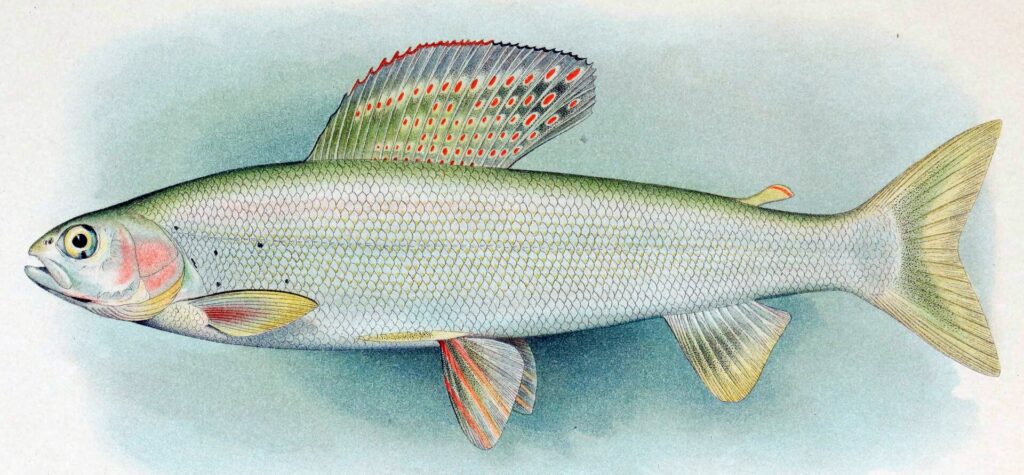
The Arctic grayling (Thymallus arcticus) is a relative of trout with a sail-like dorsal fin spotted red or purple. It lives throughout the Arctic and is found statewide in Alaska except on Kodiak, in Southeast Alaska and in the Aleutians, where it has been stocked in some waters.[1]
| Scientific name | Thymallus arcticus |
|---|---|
| Spawning age | 4–6 years, at 11–12 in |
| Lifespan | Up to about 30 years in Alaska |
| Trophy size | Over 3 lb |
| State record | 23 in, 4 lb 13 oz, Ugashik Narrows |
| Fry hatch | About 3 weeks after spawning |
Description
The grayling has a dark back, iridescent gray sides, black spots on the front portion of the sides and a large dorsal fin marked with red or purple spots. Its adipose, tail, pectoral and anal fins are gray, and the pelvic fins often have pink to orange stripes.[1]
Range
The species occurs throughout the Arctic, from the Kara River in Russia east to western Hudson Bay in Canada. It was once common as far south as Michigan and Montana but is now nearly gone from the northern United States. In Alaska it is found statewide except Kodiak, Southeast Alaska and the Aleutians, and it has been stocked in some southeastern lakes and on Kodiak Island.[1]
Habitat and diet
Grayling winter in lakes, in deep pools of medium rivers such as the Chena and Gulkana and in large glacial rivers such as the Tanana, Susitna and Yukon. They tolerate low dissolved oxygen, which lets them survive where many other salmonids die, and summer feeding areas can be up to 100 miles from spawning grounds. They are generalist feeders, taking mainly drifting mayflies, stoneflies and caddisflies, as well as salmon eggs, outmigrating salmon smolts, fallen terrestrial insects and occasionally voles or shrews.[1]
Spawning
Grayling begin spawning at about 11 to 12 inches, typically at age four to six, and spawn in spring after an upstream migration. Many return each year to the same spawning and feeding areas, and fry hatch about three weeks after spawning and stay in quiet water near their birthplace.[1]
Fishery
The largest fisheries are along Interior Alaska’s road system, and larger fish are generally found in less-fished areas. Most trophy fish registered with the department came from the Ugashik Lake system in Bristol Bay or from Nome-area rivers. Grayling rise to dry flies, and anglers should check current department rules for limits and seasons.[1]
FAQs
Where do Arctic grayling live in Alaska? Statewide except Kodiak, Southeast Alaska and the Aleutians.
How long do they live? Up to about 30 years in Alaska.
What is the state record? 23 inches and 4 pounds 13 ounces from Ugashik Narrows.
Sources
Key facts
- Record 4 lb 13 oz
- Spawns at age 4–6
Quick checkHow long can Alaska grayling live?Show answer
Up to about 30 years
Sources
- Alaska Department of Fish and Game. Arctic Grayling, Wildlife Notebook Series. 2026 (accessed 2026-11-14)
Editorially reviewed by Specialty Digest Editorial TeamLast reviewed November 14, 2026Researched and drafted with AI assistanceReport an issue