Most students prepare for an exam by reading their notes again. Experiments show that practice testing, which means closing the book and trying to recall what you read, produces far better memory after a week. Rereading feels productive because the page looks familiar, but familiarity is not the same as knowing.
In 2013, five psychologists reviewed ten popular study techniques in Psychological Science in the Public Interest. Only two earned a high utility rating: practice testing and distributed practice, which means spreading study over time. Rereading and highlighting rated low. The Study Smarter course explains how memory works.
Does rereading help? Only for a few minutes
In a 2006 experiment at Washington University in St. Louis, 120 undergraduates studied short science passages. They then either studied one again or took a recall test with no feedback, for equal time. After five minutes, rereading won: students recalled 81 percent of the ideas, against 75 percent for the tested group. After two days the order reversed, with 54 percent against 68 percent. After one week it was 42 against 56.
Example 1: the 100-fact chapter. Suppose a chapter holds 100 key facts. After a week, the rereaders would remember about 42 and the self-testers about 56. Same time at the desk, 14 more facts kept.
Why do people choose the weaker method?
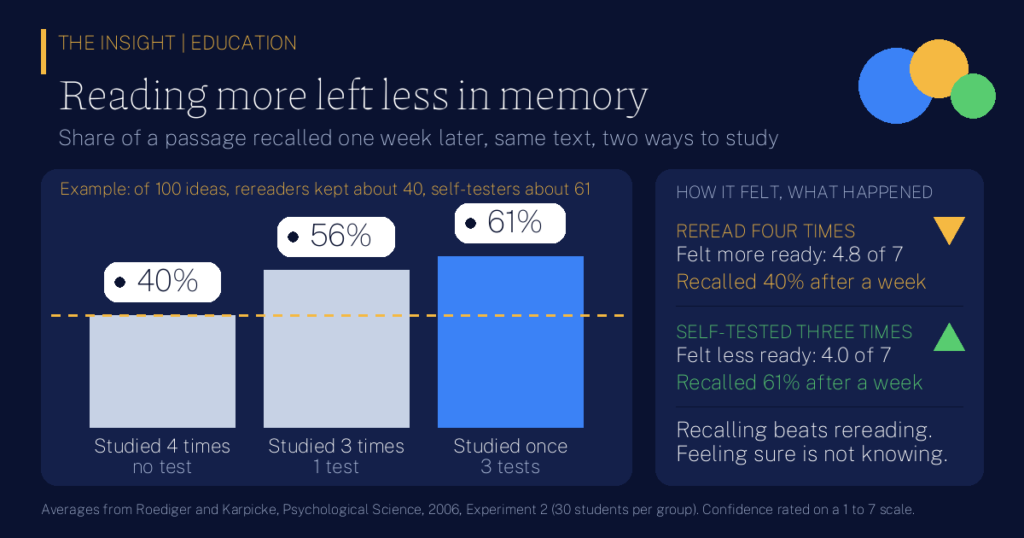
A second experiment gave the most revealing result. Students studied a passage four times, studied three times and took one test, or studied once and took three tests. They read the passage 14.2 times in the first group and only 3.4 times in the last. After one week, the group that read least recalled most: 61 percent, against 40 percent for the group that read most.
Students also rated how well they expected to remember. The group that studied four times was most confident, scoring 4.8 on a 7-point scale, against 4.0 for the testers. The authors suggest that students judge a method by its quick gains. Psychologist Robert Bjork calls effortful methods that pay off later desirable difficulties.
Example 2: two friends. One rereads notes four times; the other studies once and tests three times. On Friday, the first feels more ready. A week later, on average, the first recalls about 40 ideas in every 100 and the second about 61.
What works better, and when?
Testing builds understanding as well as memory. In a 2011 study in Science, practicing retrieval beat concept mapping, even on questions that needed inference. The retrieval practice module shows how to apply it, and what the research says about homework looks at school learning. Timing matters too. A review of 317 verbal-recall experiments found that the best gap between study sessions grows with how long you need to remember. The spacing module shows how to plan it.
Example 3: a 30-minute session. Read for 10 minutes, write what you remember for 10, check what you missed for 5, then retry those parts for 5.
How solid is this? Well-supported. The testing effect has been shown many times, and the 2013 review rated it high in utility. Limits: the 2006 experiments used university students and short science passages, and measured memory for ideas, which is one part of learning. The examples use round numbers for illustration; the session plan is a suggestion, not a tested protocol.
Key Takeaways
- Quiz yourself before rereading. After reading, close your notes, write what you recall, then check.
- Distrust the feeling of familiarity. Rereading raised confidence but lowered recall after a week.
- Spread study over several days. The best gap grows with how long you need to remember.
- Welcome the effort. Methods that feel harder while learning, such as recall, often last longer.
More in Education
- Roediger, H. L., and Karpicke, J. D. “Test-enhanced learning: Taking memory tests improves long-term retention.” Psychological Science, 17(3), 249-255, 2006.
- Dunlosky, J., Rawson, K. A., Marsh, E. J., Nathan, M. J., and Willingham, D. T. “Improving studentsu{2019} learning with effective learning techniques: Promising directions from cognitive and educational psychology.” Psychological Science in the Public Interest, 14(1), 2013.
- Karpicke, J. D., and Blunt, J. R. “Retrieval practice produces more learning than elaborative studying with concept mapping.” Science, 331(6018), 772-775, 2011.
- Cepeda, N. J., Pashler, H., Vul, E., Wixted, J. T., and Rohrer, D. “Distributed practice in verbal recall tasks: A review and quantitative synthesis.” Psychological Bulletin, 132(3), 354-380, 2006.