Few trees carry as much meaning as the olive. For thousands of years it has stood for peace, wisdom and harmony, and it has also fed, lit and healed people across the Mediterranean and far beyond. World Olive Tree Day, observed every November 26, asks us to look at it again: as a symbol, as a crop that supports whole communities, and as a living landscape that now has to cope with drought, heat and disease. It sits naturally beside the International Day of the Mediterranean Diet, because olive oil is the heart of that way of eating.
How a tree earned a day
The day was proclaimed at the 40th session of the UNESCO General Conference in 2019, and it is observed each year on November 26. UNESCO describes the aim as encouraging the protection of the olive tree and the values it embodies, and it asks people to appreciate the tree’s social, cultural, economic and environmental significance. It also ties the tree’s conservation to two modern concerns: adapting to climate change and keeping the environment sustainable.
Notice what that means. This is not only a day about a food. UNESCO’s mandate covers education, science and culture, so the day treats the olive as shared heritage: a tree planted by one generation that is expected to serve the next. That long view is part of why the olive became a lasting emblem of peace.
Why this tree matters beyond the plate
An olive grove is a managed landscape, not a wild forest and not a field of annual crops. The International Olive Council (IOC), the intergovernmental body for the sector, describes olive groves as more than eleven million hectares of cultivated forest. It says they absorb around 4.5 tonnes of carbon dioxide per hectare each year. Groves therefore hold soil, store some carbon and keep rural areas inhabited, while also producing a food whose health record is widely studied. The IOC reports more than 1,000 scientific studies on extra virgin olive oil, and it cites the PREDIMED trial, which reported a 30 percent reduction in heart disease incidence.
Example 1: what a hectare is worth to the air. Suppose a village manages 100 hectares of olive grove. At the IOC’s figure of about 4.5 tonnes of carbon dioxide per hectare per year, those groves would absorb roughly 450 tonnes each year. The numbers are round and illustrative, but they show why a grove counts as more than a crop.
The numbers behind the harvest
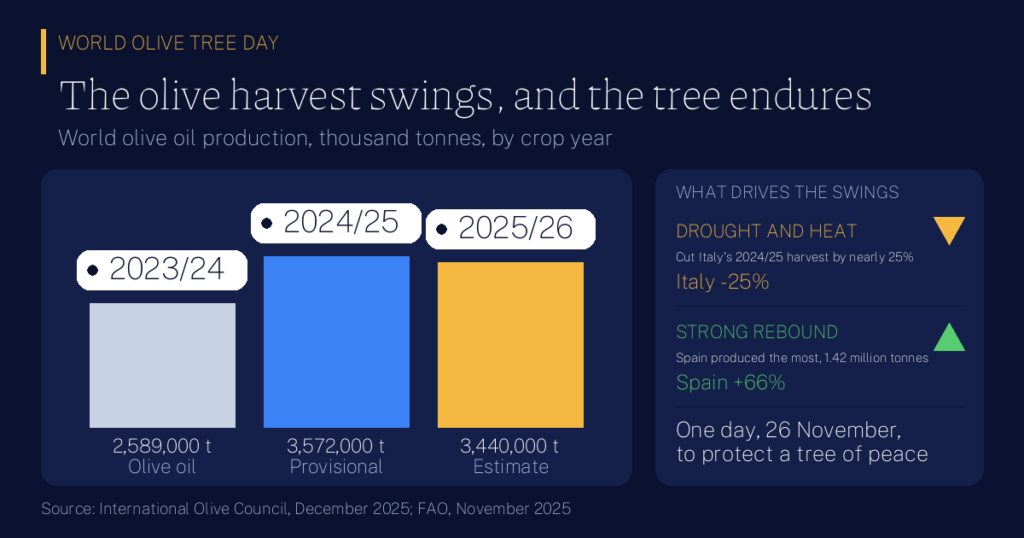
Olive oil is a crop that swings sharply from year to year. According to the IOC’s December 2025 statistics, world production was 2,589,000 tonnes in 2023/24, rose to a provisional 3,572,000 tonnes in 2024/25, a jump of 38 percent, and is estimated at 3,440,000 tonnes for 2025/26. The IOC also notes that production has tripled over the last 60 years.
Consumption was about 3,215,000 tonnes in 2024/25, up 15 percent, as demand recovered. Where the oil comes from is concentrated. Spain produced 1,419,000 tonnes in 2024/25, followed by Türkiye at 505,000, Tunisia at 340,000, Greece at 250,000, Italy at 248,000 and Portugal at 177,000. IOC members together accounted for 3,392,000 tonnes, or 95 percent of the world total.
Those swings matter. Spain’s output rose 66 percent in 2024/25 and Türkiye’s rose 135 percent, while Italy’s fell 25 percent. FAO attributes Italy’s drop to drought from June to August 2024. Spain alone produced more than the next four producers combined.
A tree under pressure
Olive trees are tough, but they are not immune. FAO’s Food Outlook of November 2025 points to irregular weather and prolonged drought as the main challenges for the sector. It reports that excessive heat and dryness since June 2025 hampered yields, and it notes that warm conditions favor Xylella fastidiosa, a plant bacterium that threatens olive trees. Because olive trees tend to bear alternately, meaning a heavy crop is often followed by a lighter one, a single hard season can be felt for years.
Example 2: a bad year for one grower. Imagine a family with 1,000 trees that normally yield 20 kilograms of olives each. In a drought year the yield falls to 14 kilograms. That is a loss of 6,000 kilograms, or 30 percent of the crop, before any price change. The numbers are round and illustrative, but they show how a dry summer reaches a household budget.
Prices, markets and the people in between
When harvests shrink, prices rise, and when they recover, prices fall. FAO reports that Spain’s extra virgin wholesale price fell from nearly 9,000 euros per tonne in January 2024 to 4,180 euros in September 2025, and that Greece fell from a historical high of 8,460 euros in January 2024 to 4,100 euros by the end of 2024/25. Italy was the exception, passing 9,500 euros per tonne in September 2025 after its smaller harvest.
Falling prices help shoppers and recovering demand, yet they squeeze producers who face rising costs. International trade is also growing. FAO forecasts that global olive oil trade will exceed 1.3 million tonnes, possibly a historical high, and it expects Tunisia to harvest more than 400,000 tonnes, a record crop for that country and about 13 percent of world output.
Example 3: price and income. Suppose a cooperative sells 100 tonnes at 8,000 euros per tonne one year and 100 tonnes at 4,000 euros the next. Revenue drops from 800,000 to 400,000 euros even though the harvest is the same size. The numbers are round and illustrative, but they explain why growers want stable markets and fair returns.
How the day is marked
A recent example of olive cooperation came on November 20, 2025, when delegations from 28 producing and exporting countries and two international organizations met in Córdoba, Spain, and endorsed the Córdoba Declaration, which addresses sustainability, health, trade and international cooperation. The IOC release calls that gathering World Olive Day, a separate observance from UNESCO’s November 26 day. Either way, the shared message is the same: care for the tree, and care for the people who tend it.
Key Takeaways
- It is a day for heritage, not only food. UNESCO proclaimed World Olive Tree Day in 2019 to protect the tree and the values it embodies.
- Groves are living landscapes. The IOC counts more than eleven million hectares of olive groves, absorbing around 4.5 tonnes of carbon dioxide per hectare each year.
- Harvests swing widely. World production went from 2.59 million to 3.57 million tonnes in one year, then eased to an estimated 3.44 million.
- Supply is concentrated. Spain alone produced 1,419,000 tonnes in 2024/25, more than the next four producers combined.
- Climate is the main risk. FAO cites drought, heat and warmth that favors Xylella as threats to yields.
- Prices follow harvests. Spanish and Greek extra virgin prices roughly halved from January 2024 to 2025, while Italy’s rose.
- Protection takes people. Healthy groves depend on growers earning a fair living and on countries cooperating, as the Córdoba Declaration aims to do.
How solid is this? Production figures for 2024/25 are provisional and 2025/26 figures are estimates from the International Olive Council, so they may be revised. Price figures are FAO wholesale prices for specific months. The three worked examples use round, made-up numbers to show an idea. See also the International Days hub and the International Days Calendar.
More in Nature
- UNESCO. World Olive Tree Day.
- UNESCO. Proclamation of World Olive Tree Day.
- International Olive Council. Olive sector statistics, December 2025 and forecasts.
- FAO. Food Outlook, November 2025: Focus on olive oil.
- International Olive Council. 30 countries and international organisations commit to promoting olive trees and olive products (November 2025).