Few health topics attract as much judgment and as little understanding as body weight. World Obesity Day, observed every March 4, tries to replace blame with facts. By the World Health Organization’s count, 1.1 billion people, about 1 in 7 on Earth, were living with obesity in 2024. The condition is also a major driver of illnesses that other observances highlight, such as the diabetes covered on World Diabetes Day. This article explains where the day comes from, what the key terms mean, what the best available numbers show, and why the date matters to every community.
A day built to change the conversation
World Obesity Day is an awareness day led by the World Obesity Federation, an international network of professional and scientific bodies. It is not a day created by a United Nations resolution, which makes it different from many entries in this series. Its power comes from the organizations, clinics, schools and governments that choose to take part each March.
The 2026 campaign carries the theme “8 billion reasons to act on obesity,” with the tagline “8 billion reasons to change the story.” The federation built it around three pillars: children, health systems, and all 8 billion people on the planet. The message is that obesity is not a private matter for a few households. It shapes families, health budgets and economies everywhere.
International health bodies are acting too. WHO’s Acceleration Plan to Stop Obesity, endorsed in 2022, supports 34 frontrunner countries that together are home to 1.3 billion people.
What the words mean
For adults, WHO defines overweight as a body mass index (BMI) of 25 or higher and obesity as a BMI of 30 or higher. BMI is weight in kilograms divided by height in meters squared. For children and teens aged 5 to 19, the measure compares BMI for age with the WHO reference: more than one standard deviation above the median counts as overweight, and more than two as obesity. BMI is a screening tool. A health professional looks at far more than one number before reaching a conclusion about any person.
Example 1: reading a BMI. Take an adult who is 1.70 meters tall and weighs 80 kilograms. Height squared is 2.89, and 80 divided by 2.89 is about 27.7, which falls in the overweight range but below the obesity line. The numbers are round and illustrative. They show how the formula works, not how any real person should be judged.
The numbers behind the day
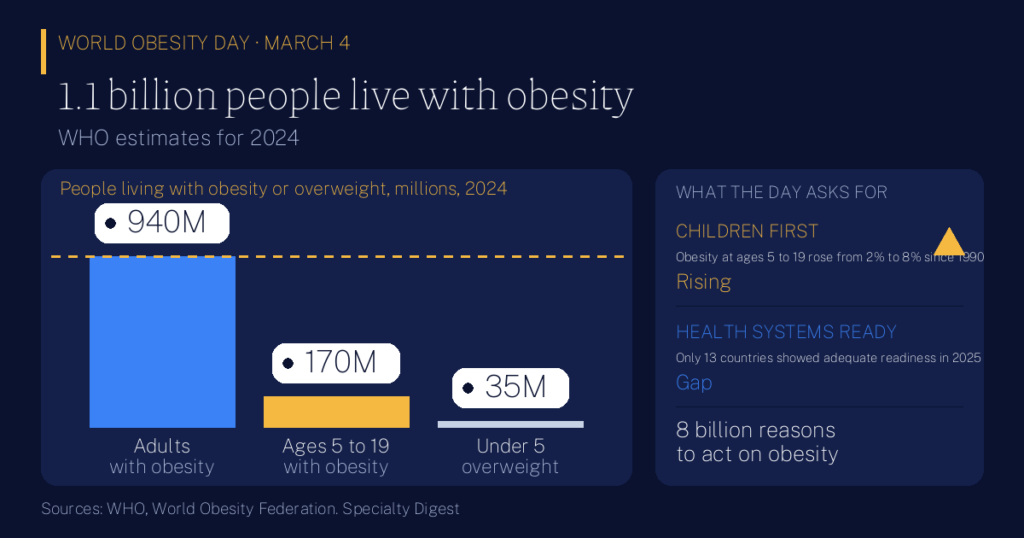
WHO’s latest figures use 2024 data. That year, 2.6 billion adults, or 45 percent of all adults, were overweight, and 940 million of them, 16 percent of all adults, were living with obesity. Among children and adolescents aged 5 to 19, 400 million were overweight, including 170 million with obesity. Another 35 million children under 5 were overweight.
- 1.1 billionpeople living with obesity in 2024, about 1 in 7
- 940 millionadults with obesity in 2024, 16% of all adults
- 170 millionchildren and teens aged 5 to 19 with obesity in 2024
- 35 millionchildren under 5 who were overweight in 2024
The direction of travel matters as much as the totals. WHO reports that adult obesity has more than doubled since 1990 and that adolescent obesity has quadrupled. Among people aged 5 to 19, overweight rose from 8 percent in 1990 to 20 percent in 2024, and obesity rose from 2 percent, about 31 million young people, to 8 percent, about 170 million.
Example 2: one school. Picture a school of 1,000 students aged 5 to 19. At the 1990 obesity share of 2 percent, about 20 students would be living with obesity. At the 2024 share of 8 percent, the figure would be about 80. These counts are round and illustrative, but the fourfold change is the pattern WHO reports.
Why it matters for health
Obesity raises the risk of type 2 diabetes, cardiovascular disease, liver and kidney disease, and several cancers, according to WHO. The agency estimates that higher-than-optimal BMI caused 3.7 million deaths in 2023. The World Obesity Atlas 2025 adds a sharp comparison: in 2021, high BMI accounted for 1.6 million deaths from noncommunicable diseases before age 70, against 1.2 million road traffic deaths that year.
The trend is not expected to reverse on its own. The same atlas projects that the number of adults with obesity will rise more than 115 percent between 2010 and 2030, from 524 million to 1.13 billion. Cases of severe obesity (BMI over 35) are projected to more than double, from 157 million to 385 million.
The cost to economies
Obesity is also a budget issue. WHO says that if nothing is done, global costs are predicted to reach US$3 trillion per year by 2030 and more than US$18 trillion by 2060. The World Obesity Federation, using a different model, projected in an earlier atlas an annual impact of $4.32 trillion by 2035, almost 3 percent of global GDP. Because the methods differ, the figures should be read as signs of scale, not as one forecast.
Example 3: a city’s share. Imagine a city of 1 million adults. At the global adult obesity share of 16 percent, about 160,000 residents would be living with obesity. If prevention and care lowered that share by one percentage point, roughly 10,000 fewer people would be affected. The city and numbers are made up and rounded, but the arithmetic shows why small shifts in a share add up to large human numbers.
Beyond blame: what progress needs
The federation’s message is that real progress needs action at several levels at once. Governments need policies, and the atlas found that 126 of 194 countries have none or only one of five key obesity policies. Health systems need to be ready, yet only 13 countries showed evidence of adequate readiness. Children need early attention, since habits and risks begin young.
Treatment is evolving as well. In December 2025, WHO issued a guideline on GLP-1 therapies for adults with obesity and described them as one component of multimodal, long-term obesity care, not a stand-alone answer. Anyone worried about their own weight or a child’s can start with a conversation with a qualified health professional. Shaming a person has never been part of good care.
Key Takeaways
- The scale is global. About 1.1 billion people, 1 in 7, lived with obesity in 2024.
- Children are affected too. Obesity among ages 5 to 19 rose from 2 percent in 1990 to 8 percent in 2024.
- Definitions matter. Adults are measured by BMI of 25 and 30, children by growth references, and BMI alone is only a screen.
- Health risks are broad. Obesity is linked to diabetes, heart, liver and kidney disease, and several cancers.
- The costs are huge. WHO projects US$3 trillion a year by 2030 if nothing is done.
- Readiness lags. Only 13 countries showed adequate health system readiness in the 2025 atlas.
- Treat people with respect. Care works best without blame, and a health professional is the right first stop.
How solid is this? Prevalence figures are modeled estimates from WHO for 2024 and are revised as new data arrive. Cost projections come from different models and years, and the 2035 figure comes from an earlier World Obesity Atlas. The three worked examples use round, made-up numbers to show an idea. World Obesity Day is a federation campaign, not a UN observance. See also the International Days hub and the International Days Calendar.
More in Health
- World Health Organization. Obesity and overweight fact sheet (2026 update, 2024 data).
- World Health Organization. One in eight people are now living with obesity (1 March 2024).
- NCD Risk Factor Collaboration. Worldwide trends in underweight and obesity from 1990 to 2022. The Lancet (2024).
- World Obesity Federation. World Obesity Day 2026: 8 billion reasons to change the story.
- World Obesity Federation. World Obesity Atlas 2025: Majority of countries unprepared for rising obesity level (March 2025).
- World Obesity Federation. Economic impact of overweight and obesity to surpass $4 trillion by 2035.