Look around the room you are in. The light overhead, the water in the pipes, the phone in your hand and the road outside all began as someone’s design problem. Engineering is the quiet craft behind almost every part of modern life, and World Engineering Day for Sustainable Development, observed each year on March 4, asks the world to notice it. The message is practical. The Sustainable Development Goals will not be reached by good intentions alone, and the world needs enough skilled engineers, from every background, to build the solutions. The day is a close cousin of World Water Day, since clean water systems are, above all, engineering.
From a federation’s idea to a UNESCO day
The day began with the World Federation of Engineering Organizations (WFEO). According to WFEO, it proposed the day in 2018 as part of its 50th anniversary and chose March 4, its founding date. UNESCO proclaimed the day in 2019, and UNESCO’s own page states that it is celebrated annually on March 4. WFEO adds that the recognition came at UNESCO’s 40th General Conference in November 2019. The text of the proclamation is linked from UNESCO’s page for the day.
UNESCO explains the purpose in plain terms. On this day it raises awareness of the role of engineering in modern life, which it calls essential to mitigate the impact of climate change and advance sustainable development, especially in Africa and the small island developing states. It also stresses that future generations of engineers and scientists, especially women and youth, must be able to design solutions for local and global challenges.
What engineering has to do with sustainability
Engineering is often pictured as bridges and machines, but its reach is wider. UNESCO’s second Engineering Report, titled Engineering for Sustainable Development: Delivering on the Sustainable Development Goals, describes the crucial role of engineering in achieving each of the 17 goals. The report came out ahead of the day in March 2021. It was prepared with partners that included the Chinese Academy of Engineering, the International Centre for Engineering Education at Tsinghua University and WFEO. A third report is scheduled for publication in 2028.
Example 1: the village well. Picture a village of 2,000 people where each family walks an hour a day to fetch water. An engineer designs a small pumped system with a storage tank and a way to keep it repaired. If the walk drops from an hour to five minutes, about 55 minutes a day return to each household. The numbers are round and illustrative, but they show why engineering and development are the same conversation: good design turns a goal into a daily change.
The shortage the world rarely counts
UNESCO states that the world is still experiencing, on average, a shortage of engineers in all domains. It does not give a single global number on the page for the day, and this article does not invent one. What the 2021 report does say, in UNESCO’s words, is that equal opportunities for all are key to an inclusive and gender balanced profession that can better respond to the shortage of engineers needed to deliver the goals. UNESCO’s Director-General at the time, Audrey Azoulay, put it in one line: the world needs more engineers and more equality.
The shortage is felt most where the need is greatest. UNESCO singles out Africa and the small island developing states as places where engineering is critical to limit the effects of climate change and advance the goals. A coastal community that needs a seawall, a clinic that needs reliable power and a city that needs a sewer all depend on trained people being there to plan, build and maintain.
Who is missing from the room
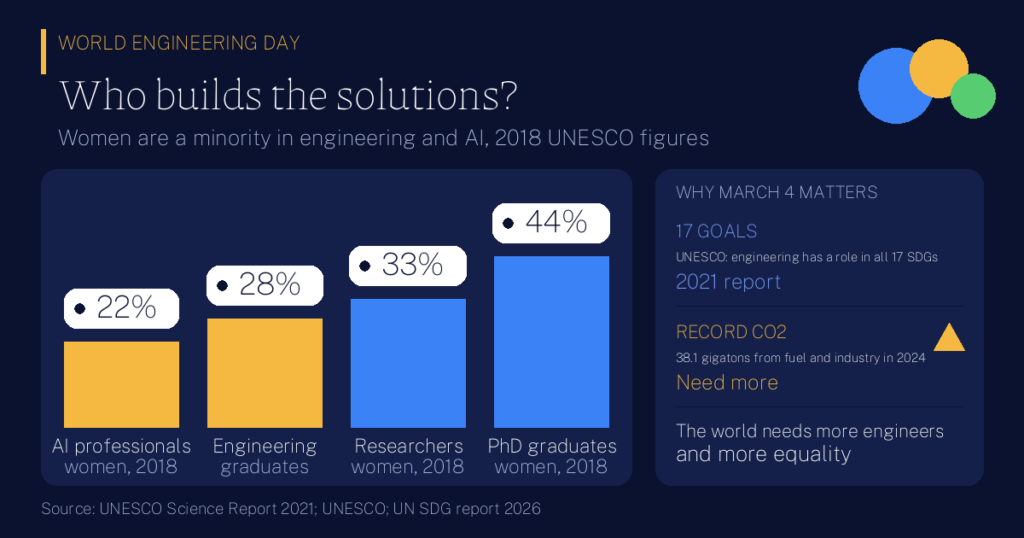
The clearest gap is gender. The UNESCO Science Report 2021 found that women were one in three researchers (33 percent) in 2018, and just over one in four (28 percent) of tertiary graduates in engineering, against 40 percent in computer science. Only 22 percent of professionals working in artificial intelligence were women in 2018. Women earned 44 percent of PhDs worldwide that year, which suggests the gap is not about ability. It opens at the doors of particular fields.
Other figures vary because they measure different things. A 2021 UN News report on the Engineering Report said women had been historically underrepresented in engineering, making up only 10 to 20 percent of workers. That counts people in jobs, while the 28 percent counts graduates, so the two should not be set side by side as one trend.
Example 2: one graduating class. Imagine a class of 100 engineering graduates. At a 28 percent share, 28 are women and 72 are men. To reach parity, 22 more women would have to graduate in a class of the same size. The numbers are round and illustrative, but they make the scale of the shift visible: not a new stadium of people, just a few more in every classroom.
What engineers build, and what is left to do
Goal 9 of the Sustainable Development Goals covers industry, innovation and infrastructure, the home turf of engineering. The UN’s Goal 9 page, drawing on The Sustainable Development Goals Report 2026, gives a mixed picture. In 2024, 96 percent of the world’s people were within reach of a mobile broadband network. Global manufacturing value added per person rose 18.1 percent between 2015 and 2025, and seaborne trade reached an estimated 24.1 billion metric tons in 2024, 16 percent higher than in 2015. Clean technologies are also making a difference: the UN says the rapid expansion of solar, wind, nuclear, electric vehicles and heat pumps since 2019 prevented an estimated 3 gigatons of CO2 in 2025 alone, roughly 8 percent of global energy-related emissions.
The same UN page records that global CO2 emissions from fuel combustion and industrial processes reached an all-time high of 38.1 gigatons in 2024, and that manufacturing’s share of total employment slipped from 14.3 percent in 2015 to 13.7 percent in 2025. In short, engineering is delivering real gains, and the demand for more of it, applied faster, is not shrinking.
Example 3: a bus depot. Suppose a city replaces 100 diesel buses with electric ones, and each diesel bus emitted 60 tons of CO2 a year from its tailpipe. The city would avoid about 6,000 tons of tailpipe CO2 a year. The figures are round and illustrative, and they leave out the emissions of generating the electricity, which engineers must also shrink. That is the daily work of sustainability: every solution comes with a new design question.
How the day is marked
Each year UNESCO, WFEO and national engineering bodies mark the day with events and a theme. The 2026 events ran from March 3 to 5 in Jakarta, Indonesia, in a hybrid format, co-organized by WFEO and the Institution of Engineers Indonesia with UNESCO’s support, and linked to Goal 9. Recent themes show how the focus has moved from recovery to resilience to digital tools.
- 2021Engineering for a healthy planet
- 2022Build back wiser, engineering the future
- 2023Engineering innovation for a resilient world
- 2024Engineering solutions for a sustainable world
- 2025Shaping our sustainable future through engineering
- 2026Smart engineering for sustainable future through innovation and digitalization
You do not need to be an engineer to join in. Ask a school to invite a local engineer to talk about their work, visit a water plant or a repair workshop, or simply notice one system you rely on and learn who keeps it running.
Key Takeaways
- Engineering sits behind every goal. UNESCO’s 2021 report describes its role in achieving all 17 Sustainable Development Goals.
- The day is young but rooted. WFEO proposed it in 2018 and UNESCO proclaimed it in 2019, with March 4 as the date.
- The world still needs more engineers. UNESCO reports a shortage in all domains, most acutely felt in Africa and small island developing states.
- The gender gap is real. Women were 28 percent of engineering graduates and 22 percent of AI professionals in the UNESCO figures.
- Progress and pressure arrive together. Broadband reaches 96 percent of people, yet CO2 emissions hit a record 38.1 gigatons in 2024.
- Anyone can take part. Learn who keeps your water, power and roads working, and encourage young people to see themselves in that work.
How solid is this? The proclamation year, themes and event details come from UNESCO and WFEO pages, and some themes (2021 to 2025) are from WFEO. We could not verify the resolution number or a global count of engineers, so none is given. Gender figures come from the UNESCO Science Report 2021 and measure graduates, researchers and PhD holders, not the whole workforce. The three worked examples use round, made-up numbers. See also the International Days hub and the International Days Calendar.
More in Science
- UNESCO. World Engineering Day for Sustainable Development.
- UNESCO. World Engineering Day for Sustainable Development 2026.
- UNESCO. UNESCO Engineering Report.
- UN News. Equality in engineering crucial to achieving sustainable development: UN-backed report (3 March 2021).
- UNESCO. UNESCO Science Report 2021, chapter 3: Women and the digital revolution.
- United Nations. Goal 9: Industry, innovation and infrastructure, citing The Sustainable Development Goals Report 2026.
- WFEO. The history of World Engineering Day.