Islamophobia is a word people use often and define rarely. The United Nations describes it as fear, prejudice and hatred of Muslims that leads to provocation, hostility and intolerance. Each year on March 15 the world is asked to look at that problem plainly: how widespread the prejudice is, who it harms, and what governments, companies and ordinary people can do about it. The day sits close to International Day for Tolerance and International Day of Peaceful Coexistence, because all three rest on one idea: that people of different faiths and backgrounds can share the same streets, schools and workplaces without fear.
How the day began
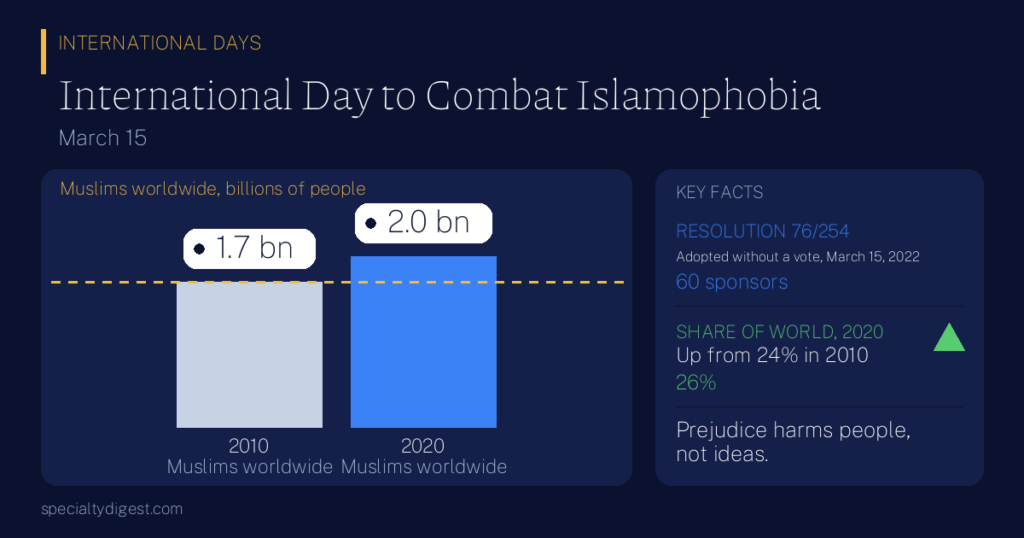
On March 15, 2022, the UN General Assembly adopted resolution 76/254, which designated March 15 as the International Day to Combat Islamophobia. It was adopted without a vote. According to the UN, the resolution was sponsored by 60 member states of the Organization of Islamic Cooperation.
The text stresses that terrorism and violent extremism cannot and should not be associated with any religion, nationality, civilization or ethnic group. It also calls for a global dialogue on promoting a culture of tolerance and peace, based on respect for human rights and for the diversity of religions and belief. In other words, the day is not aimed at any one government. It asks everyone to examine stereotypes and to replace suspicion with dialogue.
What the word means, and what it does not
Clear definitions protect free speech as well as people. The UN’s former Special Rapporteur on freedom of religion or belief, Ahmed Shaheed, made that point in a 2021 report to the Human Rights Council (A/HRC/46/30). He wrote that criticism of Islam as a set of ideas should never be conflated with Islamophobia, and that international human rights law protects individuals, not religions. What the law protects is the person: the worshipper, the neighbor, the job applicant, the student.
The same report warned of a serious pattern. In March 2021 Shaheed said that institutional suspicion and fear of Muslims, and of those perceived to be Muslim, had escalated to what he called epidemic proportions, and he urged states to take all necessary measures against direct and indirect discrimination. These are the Special Rapporteur’s findings and judgments, presented to a UN body, and they remain a central reference for the day.
The numbers behind the day
It helps to start with who we are talking about. The Pew Research Center, in a 2025 study, estimates that the number of Muslims grew 21 percent between 2010 and 2020, from 1.7 billion to 2.0 billion. Their share of the world’s people rose from 24 percent to 26 percent. Pew describes Islam as the world’s second-largest religious group and the fastest-growing major religion.
This is not one nation or one culture. In 2020, according to Pew, 59 percent of Muslims lived in the Asia-Pacific region and 18 percent in sub-Saharan Africa. Indonesia alone had roughly 240 million Muslims, about 12 percent of the world’s total, and India had 213 million, which is 15 percent of its population. These are survey-based estimates, and Pew revised its earlier 2010 figures.
- 2.0 billionMuslims worldwide in 2020, per Pew
- 26%of the world’s people in 2020
- 59%of Muslims live in Asia-Pacific
- 60states sponsored the 2022 resolution
What surveys have shown about prejudice
Prejudice is hard to measure, and the data are uneven by country and year. Still, Shaheed’s report cited surveys that give a sense of scale. In European surveys from 2018 and 2019, nearly four in ten people held unfavorable views about Muslims. In the United States, 30 percent of Americans in 2017 viewed Muslims in a negative light. These figures describe opinions, not actions, and they come from specific polls, but they show why the UN treats attitudes as a policy concern.
Example 1: the identical résumé. Imagine an employer receives 100 applications that are identical except for the applicant’s name, 50 with a name that signals a Muslim background and 50 without. If 20 of the second group are invited to interview and only 10 of the first, qualifications cannot explain the gap. The numbers here are round and made up, but this kind of paired test is how researchers measure discrimination.
Who is affected, and why it concerns everyone
The harm is not limited to people who practice Islam. The UN observance page summarizes the Secretary-General’s view that anti-Muslim hatred targets not only Muslims but also Jews, minority Christian communities and others. Hatred rarely stays inside its first target, and people who are only perceived to be Muslim are affected too, a group the Special Rapporteur explicitly included.
Shaheed also argued that some security policies disproportionately target Muslims and treat them as both high risk and at risk of radicalization. That is his assessment, and governments dispute some such claims, but it explains the resolution’s insistence that terrorism cannot be tied to any one religion. Stereotypes in policy can be as damaging as stereotypes on the street.
Example 2: the ripple. Suppose a town of 5,000 people has 250 Muslim residents, and a rumor online blames them for a local crime. If 20 of them stop sending children to the park or wearing visible religious dress for a month, 20 families have changed daily life without any court finding a fact. Numbers like these are illustrative, but they show how fear works even before a single formal act of discrimination.
What progress looks like
The UN’s answers are practical. According to its observance page, the Secretary-General calls on governments to promote social cohesion and protect religious freedom, on online platforms to tackle hate speech, and on individuals to oppose bigotry and xenophobia. In his 2026 message he noted that in May 2025 he appointed the High Representative for the UN Alliance of Civilizations as the UN Special Envoy to Combat Islamophobia, to strengthen the collective response. At a high-level event in New York marking the day in 2026, he called for equality, human rights and the dignity of every person, everywhere. The UN pages reviewed for this article list no formal theme for 2026.
Good data comes first. Hate incidents are widely under-reported, so a modest fall in recorded incidents can mean either less hatred or less trust in reporting.
Example 3: counting what is hidden. A city logs 50 anti-Muslim incidents in a year. If only 1 in 4 incidents is ever reported, the true figure is nearer 200. The rate is made up for illustration, yet it shows why easy, trusted reporting channels matter. Anyone who experiences hate, threats or violence can contact local police, their national human rights institution or a community organization, and should call local emergency services if in danger.
Key Takeaways
- It is about people, not ideas. The UN defines Islamophobia as fear, prejudice and hatred of Muslims, while human rights law protects individuals, not religions.
- The day is recent. Resolution 76/254 was adopted without a vote on March 15, 2022, with 60 sponsoring states.
- The community is vast and varied. About 2.0 billion Muslims lived in the world in 2020, most of them in Asia-Pacific.
- Prejudice can be measured. Surveys cited by the UN found nearly four in ten Europeans and 30 percent of Americans held negative views.
- No faith owns violence. The resolution stresses that terrorism cannot be associated with any religion, nationality, civilization or ethnic group.
- Hatred spreads. The Secretary-General notes it also targets Jews, minority Christians and others, so the response belongs to everyone.
- Action is concrete. Governments, platforms and individuals each have a role, and a UN Special Envoy has been in place since May 2025.
How solid is this? Resolution details come from the UN Digital Library and UN observance pages. Population figures are Pew Research Center estimates for 2020 and may be revised. The survey figures were cited by the Special Rapporteur in 2021 and are older, and the findings and judgments about institutional suspicion are his, not a consensus. The three worked examples use round, made-up numbers to show an idea. See also the International Days hub and the International Days Calendar.
More in Society
- United Nations, International Day to Combat Islamophobia (observance page)
- UN Digital Library, General Assembly resolution A/RES/76/254 (2022)
- United Nations, Secretary-General’s message, 2026
- UN Meetings Coverage, Secretary-General at the high-level event, 2026
- UN News, Anti-Muslim hatred has reached epidemic proportions, March 4, 2021
- OHCHR, Report A/HRC/46/30 of the Special Rapporteur on freedom of religion or belief
- Pew Research Center, Muslim population change, 2010 to 2020 (2025)