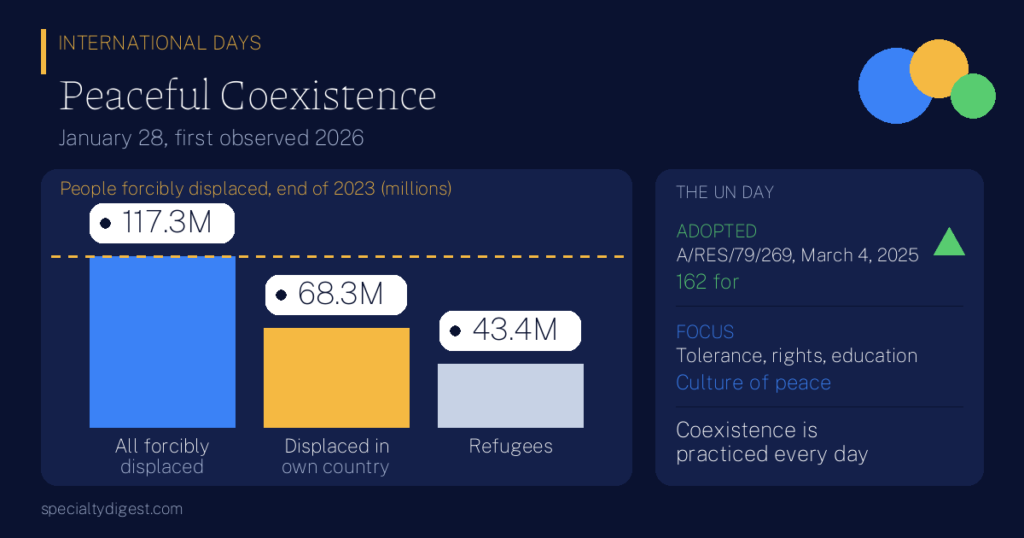
Peace is often described as the absence of war. Ask people who have lived through conflict, discrimination or exile, and they will describe something more demanding: the daily ability to share a street, a school and a future with neighbors who worship, speak or think differently. The International Day of Peaceful Coexistence, observed every year on January 28, is the newest United Nations day built around that idea. The General Assembly proclaimed it on March 4, 2025, and the first observance followed in 2026. Its message is simple and hard at once: coexistence does not happen by default. It is practiced.
A new day with deep roots
The day did not appear from nowhere. The United Nations has worked on a “culture of peace” for decades. In 1997, resolution 52/15 proclaimed the year 2000 the International Year for a Culture of Peace. In 1999, resolution 53/243 adopted the Declaration and Programme of Action on a Culture of Peace, which the UN describes as a framework for promoting non-violence, tolerance, dialogue and mutual understanding. A later resolution, A/RES/72/130, created the International Day of Living Together in Peace on May 16, which the UN describes as being about accepting differences and having the ability to listen to, recognize, respect and appreciate others.
The January 28 day adds a second marker to that calendar. According to the UN press summary of the debate, the draft resolution (A/79/L.53) was introduced by Abdulla bin Ahmed Al Khalifa, Bahrain’s Minister of Transportation and Telecommunications. Bahrain then marked the first observance in 2026, in an event the UN reported alongside the start of its term as a non-permanent member of the Security Council.
What “coexistence” means
Coexistence is not the same as agreement, and it is not the same as indifference. Khaled El Mekwad, the UN Resident Coordinator in Bahrain, put it this way at the first observance: peaceful coexistence is “more than the absence of conflict” and is “the ability to live together amid differences while upholding justice, dignity, equality, and human rights for all.” He also stressed the part education plays in building tolerance and intercultural understanding.
It helps to picture a ladder. At the bottom is simple non-violence: people differ and do not fight. Higher up is tolerance, where people accept that others hold different beliefs. Higher still is mutual respect and cooperation, where neighbors work on shared problems. The UN day points to the whole climb, and it says the climb needs justice and rights, not only calm.
Example 1: the shared playground. Imagine a town of 10,000 people where five language groups live in separate neighborhoods and rarely meet. The town builds one playground and one library that serve all of them. Within a year, children from all five groups attend the same story hour. The numbers are round and illustrative, but they show the point: coexistence grows from ordinary shared places, not only from speeches.
What the resolution asks for
According to the UN, the resolution emphasizes the role of Member States and other stakeholders in promoting tolerance, respect for religious and cultural diversity, and human rights. It invites all countries, international organizations, civil society and the media to celebrate the day through meaningful activities that foster a culture of peace, inclusion, understanding and solidarity. The UN says the day serves as a platform to raise awareness of diverse cultures, values, ways of life and beliefs, and to highlight the role of education in promoting tolerance, at a time of rising global instability and conflict.
- March 4, 2025date the General Assembly adopted A/RES/79/269
- 162votes in favor, with 3 against and 2 abstentions
- 117.3 millionpeople forcibly displaced worldwide, end of 2023
- 58%of them displaced inside their own countries, end of 2023
A recorded vote, and a debate
The resolution was not adopted by consensus. It passed by recorded vote, with 162 countries in favor, 3 against (Argentina, Israel and the United States) and 2 abstaining (Paraguay and Peru), according to the UN press summary. Explaining its position, the United States representative said the text “advances a programme of soft global governance that is inconsistent with US sovereignty,” and also raised concern that the title could be read as endorsing a particular set of diplomatic principles known as the Five Principles of Peaceful Coexistence. China’s representative replied that such principles are “widely recognized by the international community and contained in many international instruments.” Bahrain’s minister described the text as reaffirming the role of Member States and others in promoting tolerance, respect for religious and cultural diversity, and human rights.
Whatever one thinks of the debate, it shows that even a day about getting along can prompt real disagreement about how the UN should speak. That is worth knowing, and it is part of the story of the day.
Why the world needs it
The case for coexistence is easiest to see where it fails. The UN refugee agency, UNHCR, reported that more than 117.3 million people were forcibly displaced at the end of 2023, a rise of 8 percent, or 8.8 million people, from the end of 2022. That included 43.4 million refugees and 68.3 million people displaced inside their own countries by conflict and violence, who make up 58 percent of the total. UNHCR updates these figures each June, so newer editions exist. The 2023 numbers are shown here because they are the ones verified for this article, and they illustrate the scale.
Displacement is not caused by a failure of coexistence alone, but communities that are suspicious, divided or excluded are far less able to welcome newcomers or to resolve disputes early. The day asks people to build trust before a crisis, not after.
Example 2: a city that welcomes. Suppose a city of 500,000 receives 5,000 newcomers in a year, about 1 percent of its population. If language classes, job help and neighborhood events reach most of them, the newcomers become neighbors. If not, they cluster at the edges, and rumors grow. The numbers are made up and rounded, but the pattern is one that local officials and aid workers describe often.
Who is left out, and where education comes in
Minorities, migrants, indigenous peoples, people of minority faiths and people with little voice in public life are usually the first to feel the cost when coexistence breaks down. This is why the UN day pairs tolerance with human rights and with education. Schools are one of the few places where children from different backgrounds meet daily, and what they learn there about difference can last a lifetime. For more on that thread, see International Day of Education and International Day for Tolerance. If you or someone you know faces harassment or discrimination, local human rights bodies and community organizations can offer help.
How the day is marked
The UN invites governments, organizations, civil society and the media to mark the day with activities that foster a culture of peace, inclusion, understanding and solidarity. In practice that can mean classroom lessons on other cultures, community meals, interfaith or intercultural dialogue, media stories about neighbors working together, or a local project that brings different groups to the same table.
Example 3: a library’s January 28. A branch library hosts one evening with four volunteer speakers from four backgrounds, each telling a ten-minute story about their street. About 60 people attend. Afterward, 20 of them sign up for a monthly community book club. The numbers are round and illustrative, but the idea is real: small, repeated contact is how coexistence becomes a habit.
Key Takeaways
- The day is new. The General Assembly proclaimed January 28 on March 4, 2025, and the first observance came in 2026.
- Coexistence is more than quiet. The UN’s own voices describe it as living together amid differences with justice, dignity, equality and rights.
- It builds on a long agenda. It follows the 1999 Culture of Peace declaration and the May 16 day for Living Together in Peace.
- The vote was not unanimous. It passed 162 to 3, with 2 abstentions, and the debate showed differing views on how the UN should frame such days.
- Scale gives the stakes. At the end of 2023, 117.3 million people were forcibly displaced, according to UNHCR.
- Education is central. The UN highlights schools as places where tolerance is learned.
- Start small and local. Shared places and repeated contact turn good intentions into habits.
How solid is this? The vote, dates and wording of the invitation come from UN pages and the UN press summary; we did not read the full resolution text, so quotes from officials and delegates are attributed to them. Displacement figures are UNHCR’s end-2023 estimates and are provisional. The three worked examples use round, made-up numbers. See also the International Days hub and the International Days Calendar.
More in Society
- United Nations, International Day of Peaceful Coexistence, 28 January
- UN Press, General Assembly meeting coverage GA/12676 (draft A/79/L.53)
- United Nations, Bahrain marks first International Day for Peaceful Coexistence (2026)
- United Nations, International Day of Living Together in Peace, 16 May
- UN Digital Library, resolution record for the International Day of Peaceful Coexistence
- UNHCR, Global Trends 2023