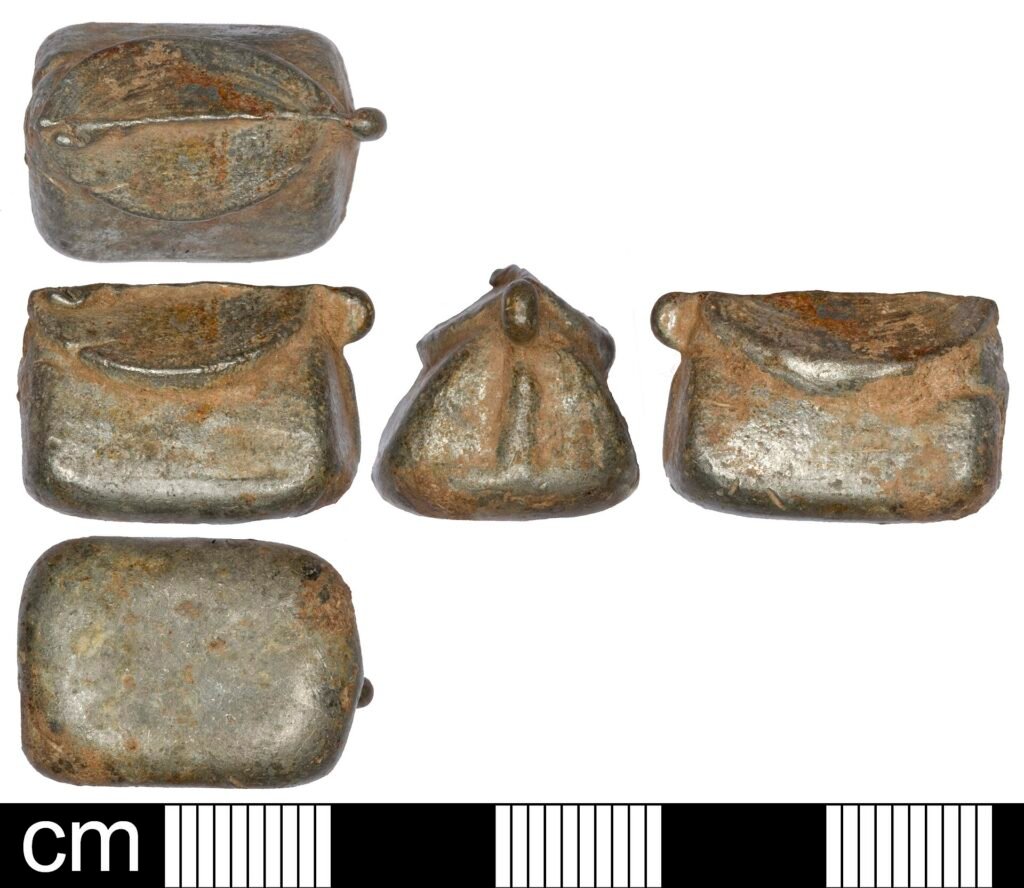
Lead is the chemical element with atomic number 82 and the symbol Pb. It is a dull, silvery-gray metal that is soft and easily worked into sheets. Lead has been mined for thousands of years, and although it is still widely used in batteries and radiation shielding, many older uses have been banned or discouraged because the metal is toxic.
History of lead
The Royal Society of Chemistry reports that lead has been mined for more than 6,000 years, and that the metal and its compounds have been used throughout history. Small lead nuggets have been found in pre-Columbian Peru, Yucatan and Guatemala. PubChem lists the discovery date as ancient, because no individual discoverer is known.
The Greeks mined lead on a large scale and knew not only how to obtain the metal but also how to convert it to white lead. Because of its superb covering power, white lead was the basis of paints for more than 2000 years, until the middle of the twentieth century.
The Romans employed lead on a large scale, mining it mainly in Spain and Britain. They used it for water pipes, coffins and pewter tableware, and to debase their silver coinage. Mining declined in the Dark Ages but reappeared in medieval times, when lead found new uses such as pottery glazes, bullets and printing type. In the twentieth century it also became a fuel additive.
Properties of lead
PubChem lists lead with an atomic mass of about 207. Its electron configuration is [Xe] 6s2 4f14 5d10 6p2. Lead sits in group 14 and period 6 of the periodic table and is classed as a post-transition metal, one of the metals to the right of the transition block. Its common oxidation states are +4 and +2.
Lead is a solid with a density of 11.342 grams per cubic centimeter. It melts at 600.61 kelvin, about 327 degrees Celsius, and boils at 2022 kelvin, about 1749 degrees Celsius. The Royal Society of Chemistry describes it as a dull, silvery-gray metal that is soft and easily worked into sheets, and as an easily worked and corrosion-resistant metal.
The first ionization energy of lead, the energy needed to remove one electron from a neutral atom, is 7.417 electronvolts, or about 716 kilojoules per mole. Its electron affinity is 35.121 kilojoules per mole. The covalent radius is 145 picometers, and the non-bonded atomic radius is 202 picometers. The two sources give different electronegativity values, 2.33 and 1.8, so no single figure is quoted here.
Occurrence and production of lead
Lead is chiefly obtained from the mineral galena by a roasting process, which means heating the ore in air. The Royal Society of Chemistry reports that at least 40 percent of lead in the United Kingdom is recycled from secondary sources such as scrap batteries and pipes.
The World Health Organization describes lead as a naturally occurring toxic metal found in the Earth’s crust. Mining, smelting, manufacturing and recycling are important sources of environmental contamination, as is the use of lead in a range of products.
Uses of lead
Lead is easily worked and resists corrosion, and for that reason it has been used for pipes, pewter and paint since Roman times. It has also been used in lead glazes for pottery and, more recently, in insecticides, hair dyes and as an anti-knock additive for petrol. The Royal Society of Chemistry states that all of these uses have now been banned, replaced or discouraged, because lead is known to be detrimental to health, particularly that of children.
Lead is still widely used for car batteries, pigments, ammunition, cable sheathing, weights for lifting, weight belts for diving, lead crystal glass, radiation protection and some solders. It is often used to store corrosive liquids, and it is sometimes used in architecture for roofing and in stained glass windows.
The World Health Organization notes that most global lead consumption is for the manufacture of lead-acid batteries for motor vehicles. It adds that lead is also used in paints, solder, stained glass, lead crystal glassware, ammunition, ceramic glazes, jewelry, toys, and some traditional cosmetics and medicines.
Isotopes of lead
Lead has four naturally occurring isotopes. An isotope is a form of an element whose atoms have the same number of protons but different numbers of neutrons. The most abundant is lead-208 at 52.4 percent, followed by lead-206 at 24.1 percent, lead-207 at 22.1 percent and lead-204 at 1.4 percent.
The Royal Society of Chemistry lists lead-208 with a half-life of more than 2 times 10 to the 19th years, which is so long that natural lead is effectively stable.
Health and environmental effects of lead
The Royal Society of Chemistry states that lead has no known biological role. It can accumulate in the body and cause serious health problems, and it is toxic, teratogenic, which means it disturbs the development of an embryo or fetus, and carcinogenic. Daily intake of lead from all sources is about 0.1 milligrams, and the average human body stores about 120 milligrams of lead in the bones.
The World Health Organization states that exposure to lead can affect multiple body systems and is particularly harmful to young children and women of child-bearing age. Lead is distributed to the brain, liver, kidney and bones, and it is stored in the teeth and bones, where it can accumulate over time. Human exposure is assessed by measuring lead in the blood. The organization attributes more than 3.5 million deaths globally in 2023 to lead exposure, primarily through cardiovascular effects, and states that no level of exposure is known to be without harmful effects.
People are exposed through occupational and environmental sources, mainly by inhaling lead particles created when materials containing lead are burned, as in smelting, recycling and stripping leaded paint, and by ingesting contaminated dust, soil, water or food. Lead can contaminate drinking water through plumbing that contains lead pipes, solders and fittings. Young children may absorb 4 to 5 times as much lead as adults from an ingested dose. The World Health Organization says that the harmful impacts of lead exposure are entirely preventable. This entry gives general background drawn from reference sources and is not advice.
Key facts
- Lead has atomic number 82, symbol Pb, and sits in group 14 and period 6 of the periodic table.2
- Lead has been mined for more than 6,000 years and was used by the Greeks and Romans.1
- Lead is chiefly obtained from the mineral galena by a roasting process.1
- Most global lead consumption is for lead-acid batteries for motor vehicles.3
- The World Health Organization states that no level of lead exposure is known to be without harmful effects.3
This entry explains a medical term. It is not medical advice. If you are concerned about your health, speak with a qualified health professional.
Related concepts
In the news
- BusinessAntimony in 2025: USGS Shows a $25 Price as U.S. Import Reliance Hits 91 Percent
- BusinessTin in 2025: USGS Shows China and Indonesia Mine 46 Percent
- BusinessLead in 2025: USGS Shows China Mines 42 Percent as U.S. Import Reliance Rises
- BusinessPlatinum-Group Metals in 2025: USGS Shows South Africa Mines 71 Percent of Platinum
- NatureBismarck Sea Submarine Eruption: Satellites Track Plumes and Pumice in May 2026
Quick checkWhat is the main use of lead today?Show answer
Most global lead consumption is for the manufacture of lead-acid batteries for motor vehicles, according to the World Health Organization.
Sources
- Royal Society of Chemistry, Periodic Table: Lead, https://periodic-table.rsc.org/element/82/lead
- National Center for Biotechnology Information, PubChem Periodic Table: Lead (element 82), https://pubchem.ncbi.nlm.nih.gov/element/82
- World Health Organization, Lead poisoning and health (fact sheet), https://www.who.int/news-room/fact-sheets/detail/lead-poisoning-and-health
Editorially reviewed by Specialty Digest Editorial TeamLast reviewed November 4, 2026Researched and drafted with AI assistanceReport an issue