Every purchase is a small act of trust. When you buy a toy, a phone charger, a bottle of medicine or a loaf of bread, you cannot test it yourself. You rely on rules, labels, inspectors and honest sellers. World Consumer Rights Day, marked every March 15, asks a plain question: does that trust rest on solid ground? It is a day for the rights to be safe, to be informed and to be heard in the marketplace, and in 2026 it puts one idea in front of everything else, which is that the things people buy should not hurt them.
From a speech to a global movement
On March 15, 1962, President John F. Kennedy sent a special message to the US Congress on protecting the consumer interest. UNCTAD, the UN trade and development body, says he defined modern consumer rights in that message. The consumer movement later chose its anniversary as a day of action. Consumers International, the global federation of consumer groups, which counts about 200 members spanning more than 100 countries, has marked March 15 as World Consumer Rights Day for more than thirty years, and it picks a campaign theme each year.
The status of the day is worth stating clearly. Unlike days created by a General Assembly resolution, this one grew from the consumer movement itself, and Consumers International says it is campaigning for the United Nations to recognize it formally as an international day. Its footing in UN law comes from a different document, the Guidelines for Consumer Protection, which gives the day its substance.
The UN rulebook for shoppers
The General Assembly adopted the UN Guidelines for Consumer Protection on April 16, 1985, in resolution 39/248. They set out principles for good consumer protection laws and for the institutions that enforce them. Thirty years later the world of shopping had changed. At the Seventh UN Conference on competition and consumer protection in Geneva, July 6 to 10, 2015, governments adopted a revised text by unanimity, and the General Assembly endorsed it on December 22, 2015, in resolution 70/186. UNCTAD says the revision responded to the rise of electronic commerce and added entirely new sections on it (guidelines 63 to 65). It also estimates that e-commerce was worth about $25 trillion in 2015.
What consumers are owed
The revised Guidelines list eleven legitimate needs of consumers. In paraphrase, they cover access to essential goods and services, such as the safe water that households depend on; protection of vulnerable and disadvantaged consumers; protection from hazards to health and safety; protection of economic interests; adequate information to make informed choices; consumer education; effective dispute resolution and redress; freedom to form consumer groups and be heard; sustainable consumption; a level of protection online that is not less than in other commerce; and privacy. UNCTAD notes that the 2015 revision added four new needs.
Example 1: the overheating charger. Suppose a shopper buys a $10 phone charger from an overseas seller on an online marketplace, and it overheats within a week. Several needs collide at once: safety, honest information about the product, a way to get a refund, and protection that is as strong online as in a shop. The numbers here are round and illustrative, but the chain of questions is exactly what the Guidelines were written to answer.
Why product safety leads in 2026
The 2026 theme, Safe Products, Confident Consumers, comes from Consumers International. Its campaign page says: “Product safety is more than a regulatory issue, it is fundamental to the human rights to life, health and safety.” It names the harms of unsafe goods as injury, financial loss, environmental harm and, in the most serious cases, loss of life, and it points to products from children’s toys and household electronics to medicines. Dialogues held on March 16, 2026 followed the day itself.
The timing is not an accident. On December 15, 2025, the General Assembly adopted the first-ever UN Principles for Consumer Product Safety in resolution 80/119. UNCTAD reports that the draft was sponsored by Brazil, Costa Rica, Peru, South Africa, Spain and Sweden, and had been agreed by consensus at the Ninth UN Conference on competition and consumer protection in Geneva in July 2025. As UNCTAD summarizes them, the Principles affirm that all consumers have a right to safe, non-hazardous products sold online and offline, give businesses the primary responsibility for safety across a product’s life cycle, and allow public authorities to assess risks, order recalls, remove unsafe online listings and share safety alerts across borders, all within a flexible framework that is not meant to restrict trade.
Example 2: one alert, three countries. Imagine a regulator finds that a children’s lamp sold in three countries has a wiring fault, and about 5,000 units are in homes. If it shares the alert across borders, and the other two authorities order the same recall and removal of online listings, the faulty lamp can be pulled in days. Without sharing, each country might find the fault separately, months apart. These figures are illustrative.
The numbers behind the day
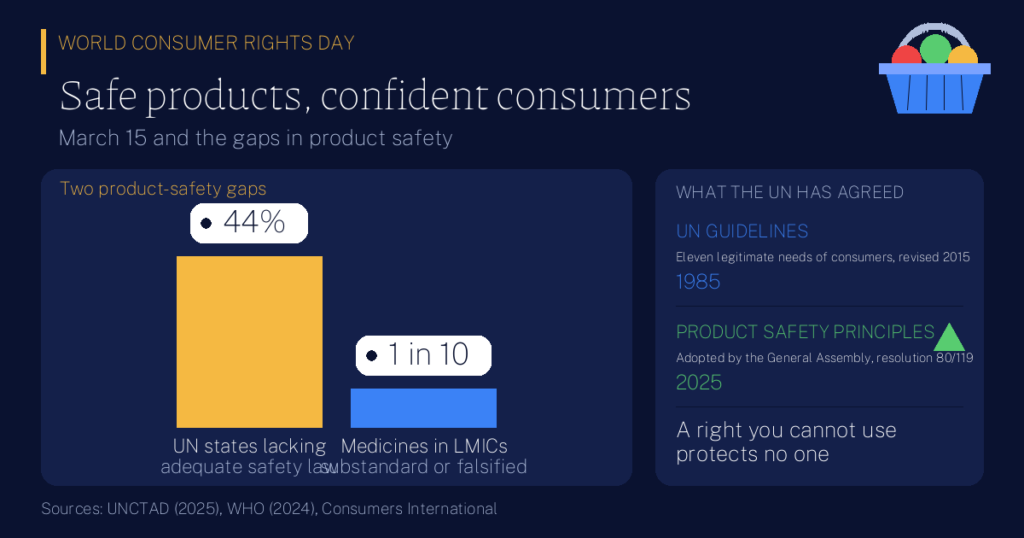
The gaps are measurable. UNCTAD reports, citing its World Consumer Protection Map, that 44 percent of UN Member States lack sufficient legal frameworks to ensure product safety (2025). On medicines, the World Health Organization says at least 1 in 10 medicines in low- and middle-income countries are substandard or falsified, an estimate dating from 2017 that its December 2024 fact sheet still reports, and that countries spend an estimated $30.5 billion per year on such products. WHO adds that they are often sold online or in informal markets.
- 44%of UN Member States lack sufficient product safety law, 2025
- 1 in 10medicines in low- and middle-income countries substandard or falsified
- $30.5 billionestimated yearly spending on such medical products
- 11legitimate needs in the UN Guidelines
Who is left behind
The Guidelines single out vulnerable and disadvantaged consumers for a reason. People on low incomes tend to buy the cheapest goods, which are often the least tested, and they have the least room to absorb a loss. Older people and those with limited digital skills can struggle with online disputes, and shoppers in countries with weak safety law have fewer places to turn after a harm. A consumer who cannot afford to replace a faulty product, or to travel to a distant court, effectively has a right on paper only.
Example 3: the cost of a bad heater. Picture a household with a weekly budget of $50 that buys a $20 heater which fails in a month. The loss is 40 percent of one week’s budget, and the family has no easy refund path. A wealthier household would shrug off the same loss. The numbers are round and illustrative, yet they show why redress and safety rules matter most to those who can least afford mistakes.
How the day is marked and what progress needs
Consumers International coordinates the day with its member organizations, which run campaigns, tests, dialogues and public events each March. Progress after the day depends on slow, practical work: laws that set clear safety duties, regulators with the staff to inspect and recall, cooperation between countries so that a hazard found in one market is flagged in others, and consumer groups strong enough to speak in decisions that affect them. The new Principles give governments a shared reference, and the Guidelines give consumer advocates a standard to hold them to.
Key Takeaways
- The date comes from 1962. March 15 marks Kennedy’s special message to Congress on the consumer interest.
- It is a movement day. Consumers International leads it and is seeking formal UN recognition.
- The UN rulebook is real. The Guidelines, adopted in 1985 and revised in 2015, list eleven legitimate needs.
- Safety is the 2026 focus. The theme is Safe Products, Confident Consumers.
- There is a new global text. The UN Principles for Consumer Product Safety were adopted on December 15, 2025.
- Gaps remain. UNCTAD reports 44 percent of UN Member States lack sufficient product safety law.
- Redress matters most to the vulnerable. A right you cannot use protects no one.
How solid is this? Dates, resolution numbers and quoted text come from Consumers International, UNCTAD and WHO pages. The WHO medicines figure is an estimate from 2017 that the agency still reports, and the 44 percent figure comes from UNCTAD’s own map, so treat both as approximate. The three worked examples use round, made-up numbers. See also the International Days hub and the International Days Calendar.
More in Society
- Consumers International, World Consumer Rights Day 2026: Safe Products, Confident Consumers
- Consumers International, United Nations Recognition of World Consumer Rights Day
- UNCTAD, Consumer rights are a cornerstone of inclusive development (2018)
- UNCTAD, UN Guidelines for Consumer Protection
- UNCTAD, Consumer product safety: new global principles adopted by the UN (December 2025)
- UNCTAD, Emerging trends and challenges in consumer product safety (2025)
- WHO, Substandard and falsified medical products fact sheet (December 2024)