Around the first day of spring, people from the Balkans to Central Asia begin a new year with songs, shared meals and visits to family and friends. The festival is called Nowruz, a Persian word meaning “new day.” The United Nations recognizes March 21 as the International Day of Nowruz, and the point is not to give one country a holiday. It is to honor a tradition that belongs to many peoples at once. This article explains where the festival comes from, what it involves, how it won global recognition, and why the UN ties it to peace. If you like observances that link people to the natural world, see also World Water Day.
A festival older than most countries
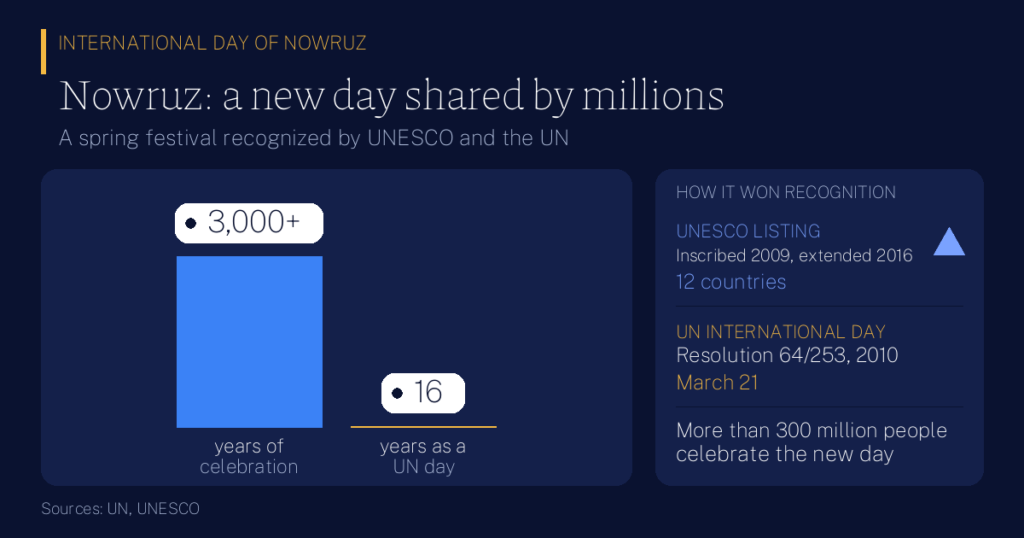
The UN describes Nowruz as a festival celebrated for over 3,000 years in the Balkans, the Black Sea Basin, the Caucasus, Central Asia, the Middle East and other regions. It says more than 300 million people celebrate it. A UN General Assembly statement in 2014 noted that Nowruz originated in Persian culture, and UNESCO records that local legends often center on Jamshid, a mythological king of Iran.
UNESCO describes it as an ancestral festivity marking the first day of spring and the renewal of nature. In a world where most calendars begin in the dead of winter, a new year that starts when the days are lengthening and the land is waking up has a natural logic. It is a holiday built on a season, not on a single faith or state, which is a large part of why so many communities can share it.
How the world recognized it
Global recognition came in two steps. In 2009, UNESCO inscribed Nowruz on its Representative List of the Intangible Cultural Heritage of Humanity. In 2010, the General Assembly adopted resolution 64/253, “International Day of Nowruz,” without a vote, under the agenda item on a culture of peace. The resolution recognizes March 21 as the day, welcomes the efforts of countries where it is celebrated to preserve and develop their traditions, and encourages them to raise awareness and hold annual events. It also invites UN bodies, in particular UNESCO, to take part. In 2016, the UNESCO listing was extended, and it now names 12 countries.
What happens during Nowruz
There is no single script. UNESCO notes that rites vary from place to place, and that the celebration can last about two weeks, filled with rituals, ceremonies and cultural events. Songs and dances are common to almost all regions. In some places people leave lit candles at their house doors, and children decorate hard-boiled eggs. In Iran, people leap over fires and streams. Elsewhere the program includes tightrope walking, horse racing, and the traditional wrestling practiced in Kyrgyzstan.
The shared core is simple and human. UNESCO describes new clothes, visits to family and friends, gifts exchanged especially for children, and a special meal enjoyed with loved ones. It adds that women play a key role in organizing the festival and passing on its traditions, and that children are its primary beneficiaries. That is the quiet strength of this heritage: it is carried in kitchens and living rooms, and it survives because each generation is invited in.
Example 1: the visiting calendar. Imagine a family that spends two weeks of the festival visiting. Say it calls on 10 households and each household receives about 6 guests during the period. That is roughly 60 guest visits, each with a meal, a gift for a child or a story passed along. The numbers are round and illustrative, but they show how one festival can weave dozens of small connections in a single neighborhood.
Why a date tied to the sky
UNESCO says Nowruz is celebrated on March 21, a date originally determined by astronomical calculations. The UN observance page ties it to the vernal equinox, which it says usually falls on March 20 or 21. The UN day is fixed on March 21, so in a given year the astronomical moment can differ slightly from the date on the calendar. The rule is the same every year: the festival follows the arrival of spring in the Northern Hemisphere, and the UN observes it on March 21.
Example 2: counting back from spring. Suppose a community plans a public Nowruz gathering and starts preparing eight weeks ahead. If the festival begins on March 21, work begins in late January. A school choir rehearses, a market stall plans its menu, and a local council books a hall. The numbers are made up for illustration, but they show how a date linked to the seasons gives planners a clear, shared target.
The numbers, and how to read them
Three figures appear again and again in UN and UNESCO materials: more than 3,000 years of history, more than 300 million celebrants, and 12 countries in the UNESCO listing. The figure for celebrants appears in UN statements from 2012, 2014 and 2022, and it is a rounded estimate, not a census count. Treat it as a size class, not a precise tally. The number of countries is firmer, but the festival is also marked by communities outside the listed states.
Why the UN links it to peace
The resolution was adopted under the agenda item on a culture of peace, and UN messages keep returning to that idea. UNESCO says the festival promotes values of peace and solidarity between generations and within families, along with reconciliation, neighborliness, cultural diversity and friendship among peoples. In his 2022 message, Secretary-General António Guterres said Nowruz “unites over 300 million people, between generations and beyond borders,” and that it “echoes the values of the United Nations of peace, human rights and dignity.” In 2012, Ban Ki-moon called the holiday “a reminder that we share a common fate and must work for a better future for all.”
It matters that these are statements by the UN and its agencies about the spirit of a festival, not claims that a holiday ends disputes. What the festival offers is a ritual of welcome, and rituals of welcome are a practical starting point for dialogue between neighbors.
Example 3: a shared table. Picture two neighboring towns of about 1,000 people each, with different languages at home but the same spring festival. If they hold one joint evening with 20 shared dishes, roughly 2,000 people meet over food they all recognize. The numbers are round and illustrative. The point is that a common tradition gives strangers something to talk about before they talk about anything harder.
How the day is marked, and how to take part
The resolution encourages countries to hold annual commemorative events and to share knowledge of Nowruz heritage with the international community. Each year the Secretary-General issues a message, and UN bodies take part in events organized by the countries that celebrate. The 2026 message carried the line, “Across all nations and cultures, let’s walk together as we build a more peaceful, sustainable and inclusive world for all people.” For individuals, the simplest way to take part is to ask a neighbor or classmate who celebrates it how their family marks the day, and to attend a public event when invited.
Key Takeaways
- Nowruz means “new day.” It marks the first day of spring and the renewal of nature, and it is observed on March 21.
- It is very old and very wide. The UN cites over 3,000 years of celebration and more than 300 million celebrants across several regions.
- Recognition came in steps. UNESCO listed it in 2009 and extended the listing in 2016, and the General Assembly created the day in 2010.
- Twelve countries share the listing. The festival still reaches well beyond them.
- The core is family and community. New clothes, visits, gifts for children and a special meal sit at the center, with local customs on top.
- The UN links it to peace. The resolution sits under a culture of peace, and UNESCO stresses solidarity between generations.
How solid is this? The 3,000 years and 300 million figures are rounded statements from the UN, not audited counts, and customs vary by community. The UN Digital Library records the resolution as adopted without a vote in 2010. The three worked examples use round, made-up numbers to show an idea. See also World Water Day, the International Days hub and the International Days Calendar.
More in Society
- United Nations, International Nowruz Day
- UN Digital Library, A/RES/64/253, International Day of Nowruz (2010)
- UNESCO, International Day of Nowruz
- UNESCO Intangible Cultural Heritage, 21 March: the International Day of Nowruz
- UNESCO Intangible Cultural Heritage, Decision 11.COM 10.B.1 (2016)
- United Nations, Secretary-General message on Nowruz (2022)
- UN News, International Day of Nowruz (2012)