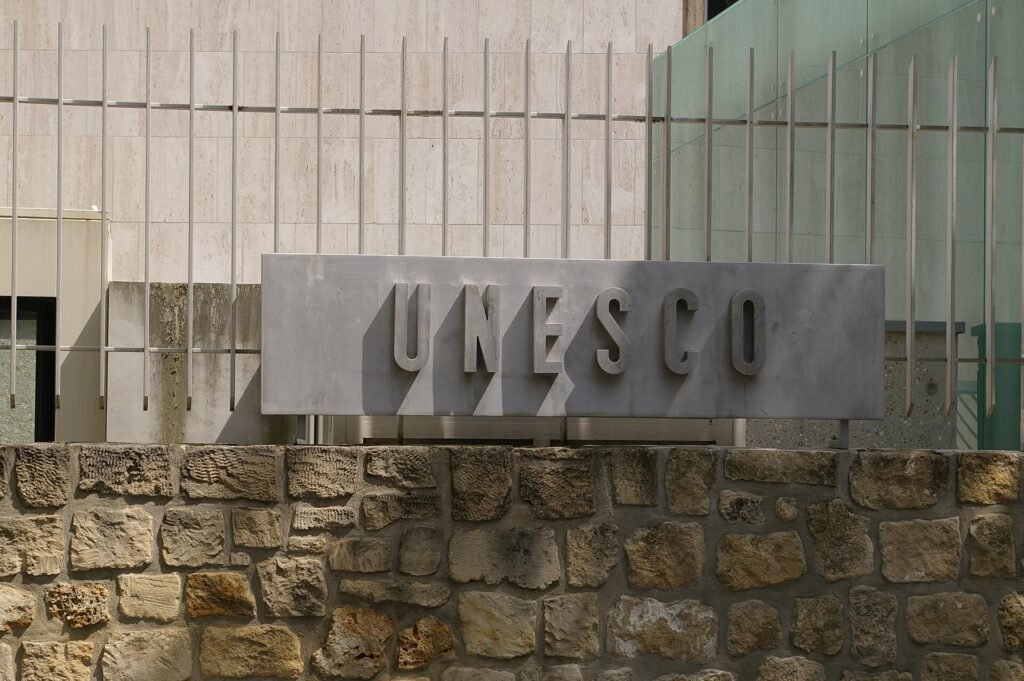
UNESCO, the United Nations Educational, Scientific and Cultural Organization, is the United Nations agency that promotes international cooperation in education, the sciences, culture, communication and information in order to contribute to peace and security. It was created by a constitution agreed in London in November 1945 and is best known for its World Heritage List.
History of UNESCO
The idea began during the Second World War. As early as 1942, the governments of European countries fighting Nazi Germany and its allies met in the United Kingdom for the Conference of Allied Ministers of Education. They were looking for ways to rebuild their education systems once peace returned. The project gained momentum, took on a universal character, and drew in new governments, including that of the United States.
On the proposal of that conference, a United Nations conference to establish an educational and cultural organization met in London from 1 to 16 November 1945, just after the war ended. Representatives of forty-four countries decided to create an organization that would embody a culture of peace. The Constitution was signed in London on 16 November 1945 and entered into force on 4 November 1946.
The founders held that political and economic arrangements between governments are not enough to secure lasting peace. The Constitution says that peace must be founded on what it calls the intellectual and moral solidarity of humankind, and it sets out the aim of advancing mutual understanding through education, science and culture.
Mission and mandate
UNESCO describes its purpose as promoting knowledge sharing and the free flow of ideas to build mutual understanding. Its programs are meant to contribute to the Sustainable Development Goals in the 2030 Agenda, which the UN General Assembly adopted in 2015.
Its areas of work, as it describes them, include the following:
Education: helping ensure that every child and citizen has access to quality education, and developing educational tools for global citizenship free of hate and intolerance.
Culture: promoting cultural heritage and the equal dignity of all cultures.
Science: fostering scientific programs and policies as platforms for development and cooperation.
Communication and information: standing up for freedom of expression as a fundamental right and a condition for democracy and development.
UNESCO also helps countries adopt international standards. Its two stated global priorities are Africa and gender equality.
World Heritage and international conventions
The activity most people associate with UNESCO is World Heritage. In 1972 the organization adopted the Convention concerning the Protection of the World Cultural and Natural Heritage, an international treaty under which countries identify, protect and preserve cultural and natural sites considered to be of outstanding value to humanity.
The Convention is unusual because it links nature conservation and the preservation of cultural properties in a single document. It also treats World Heritage as universal: sites belong to all the peoples of the world, regardless of the territory on which they stand.
Countries that sign the Convention are called States Parties. They nominate sites on their own territory for the World Heritage List, pledge to conserve both listed sites and their wider national heritage, and report regularly to the World Heritage Committee on the condition of those sites. The Convention also creates the World Heritage Fund, from which international financial assistance can be provided under set conditions. The Committee has adopted strategic objectives known as the Five Cs: credibility, conservation, capacity-building, communication and communities.
Structure and membership
UNESCO has 194 Members and 12 Associate Members. Membership of the United Nations carries with it the right to membership of UNESCO. A state that is not a UN member can be admitted on the recommendation of the Executive Board by a two-thirds majority vote of the General Conference. Territories that are not responsible for their own international relations can become Associate Members, and the General Conference sets their rights and obligations.
The General Conference, in which Member States decide the organization’s policies, and the Executive Board are its governing bodies. Most Member States maintain a Permanent Delegation to UNESCO headed by an ambassador, and all have set up a National Commission, a national cooperating body that links their governmental and non-governmental organizations to UNESCO’s work. The organization is headquartered in Paris.
Criticism and challenges
Membership in UNESCO has at times been contested. In July 2025 the United States informed Director-General Audrey Azoulay that it would withdraw effective 31 December 2026. A State Department spokesperson said continued participation was not in the national interest, and described UNESCO as advancing divisive social and cultural causes with an outsized focus on the UN Sustainable Development Goals. The spokesperson also called the 2011 admission of Palestine as a member state contrary to US policy.
Azoulay said she deeply regretted the decision, which she said contradicted the fundamental principles of multilateralism, and she pointed to UNESCO’s work on Holocaust education and on combating antisemitism. The withdrawal is made under Article II(6) of the Constitution, and the United States remains a full member until it takes effect.
The episode shows how an organization built on agreement among governments depends on their continued participation. UNESCO’s own account also admits that cultural diversity and freedom of expression face new pressures, which it presents as the reason its mandate remains relevant.
Legacy and impact
UNESCO calls itself a laboratory of ideas. It helps countries adopt international standards and runs programs that encourage the free flow of ideas and the exchange of knowledge.
Its founding vision, in its own account, was born in response to a world war marked by racist and anti-Semitic violence. It argues that its mandate remains relevant today because cultural diversity is under attack and because intolerance, the rejection of scientific facts and threats to freedom of expression challenge peace and human rights.
For the wider public, the World Heritage List is the clearest legacy. By treating outstanding sites as the shared inheritance of all peoples, the 1972 Convention gave international protection of heritage a lasting framework that countries continue to join and use.
More in Education Policy
Key facts
- UNESCO was created at a London conference of 44 countries held from 1 to 16 November 1945.1
- Its Constitution was signed on 16 November 1945 and entered into force on 4 November 1946.2
- UNESCO has 194 Members and 12 Associate Members.3
- UNESCO adopted the World Heritage Convention in 1972.4
- The United States gave notice in July 2025 that it will leave UNESCO on 31 December 2026.5
Related concepts
In the news
Quick checkWhat is UNESCO best known for?Show answer
UNESCO is best known for the World Heritage List, created under the 1972 World Heritage Convention, and for its work promoting education, science, culture and freedom of expression.
Sources
- UNESCO, UNESCO in brief, https://www.unesco.org/en/brief
- Constitution of the United Nations Educational, Scientific and Cultural Organization, London, 1945 (University of Oslo treaty library), https://jus.uio.no/english/services/library/treaties/14/14-01/constitution-unesco.html
- UNESCO, Member States, https://www.unesco.org/en/countries
- UNESCO World Heritage Centre, World Heritage Convention, https://whc.unesco.org/en/convention/
- Emirates News Agency (WAM), US to officially withdraw from UNESCO by 31st December 2026, https://www.wam.ae/en/article/bkt889w-officially-withdraw-from-unesco-31st-december
Editorially reviewed by Specialty Digest Editorial TeamLast reviewed November 4, 2026Researched and drafted with AI assistanceReport an issue