Most people spend more of their waking life working than doing anything else. Yet the rules that decide how long we work, how safely, and for what pay were not handed down. They were argued for, often in the streets. International Workers’ Day, observed every May 1, is the world’s oldest and most widespread reminder of that fact. It sits close to World Day for Safety and Health at Work, which falls just days earlier, and together the two days frame a single question: what makes a job decent?
From a fight over hours to a global day
The International Labour Organization (ILO) describes May 1 as dating back to the 1880s and as born from the worldwide struggle of workers over daily working hours. It calls the occasion International Workers’ Day, the day of labour and solidarity. The date has a specific story. In 1889, an international federation of socialist groups and trade unions designated May 1 as a day in support of workers, in commemoration of the Haymarket affair in Chicago in 1886, according to Britannica.
The day is therefore not a creation of a single United Nations vote. It grew out of the labour movement itself and spread from country to country, taking different forms along the way. Some places hold marches and rallies, others treat it as a quiet public holiday. The United States and Canada keep a separate Labor Day in September, which is why many North Americans are surprised to learn that much of the world celebrates workers in spring.
Example 1: the hours that add up. Imagine a worker whose week runs 48 hours instead of 40. That is 8 extra hours every week. Over 50 working weeks, it comes to 400 extra hours, or the equivalent of 10 full 40-hour weeks of work. The numbers are round and illustrative, but they show why the length of the workday, the original demand behind May 1, still matters.
What “decent work” means
Today the movement’s old goals are written into the global development agenda. Sustainable Development Goal 8 aims to promote sustained, inclusive and sustainable economic growth, full and productive employment and decent work for all. The idea of decent work goes beyond having a job. It covers fair pay, safety, security, a voice at work and freedom from discrimination. An unsafe or unstable job can leave a family poorer than no job at all.
The numbers behind the day
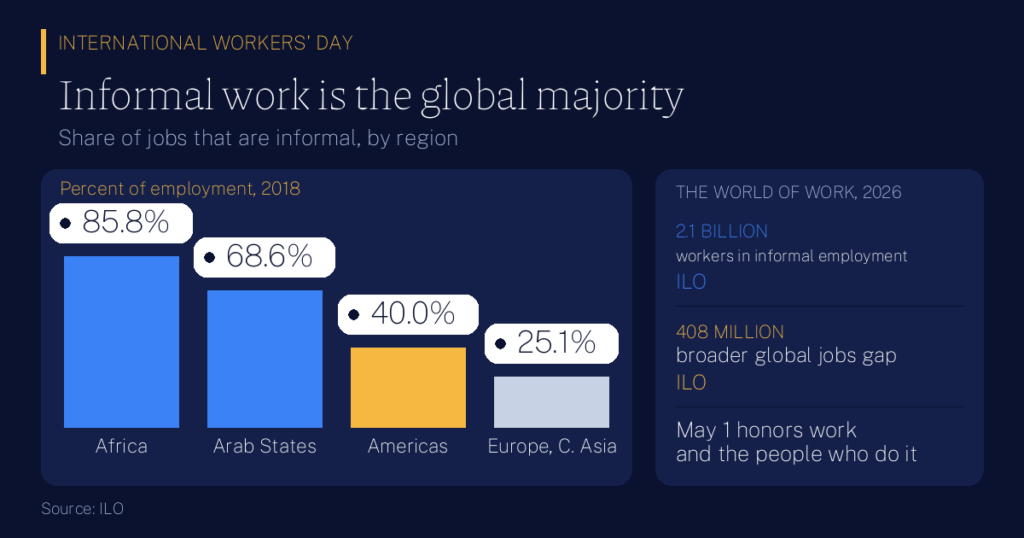
The ILO’s Employment and Social Trends 2026 report, published in January 2026, paints a picture of fragile stability. Global unemployment is projected to remain unchanged at 4.9 percent in 2026, which UN News translates as about 186 million people out of work. A low headline rate hides a lot, though. The ILO says the broader global jobs gap is projected to reach 408 million in 2026, and nearly 300 million workers continue to live in extreme working poverty, earning less than $3 a day.
- 4.9%global unemployment rate projected for 2026
- 408 millionbroader global jobs gap projected for 2026
- 2.1 billionworkers in informal employment
- 24.2%less likely for women than men to take part in the labor force
The informal majority
The largest group of workers on Earth has no formal contract, no employer-paid insurance and often no legal protection. The ILO counts 2.1 billion workers in informal employment, and ILOSTAT reported that more than 2 billion workers were informal in 2023, or 58.0 percent of the global workforce. These are street vendors, farm laborers, home-based producers, domestic workers and many others whose work is essential but unrecorded.
The share varies sharply by region. In the ILO’s 2018 estimates, informal employment made up 85.8 percent of jobs in Africa, 68.6 percent in the Arab States, 68.2 percent in Asia and the Pacific, 40.0 percent in the Americas and 25.1 percent in Europe and Central Asia.
Example 2: the cost of a sick day. Suppose a market vendor earns $20 on a normal day and has no paid leave. A bout of illness keeps the vendor home for 5 days, so $100 of income vanishes, and the rent still comes due. A salaried employee with paid sick leave would lose nothing. The figures are round and illustrative, but this gap in protection is what formalization and social security aim to close.
Who is left behind
Gender and age show where the shortfalls are deepest. The ILO reports that women account for only two-fifths of global employment and are 24.2 percent less likely than men to participate in the labor force. In management, women held 27.5 percent of positions in 2022, and ILOSTAT noted that at that pace it would take 176 years to reach gender parity in managerial roles.
Young people face their own barriers. Global youth unemployment stands at 12.4 percent, and 20 percent of youth, around 260 million people, are not in employment, education or training. In low-income countries the figure is higher: more than a quarter, 27.9 percent, are neither working nor studying.
Example 3: the participation gap. Take 100 men and 100 women of working age in a country where 70 of the men are in the labor force. If women are 24.2 percent less likely to take part, about 53 of the 100 women would be. That is roughly 17 fewer women in the labor force, a gap that reflects unpaid care work, social norms and limited access to jobs. The numbers are illustrative, but the percentage comes from the ILO.
Marking the day, and what progress needs
May 1 is observed in many forms, from large public marches to union meetings, speeches and community events. What unites them is a simple message: work should lift people up, not wear them down. Progress needs three things. Governments must extend legal and social protection to the informal majority. Employers must keep workplaces safe and wages fair. And workers need a real voice, through unions and other representation, in decisions that shape their lives. Trade ties many of those jobs to the wider world too, with around 465 million jobs linked to foreign demand, so what happens in one economy ripples across many.
Key Takeaways
- May 1 grew from a struggle over hours. It traces to the 1880s fight over the working day and to a 1889 decision to honor the 1886 Haymarket affair.
- It is a day of the labour movement. The ILO calls it the day of labour and solidarity, and it spread country by country.
- Jobs are not the same as decent jobs. Unemployment is projected at 4.9 percent in 2026, yet the jobs gap is 408 million.
- Working poverty persists. Nearly 300 million workers earn less than $3 a day.
- Informal work is the global majority. About 2.1 billion workers lack formal protection, and 58.0 percent of the workforce was informal in 2023.
- Women and young people are left behind. Women are 24.2 percent less likely to take part, and about 260 million youth are outside work and school.
- Rights are never finished. Fair hours, safety and a voice at work must be defended in each generation.
How solid is this? The 2026 figures are ILO projections and will be revised. The regional informality shares are 2018 estimates and the global share of 58.0 percent is for 2023, so the two should not be compared directly. The historical account follows the ILO and Britannica, and details of the Haymarket affair are deliberately not described here. The three worked examples use round, made-up numbers to show an idea. See also the International Days hub and the International Days Calendar.
More in Society
- International Labour Organization. Employment and Social Trends 2026 (January 2026).
- UN News. Global employment stable but decent jobs in short supply (January 14, 2026).
- International Labour Organization. May Day: The International Day of Labour, day of labour and solidarity (2020).
- International Labour Organization. More than 60 per cent of the world’s employed population are in the informal economy (2018).
- ILOSTAT. Charting progress on the global goals and decent work.
- Encyclopaedia Britannica. May Day.