Most of what we know about the world beyond our own street reached us through a reporter. A city council vote, a failing hospital, a contaminated well, a war zone: someone had to go, ask, check and write it down. World Press Freedom Day, observed every May 3, exists to defend that work. It reminds governments that a free press is a public good, it honors journalists who have paid a high price for their work, and it asks a simple question of every country: can people here report the truth and read it without fear?
From a declaration in Africa to a day for the world
The story starts with journalists themselves. In 1991, African journalists produced the Windhoek Declaration, a statement of principles on an independent and pluralistic press. UNESCO’s General Conference took up the idea at its 26th session that same year, and in 1993 the UN General Assembly proclaimed World Press Freedom Day. Each year since, UNESCO leads the observance, often with a host country and a global conference.
A prize grew alongside the day. In 1997 UNESCO created the Guillermo Cano World Press Freedom Prize, named for a Colombian journalist who was assassinated on December 17, 1986, outside the offices of his newspaper, El Espectador, in Bogota. UNESCO describes it as the only United Nations prize awarded to journalists. It goes each year to a person, organization or institution that has defended press freedom, especially in dangerous conditions.
What press freedom actually means
Press freedom is not a privilege of reporters. It is the public’s right to seek and receive information, and the practical conditions that make it possible. Those conditions include safety from violence, protection from arbitrary arrest, editorial independence, and legal access to public records. UNESCO notes that 139 UN member states have legal guarantees for public access to information, a tool that lets citizens and reporters see how decisions are made.
The idea also has a limit worth stating plainly. Press freedom does not mean that every claim in print is true. It means that errors, lies and abuses can be challenged in the open by other reporters, courts and readers, rather than by those in power deciding what may be said. It is closely tied to the other rights you may know from World Water Day and similar observances: a community can only demand safe water, schools or clinics if someone is free to report when they fail.
The numbers behind the day
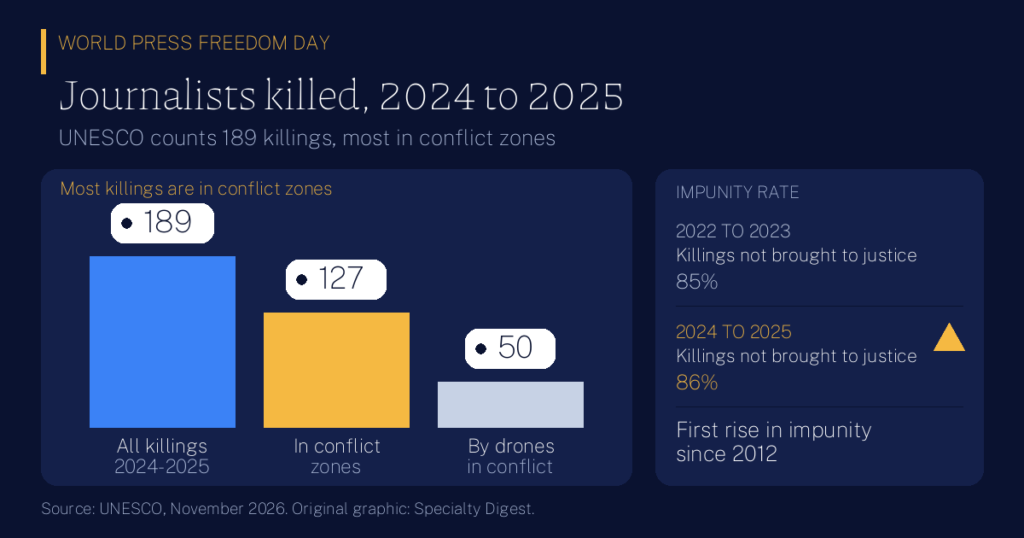
UNESCO tracks the killing of journalists and what happens afterward. In its November 2026 report, it recorded 189 journalists killed in 2024 and 2025, about 20 percent more than in the previous two years. Some 127 of them, just over two thirds, died in conflict zones. Drones accounted for 50 of those deaths, around 40 percent of the killings in conflict areas. Fourteen of the journalists killed were women, and 93 percent of those women died in conflicts.
The harder number is what follows. UNESCO found that 86 percent of journalist killings in 2024 and 2025 remained unresolved, compared with 85 percent in the previous two years. UNESCO says this is the first rise since it began measuring in 2012. Outside conflict zones the trend has been better: impunity in those countries fell from 94 percent in 2012 to 77 percent in the latest measurement.
Example 1: what 86 percent means. Picture a country where 100 reporters are killed. At an 86 percent impunity rate, only 14 of those cases would end with someone held to account. The numbers are round and illustrative, but they show why UNESCO treats unpunished killings as a threat to every other reporter, not only to the victims.
A quieter squeeze: fear, abuse and self-censorship
Not every attack is physical. UNESCO’s World Trends in Freedom of Expression and Media Development report, published in December 2025 for the years 2022 to 2025, found that freedom of expression has fallen by 10 percent worldwide since 2012, a level it describes as not seen in decades. Self-censorship among journalists rose by 63 percent over the same stretch, which UNESCO puts at about 5 percent a year.
Women reporters face a particular burden. UNESCO reports that 75 percent of women journalists experienced online violence in 2025, up from 73 percent in 2020. This kind of abuse can push people out of the profession, and it often spills into the offline world.
- 10%fall in freedom of expression worldwide since 2012
- 63%rise in journalist self-censorship, per UNESCO’s 2022 to 2025 report
- 75%of women journalists faced online violence in 2025
- 139UN member states with legal guarantees of access to information
Example 2: the story that never runs. Suppose a local reporter uncovers a pattern of unsafe building permits, but a colleague was threatened last year for a similar report. The reporter drops the story. No arrest or ban takes place, yet the public never learns what the inspectors missed. The case is invented, but it describes how self-censorship works: silence arrives without a single order.
Who is affected, and where the day points
The people most exposed are those who report close to danger: local and freelance journalists, photographers, and reporters covering conflict. The 2026 Guillermo Cano Prize, announced on April 30, 2026, went to the Sudanese Journalists Syndicate. UNESCO cited its stand against the deliberate targeting of journalists in Sudan’s ongoing conflict. The syndicate has documented 32 journalists’ deaths and 556 violations against media workers since 2023.
The 2026 theme, “Shaping a Future at Peace: Promoting Press Freedom for Human Rights, Development, and Security,” links reporting to the wider goal of stable societies. UNESCO and the Government of Zambia co-hosted the global conference in Lusaka. The idea is practical. Reliable information helps communities resolve disputes, hold institutions to account and make decisions in a crisis. Where it is silenced, rumor and fear fill the gap.
Example 3: a day of local news. Imagine a town of 50,000 people with one independent radio station. It broadcasts flood warnings, publishes school board results and questions a road contract. If the station closes, those three services vanish together. The town and the figures are illustrative, but they show how one outlet can carry many ordinary needs.
How the day is marked, and what you can do
On May 3, UNESCO and partners hold events, panels and the announcement of prize activities, and many newsrooms publish special reports. Individuals can take part in simple ways: pay for or share trustworthy journalism, check a claim before passing it on, learn how to spot manipulated content, and support groups that defend reporters. Journalists who face threats can contact press freedom organizations in their country or region for legal and safety help.
Key Takeaways
- The day grew from journalists’ own call. The 1991 Windhoek Declaration led to the UN General Assembly proclaiming May 3 in 1993.
- Press freedom is a public right. It protects everyone’s ability to seek and receive information, not only reporters.
- The danger is concentrated in conflict. UNESCO recorded 189 journalists killed in 2024 and 2025, and 127 died in conflict zones.
- Justice is rare. About 86 percent of these killings were unresolved, the first rise since 2012.
- Pressure is not only physical. Self-censorship and online abuse, especially against women journalists, quietly narrow what the public learns.
- Local reporting carries daily life. Warnings, budgets and contracts often reach people through small outlets.
- Everyone has a part. Supporting reliable news and checking what you share helps keep the information space open.
How solid is this? Killing and impunity counts come from UNESCO’s monitoring and are revised as cases are reviewed. Freedom of expression and self-censorship figures are UNESCO analyses of index data, and different periods give different percentages. The three worked examples use round, made-up numbers to show an idea. See also the International Days hub and the International Days Calendar.
More in Society
- UNESCO. World Press Freedom Day 2026.
- UNESCO. World Press Freedom Day 2026 spotlights the continued decline of press freedom globally.
- UNESCO. Six out of seven journalists’ killings are not brought to justice (November 2026).
- UNESCO. New report: UNESCO warns of serious decline in freedom of expression (World Trends report, December 2025).
- UNESCO. Guillermo Cano World Press Freedom Prize 2026 awarded to the Sudanese Journalists Syndicate (April 2026).
- UNESCO. UNESCO/Guillermo Cano World Press Freedom Prize.