When a spouse dies, grief is private, but what follows is often public and unequal. For millions of women, widowhood brings the loss of income, a home, land or standing in the community, sometimes on the same week as the funeral. International Widows’ Day, observed every year on June 23, asks the world to look at that second loss. It sits close to the concerns of International Women’s Day and Human Rights Day, because the problems widows face are, at root, questions of equal rights.
How the day began
The idea started outside the United Nations. The Loomba Foundation, a charity founded by Raj Loomba, says it launched June 23 as an International Widows’ Day in 2005. The campaign then found a government sponsor. According to the Foundation, Gabon brought a motion to the General Assembly, which adopted it in December 2010 as resolution A/RES/65/189. The UN’s own observance page records that the Assembly declared June 23, 2011 as the first International Widows’ Day, and the date has been marked every year since.
The purpose is stated plainly by the UN: to draw attention to widows of all ages and across regions and cultures, and to the injustice many of them face. It is a day for governments, agencies and communities to ask who is counted, who is protected and who is left out.
What widowhood changes
Widowhood is not one experience. A woman in her seventies who loses a husband after fifty years of marriage faces different risks from a woman in her twenties with young children, or from a girl who was married before adulthood. What many cases share, according to UN sources, is a sudden drop in security. Widows can lose access to credit and other economic resources, can be denied inheritance, and can have property taken after a partner’s death. The UN also notes that women everywhere are much less likely than men to have an old age pension, so a husband’s death can remove the household’s only dependable income.
The numbers behind the day
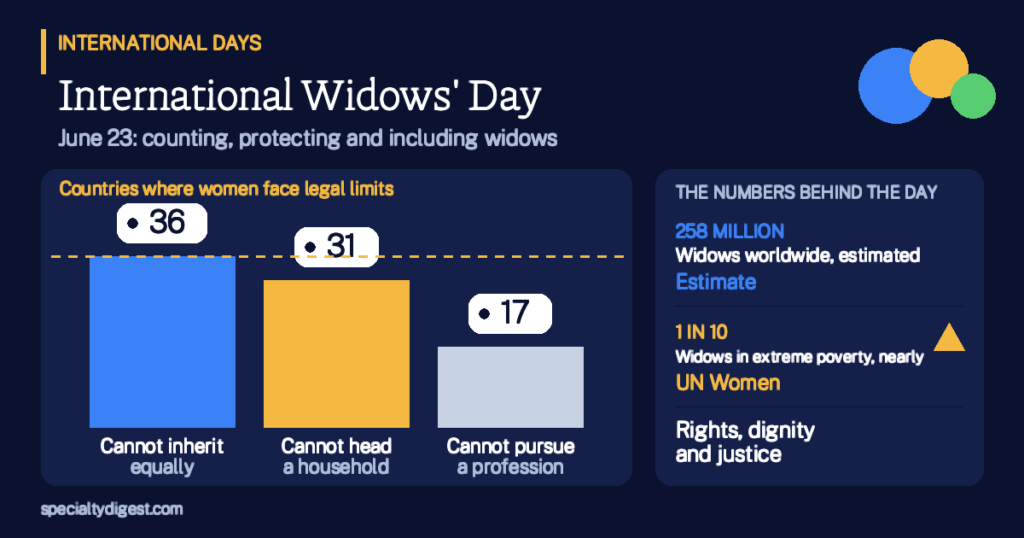
Counting widows is harder than it sounds, because many countries do not record marital status in a way that shows them. The figure the UN repeats comes from the Loomba Foundation: an estimated 258 million widows worldwide, with 584 million children in their households, according to its 2015 report. The UN notes that nearly one in ten of them lives in extreme poverty, a finding attributed to UN Women’s 2018 work. The Foundation’s own report puts the minimum number of widows in extreme poverty at 38 million, or 14.8 percent, so the two sources do not match exactly, which itself shows how uncertain the data are.
- 258 millionwidows worldwide, Loomba Foundation estimate cited by the UN
- 1 in 10nearly, lives in extreme poverty, per UN Women (2018)
- 1.36 millionat least are child widows, and the true number is likely higher
- 36countries where women cannot inherit equally with men
Example 1: the household budget. Suppose a family of four lives on $600 a month, and the husband earned $400 of it. After his death, $200 remains for four people, or $50 each instead of $150. The numbers are round and illustrative, but they show how one death can push a household from tight to desperate in a single month.
Law, land and the right to inherit
For many widows, the largest threat is not grief but paperwork. UN Women reports that in many countries widows do not have equal inheritance rights. Across the world, women cannot inherit equally with men in 36 countries, cannot be heads of households or families in 31 countries, and cannot have a job or pursue a profession in 17 states. Where such rules apply, a husband’s death can leave a widow without legal standing over the home and land she has worked.
Example 2: one name on the title. Imagine two neighbors, each with a small farm of the same size. One farm is registered only in the husband’s name, and after his death his relatives claim it. The other is registered jointly, and the widow keeps it without a dispute. The figures are made up, but the lesson is real: a name on a document can decide whether a family keeps its home.
Stigma, violence and health
Where the law fails, custom can make matters worse. UN News has reported that in many countries widows become victims of physical and mental violence, including sexual abuse, linked to inheritance, land and property disputes. The UN observance page also describes harmful mourning practices and notes that widows are particularly vulnerable in the context of HIV and AIDS. Widows often endure poor nutrition, inadequate shelter and limited access to health care, and their gynecological needs often go unaddressed. Women facing threats to their safety or property can contact local legal aid services, national women’s organizations or the nearest UN Women office.
Widows in conflict and crisis
War and disaster create widows in large numbers at once. The UN observance page cites parts of eastern Democratic Republic of the Congo where around half of women are widows, and says there are an estimated three million widows in Iraq and more than 70,000 in Kabul. These are figures from the UN page and are not dated there, so they describe a pattern more than a current count. The pattern is clear, though: after conflict, widows are often the heads of households who rebuild communities, while receiving the least recognition.
What progress looks like
UN Women’s message in 2018 called widows heroes and said the barriers to justice must be removed and social stigma tackled. Concretely, that means four things. Equal inheritance and property rights written into law and enforced. Pensions and social protection that do not depend on a husband. Protection from violence and harmful mourning rites. And better data, because UN Women points out that a widow who is not counted cannot be reached. It recommends that censuses record marital status with at least five categories, so that widows appear in the numbers.
Example 3: counting to reach. A district has 10,000 adult women, and its survey records only “married” and “single.” Say 800 are in fact widows. A cash support program designed from that survey misses all 800. A survey with a widowed category would find them. The numbers are illustrative, but this is how invisibility becomes policy.
Key Takeaways
- The day has a clear origin. The UN General Assembly adopted resolution A/RES/65/189 in December 2010, and the first observance was June 23, 2011.
- Widowhood is an economic shock. Loss of income, credit and pensions can strike at the same moment as grief.
- The numbers are large and uncertain. An estimated 258 million widows exist, and counting them is hard.
- Poverty is common. Nearly one in ten widows lives in extreme poverty, according to UN Women.
- Law matters. Women cannot inherit equally in 36 countries, and unequal rules can leave a widow without a home.
- Child widows are real. At least 1.36 million girls are counted as widows, and the true number is likely higher.
- What helps is practical. Equal property rights, pensions, protection from violence and better data bring widows into view.
How solid is this? The global count of 258 million widows is an estimate by the Loomba Foundation, a charity, that the UN repeats, and it is not a census figure. The extreme poverty share differs between the UN and the Foundation. I could not confirm an official theme for the 2026 observance from a UN source, so none is given here. The three worked examples use round, made-up numbers to show an idea. See also the International Days hub and the International Days Calendar.
More in Society