Almost everything you own has spent time on a ship. The clothes you wear, the fuel in the delivery truck and much of the food on your table crossed water first, and a relatively small workforce made that possible far from home, family and land. Day of the Seafarer, observed every June 25, exists to make those workers visible. It is led by the International Maritime Organization (IMO), the United Nations agency for shipping, and it asks a plain question: what do we owe the people who carry the world’s cargo? It is a natural companion to World Oceans Day, because both begin with the sea.
A day born at a treaty conference
The day has an unusually practical origin. In 2010 the IMO held a diplomatic conference in Manila, in the Philippines, to adopt amendments to the STCW Convention, the international treaty that sets training and certification standards for seafarers. The conference also adopted a resolution, numbered Resolution 19, that resolved to nominate June 25 of each year as the Day of the Seafarer. June 25, 2010 was the date on which the STCW amendments were adopted, and the IMO had named 2010 the Year of the Seafarer.
The resolution did something modest but lasting. It encouraged governments, shipping organizations and companies to promote the day appropriately, and it invited the IMO Secretary-General to bring the resolution to the IMO Assembly for endorsement. It also recognized the considerable risks seafarers shoulder in their daily tasks. The day is therefore not a celebration of ships. It is a recognition of people, and of risk.
Who goes to sea, and what they carry
UNCTAD’s Review of Maritime Transport 2025 describes maritime transport as 1.9 million seafarers, most of whom come from developing countries. The ILO’s 2026 guide to the Maritime Labour Convention uses the same 1.9 million, while the IMO Secretary-General’s 2026 statement for the day refers to 1.8 million. Sources round differently, so it is safest to think of roughly 1.8 to 1.9 million people.
- 1.9 millionseafarers worldwide, per UNCTAD (2025)
- 12,720 milliontons of goods moved by sea in 2024
- 112countries had ratified the Maritime Labour Convention by May 31, 2026
- 1.2%of seafarers were women, per a 2021 industry report cited by the IMO
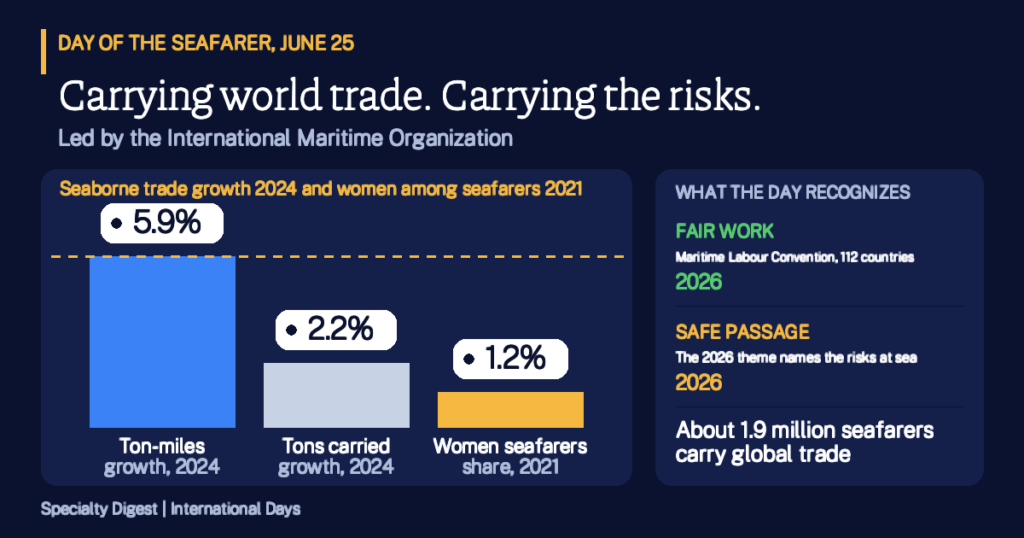
What they carry is vast. According to UNCTAD, maritime trade volumes reached 12,720 million tons in 2024, up 2.2 percent on the year before. Measured in ton-miles, which counts how far goods travel as well as how much, seaborne trade reached 66,781 billion ton-miles in 2024, up 5.9 percent. In his 2026 message for the day, the UN Secretary-General said that almost 90 percent of all goods and commodities reach us by sea.
Example 1: the crew and the cargo. Suppose a container ship with a crew of 20 carries 20,000 containers on one voyage. That is 1,000 containers for every crew member, each one full of goods bound for shops, factories and homes. The numbers are round and illustrative, but they show how a small number of people can stand behind a very large share of everyday life.
A workplace with its own rulebook
Working on a ship means living at work, so seafarers have a labor code of their own. The ILO adopted the Maritime Labour Convention (MLC) on February 23, 2006, and it entered into force on August 20, 2013. The IMO calls it the fourth pillar of the international regulatory regime for quality shipping, alongside the conventions on safety, security and training. As of May 31, 2026, the ILO reports that 112 countries, representing more than 96 percent of world gross tonnage, had ratified it.
What does the convention guarantee? It sets out seafarers’ rights to decent conditions of work. Pay must arrive at intervals of no more than one month. The convention itself does not set a mandatory minimum wage, but the ILO’s Joint Maritime Commission sets a minimum monthly basic pay figure for able seafarers, listed as US$690 as of January 1, 2026. Repatriation, the trip home when a contract ends, is a right at no cost to the seafarer. Wages must keep being paid during captivity by pirates, under 2018 amendments in force since December 26, 2020.
Hours are limited too, and a country chooses one of two methods. It may cap work at no more than 14 hours in any 24 hours and 72 hours in any seven days, or it may guarantee rest of at least 10 hours in any 24 hours and 77 hours in any seven days.
Example 2: why both limits matter. Suppose a country uses the work ceiling and a crew member logs 12 hours a day for seven days. That is 84 hours, above the 72-hour weekly limit even though no single day passes the 14-hour daily cap. The numbers are round and illustrative, but they show why a daily and a weekly rule work together.
When the ship cannot come home
The rules are tested when the world is disrupted. During the COVID-19 pandemic, travel limits made it hard to change crews. In December 2020 the ILO Governing Body called for urgent action, noting that hundreds of thousands of seafarers continued to work well beyond usual periods of service at sea, with some on board for 17 months and longer.
Example 3: a stretched contract. Imagine a seafarer signed on for six months. A stay of 17 months is nearly three times as long as the plan. The contract length is made up for illustration, but it conveys how an unusual stretch at sea can pile up when ports and borders close.
Disruption today is of a different kind. For 2026 the IMO chose the theme Carrying world trade. Carrying the risks. Its statement points to heightened geopolitical tensions, including the evolving situations in the Strait of Hormuz, the Black Sea and the Sea of Azov, and the Red Sea region, and says seafarers must never become collateral victims of geopolitical conflicts. The UN Secretary-General said that tens of thousands of seafarers were stranded in the Strait of Hormuz, and the IMO says it is working with member states to evacuate stranded seafarers and ships. UNCTAD notes that the strait accounts for 11 percent of maritime trade and over one third of seaborne oil exports (2025 review). Seafarers in distress, and families worried about someone at sea, can turn first to the shipping company, a union or a port welfare organization, and to local emergency services in an emergency.
Who is still missing from the deck
Shipping remains one of the most male-dominated workforces. The IMO cites the BIMCO/ICS 2021 Seafarer Workforce Report, which found that women represented only 1.2 percent of the global seafarer workforce, an estimated 24,059 women and a 45.8 percent increase from the 2015 report. The IMO marks a separate International Day for Women in Maritime on May 18.
Safety at work is part of inclusion. The IMO reports that STCW amendments on violence and harassment training entered into force on January 1, 2026, and that it began a comprehensive review of the STCW Convention in 2024.
How the day is marked
Each year the IMO runs a campaign around a theme and shares it under the hashtag #DayoftheSeafarer, and the UN Secretary-General issues a message. Governments, shipping companies and unions are encouraged by the Manila resolution to promote the day. Individuals can join in simply: notice where the goods around you came from, follow the campaign, and support port welfare groups that look after crews who are far from home.
Key Takeaways
- The day began as a resolution. The 2010 Manila conference named June 25 the Day of the Seafarer.
- The workforce is small and the load is large. Roughly 1.8 to 1.9 million seafarers moved 12,720 million tons in 2024.
- Seafarers have their own labor code. The Maritime Labour Convention covers pay, hours, rest and repatriation.
- Rules need broad adoption. 112 countries, covering over 96 percent of gross tonnage, had ratified the convention by May 31, 2026.
- Disruption hits crews first. In 2020 some seafarers stayed on board for 17 months and longer.
- The 2026 theme names the risks. The IMO says seafarers must never become collateral victims of geopolitical conflicts.
- Representation is still thin. Women were 1.2 percent of seafarers in 2021, and safer workplaces are part of the answer.
How solid is this? Seafarer counts differ by source (1.8 million from the IMO in 2026, 1.9 million from UNCTAD in 2025 and the ILO in 2026), and the women’s share is a modeled 2021 estimate. Trade figures come from UNCTAD’s 2025 review citing industry data. The three worked examples use round, made-up numbers. See the International Days hub and the International Days Calendar.
More in Society
- Day of the Seafarer 2026: Carrying world trade. Carrying the risks., IMO
- Resolution 19, Day of the Seafarer (STCW/CONF.2/DC/4), IMO Manila Conference, 2010
- Message of the UN Secretary-General for the Day of the Seafarer, June 25, 2026
- Review of Maritime Transport 2025, UNCTAD
- Maritime Labour Convention, 2006: Frequently Asked Questions, sixth edition, ILO, 2026
- ILO Governing Body calls for urgent action on seafarer COVID-19 crisis, ILO, 2020
- Women in Maritime and Supporting Seafarers, IMO