Many people think of yoga as a studio hobby: a mat, a quiet room, a few stretches. The United Nations sees something larger. Each year on June 21, the world marks the International Day of Yoga to recognize a practice that began in India more than two millennia ago and is now followed by hundreds of millions of people. Behind the calm image sits a serious public health question. How do we help ordinary people move more, hurt less and stay well as they age? The day is a good moment to look at what yoga is, what the evidence says, and where it fits among the world’s efforts to get people moving. Another day with a health focus, World Health Day, asks a similar question from a wider angle.
How a practice became a United Nations day
The idea came from India, which proposed the observance at the UN General Assembly. In 2014 the Assembly declared June 21 the International Day of Yoga, with the support of 175 Member States, according to the World Health Organization’s South-East Asia office. The first observance followed in 2015, and by 2026 the WHO was describing the year’s event as the 12th International Day of Yoga.
The date has its own logic. June 21 falls near the summer solstice in the Northern Hemisphere, the longest day of the year, and that is the date the Assembly chose. The official UN observance page presents the day as a way to raise awareness of the many benefits of the practice. The point is not to promote one school or one teacher. It is to put a low-cost form of physical activity in front of as many people as possible.
What yoga is, and what it is not
Yoga is a body of practices that combine physical postures, controlled breathing and focused attention. The WHO notes that it began in India more than two thousand years ago. In everyday use, most people meet it as a mix of gentle movement and breathing exercises, sometimes ending in a few minutes of rest or meditation.
It is helpful to be clear about what it is not. Yoga is not a medical treatment that replaces care from a doctor, and it is not one single method. Styles range from slow and restorative to vigorous. The WHO estimates that about 300 million people around the world practice yoga, a figure it describes as almost double the number of people with gym memberships. That is an estimate, and counts vary by definition, but it shows how far the practice has spread.
Example 1: the desk worker. Imagine an office worker who sits for eight hours and adds a 20 minute gentle yoga routine three mornings a week. That is one hour of extra movement a week. The numbers are round and illustrative, but they show how a short, repeatable habit can build a base of activity without equipment or a gym fee.
Why the world needs people to move
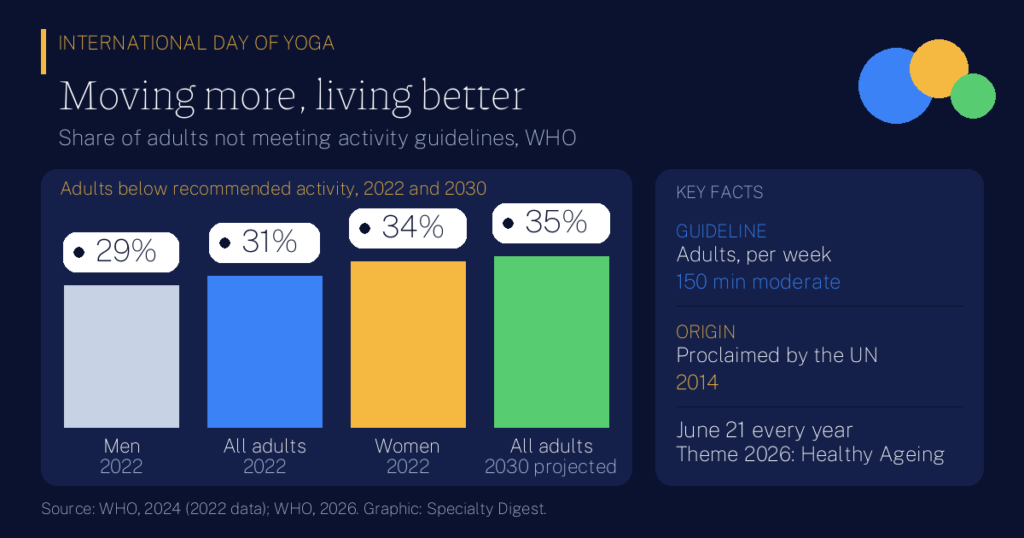
The reason a health agency cares about yoga becomes clear when you look at how much of the world is inactive. The WHO reports that 31 percent of adults, about 1.8 billion people, did not meet recommended levels of physical activity in 2022. That is up by about five percentage points since 2010, and the WHO projects inactivity could reach 35 percent by 2030 if trends do not change. Women are less active than men, at 34 percent compared with 29 percent. Among adolescents, 86 percent do not meet the recommended levels.
The cost is real. The WHO says people who are insufficiently active face a 20 to 30 percent higher risk of death, and it projects that inactivity will cost public health care systems nearly US$300 billion between 2020 and 2030. For adults, the WHO recommends at least 150 minutes of moderate activity a week, or 75 minutes of vigorous activity, or an equivalent mix. Gentle yoga can count toward the lower intensity end of that goal, and that is one reason the practice gets public health attention.
What the evidence says
The science is encouraging but uneven, and it is best read with care. For back pain, the U.S. National Center for Complementary and Integrative Health reports that a 2018 review of 8 trials with 1,466 participants found yoga improved pain and function in the short and intermediate term, with effects similar to exercise. The WHO adds that a randomized trial in a low-income population with chronic low back pain found a 12 week yoga program as effective as physical therapy, with benefits that lasted a year. The U.S. agency also says yoga may help neck pain but has not been shown to help some other painful conditions.
For mood and well-being, the WHO points to a 2026 trial in cancer survivors in which a structured, gentle yoga program improved mood and reduced anxiety and fatigue. It also describes growing evidence that yoga can support brain health, which could matter for slowing cognitive decline. These are promising findings rather than final answers, and the WHO frames them as support for broader research.
Example 2: the person with a sore back. Suppose a 55 year old with chronic low back pain joins a supervised 12 week gentle yoga class, two sessions a week, about 24 sessions in all. If the program works as the trials suggest, the benefit is comparable to a physical therapy course and can last. The numbers are round and illustrative, and anyone with chronic pain should talk to a clinician first.
Healthy ageing and who benefits most
The 2026 theme, Yoga for Healthy Ageing, points to older adults. The WHO’s South-East Asia office says yoga addresses core pillars of healthy ageing by improving mobility, protecting cognitive health and reducing isolation through community. The last point is easy to miss: a weekly class is also a reason to leave the house and meet people.
Participation among older Americans has grown. The U.S. agency reports that 6.7 percent of adults aged 65 and over practiced yoga in 2017, compared with 3.3 percent in 2012. The 2025 theme, One Earth, One Health, linked personal health with the health of the planet, a reminder that wellness is not only individual.
Practicing safely, and how the day is marked
Yoga is generally considered safe for healthy people when practiced properly, according to the U.S. agency, and the most common injuries are sprains and strains. Beginners should start with gentle classes, move slowly, skip any posture that causes pain and tell the instructor about health conditions. People with a medical condition, or who are pregnant, should ask their health provider before starting.
On the day itself, governments, schools, clinics and community groups hold free sessions, and the WHO has joined mass events, including a 90 minute practice linked to Geneva and New York in 2026. You can mark it quietly: try a free beginner class, invite a relative or neighbor, or simply stretch for ten minutes.
Example 3: a community class. Picture a town that offers a free weekly session for 40 residents for 12 months. That is 480 resident visits a month if everyone attends every week, and perhaps half that if attendance is typical. The numbers are round and illustrative, but they show how a small local effort can add up.
Key Takeaways
- The day has a clear origin. The UN General Assembly proclaimed June 21 in 2014, and the first observance followed in 2015.
- Yoga is old and widespread. It began in India more than two millennia ago, and the WHO estimates about 300 million people practice it.
- The world is not moving enough. About 31 percent of adults, roughly 1.8 billion people, fell short of activity guidelines in 2022.
- Evidence is strongest for back pain. Trials show benefits similar to exercise or physical therapy, while evidence for other conditions is still growing.
- It suits healthy ageing. Mobility, brain health and social connection are the reasons for the 2026 theme.
- Safety matters. Start gently, listen to your body and check with a clinician if you have a health condition.
- Small habits count. Even short, regular sessions help you move toward the weekly 150 minute target.
How solid is this? Participation figures such as the 300 million estimate are approximations, and activity levels come from modeled WHO estimates for 2022. The back pain evidence summary dates from a 2018 review reported in 2020, and the 2026 findings come from WHO summaries of recent trials. The three worked examples use round, made-up numbers. This article is general information, not medical advice. See also the International Days hub and the International Days Calendar.
More in Health
- United Nations, International Day of Yoga observance page
- UN News, Celebrating first International Day (June 2015)
- WHO South-East Asia, International Day of Yoga 2026 (June 2026)
- WHO, WHO celebrates the power of yoga for healthy ageing (June 2026)
- WHO, Yoga for healthy ageing: global practice and clinical evidence (2026)
- WHO, Nearly 1.8 billion adults at risk of disease from not doing enough physical activity (2024)
- NCCIH, Yoga for Health: What the Science Says (2020)