A diploma opens a door only if there is a job behind it, and a job is only reachable if a young person has the right skills to do it. That simple chain explains why the world sets aside July 15 each year for World Youth Skills Day. The day asks a practical question: are young people being prepared for the work, and the world, they are about to inherit? With roughly 1.2 billion people aged 15 to 24 on Earth, according to the United Nations, the answer shapes the economic future of almost every country. It is also a close cousin of World Population Day, since the size and age of a population decide how much opportunity must be created.
From a 2014 resolution to a yearly day
In 2014, the United Nations General Assembly declared July 15 as World Youth Skills Day, in resolution A/RES/69/145. The aim, as UNESCO describes it, is to celebrate the strategic importance of equipping young people with skills for employment, decent work and entrepreneurship. In 2025 the day marked its 10th anniversary, which UNESCO used to call for empowering young people through digital and artificial intelligence skills.
No single agency owns the day. UNESCO’s International Centre for Technical and Vocational Education and Training, known as UNESCO-UNEVOC, runs a yearly event. The 2026 edition was a webinar hosted from Bonn, Germany, and a digital campaign is run by the UN Youth Office and Generation Unlimited at UNICEF. The International Labour Organization supplies much of the labor market evidence that gives the day its urgency.
What the word “skills” really covers
When people hear “skills,” they often picture a trade such as welding or plumbing. That is part of it, and it is the core of technical and vocational education and training, usually shortened to TVET, which the UN says can equip young people with the skills needed to reach the world of work. But the idea is wider. UNESCO’s 2026 framing speaks of technical, digital, AI, green, social-emotional and civic skills. In plain terms, a young person needs to know how to do a task, how to use modern tools, how to work with others and how to take part in community life.
The 2026 theme, “Skills for a shared future,” signals that last point. Skills are not only a private advantage. When a young person can earn, repair, build, teach or lead, the benefit spreads to a family, a town and an economy.
Example 1: two paths from the same school. Imagine two classmates who finish school together. One joins a six-month training course in solar panel installation and is hired by a local firm. The other has no training and takes casual day work. The numbers here are round and illustrative, but the pattern is the one the ILO describes: skills tend to turn a general wish for work into a specific, hireable ability.
The numbers behind the day
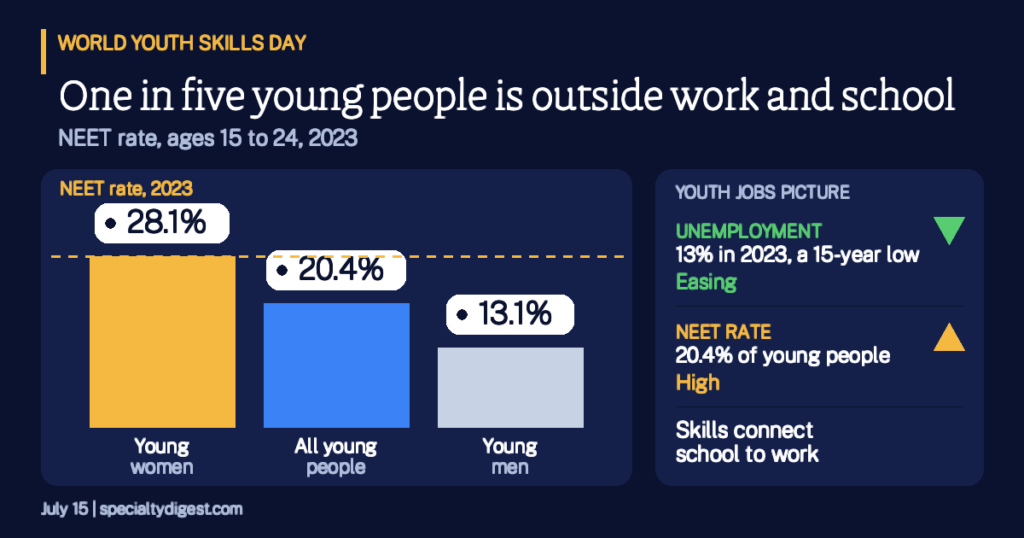
The ILO’s Global Employment Trends for Youth 2024 gives a mixed picture. The global youth unemployment rate was 13 percent in 2023, equal to 64.9 million young people, which the ILO called a 15-year low. It was below the pre-pandemic level of 13.8 percent in 2019, and the ILO expected it to fall slightly further to 12.8 percent in 2024 and 2025.
A falling unemployment rate can hide a larger problem. Unemployment counts only people who are looking for work. Many young people have stopped looking, or never started, because they are caring for family, discouraged, or unable to afford training. The ILO tracks them with a separate measure, called NEET, for young people not in employment, education or training. Globally, one in five young people, or 20.4 percent, were NEET in 2023.
Who is left behind
The NEET figure splits sharply by sex. In 2023 the rate for young women was 28.1 percent, against 13.1 percent for young men, and two in three of all NEET young people were female. The ILO links this to unpaid care work and to barriers that keep young women out of paid jobs and training.
Geography matters as much as gender. The ILO reports that three in four young people in sub-Saharan Africa lack secure work, and that one in three economically active young people in the Arab States and North Africa are unemployed. Across the world, more than half of young workers are in informal employment, which usually means no contract, no social protection and little chance to build skills on the job.
Income level tells the same story from another angle. The ILO notes that in high-income countries four in five young adult workers aged 25 to 29 hold a regular paid job, compared with one in five in low-income countries.
Example 2: the cost of an idle year. Suppose a district has 1,000 young people and 200 of them are NEET, matching the global rate. If a training program brings 50 into paid work, the district gains 50 earners, not only 50 trainees. The numbers are round and illustrative, but they show why the NEET rate is watched closely.
Skills for a changing economy
Work itself is changing. The UN’s observance page lists a set of facts for the day, including that 22 percent of jobs will transform by 2030 because of technological disruption and that investment in green and blue sectors could create 8.4 million youth jobs by 2030. Those pages do not name a source for every item, so treat them as the UN’s framing of the challenge rather than precise forecasts. A UNESCO official said at the 2025 anniversary that more than two-thirds of secondary and tertiary students already use AI tools to support their studies, and that by 2030 nearly 40 percent of work-related skills will require reskilling or upskilling. These are statements made at an event, not audited statistics, but they point in one direction: learning cannot stop at graduation.
That is why UNESCO launched a Skills for the Future platform and a Global Skills Academy for digital training, and why the 2025 anniversary urged young people to be treated as agents of change, not only as beneficiaries.
Example 3: the reskilling loop. Picture a 22-year-old who learns bookkeeping, then adds spreadsheet and basic data skills a year later, then a short course in an AI tool. Each step takes a few weeks. Together they turn one job into a path. The steps are illustrative, but this stacking of short courses is the idea behind lifelong skills.
How the day is marked, and what progress needs
Each July 15, schools, training centers, governments, employers and youth groups hold events, webinars and exhibitions. In 2026 the UNESCO-UNEVOC webinar ran under the theme “Skills for a shared future,” on July 15. What the day asks for is concrete: training that matches real jobs, access for young women and for rural and low-income youth, partnerships with employers, and recognition for skills learned outside a classroom. Progress is measured in the same indicators this article cites, such as the unemployment rate and the NEET rate.
Key Takeaways
- Skills connect school to work. World Youth Skills Day, set by the General Assembly in 2014, focuses on employment, decent work and entrepreneurship.
- “Skills” means more than a trade. It covers technical, digital, AI, green, social-emotional and civic skills.
- Unemployment is easing. The global youth rate was 13 percent in 2023, down from 13.8 percent in 2019.
- One in five is outside work and school. The NEET rate was 20.4 percent in 2023, so unemployment alone understates the gap.
- Young women face the steepest barrier. Their NEET rate was 28.1 percent, more than double the 13.1 percent for young men.
- Where you live shapes your options. Four in five young adult workers in high-income countries have a regular paid job, against one in five in low-income countries.
- Learning is lifelong. Short, repeated upskilling will matter more as work changes.
How solid is this? Labor figures come from the ILO’s Global Employment Trends for Youth 2024, which uses modeled estimates for 2023 and a forecast for 2024, and newer editions revise them. The population figure and the jobs-by-2030 items come from UN web pages that do not always name their sources, so they are presented as the UN’s own statements. The three worked examples use round, made-up numbers to show an idea. See also World Population Day, the International Days hub and the International Days Calendar.
More in Education
- United Nations, World Youth Skills Day
- ILO, Number of youth NEET a cause for concern (2024)
- ILO, Global Employment Trends for Youth 2024: In figures
- UNESCO, World Youth Skills Day 2026: Skills for a shared future
- UNESCO, Agents of Change: 10th anniversary of World Youth Skills Day (2025)
- United Nations, Youth