Most people picture dust as a household nuisance. At planetary scale it is a hazard that ignores borders. Every year, wind lifts roughly two billion tonnes of dust and sand into the atmosphere, and the clouds can travel thousands of kilometers before they settle on farms, cities and oceans. The International Day of Combating Sand and Dust Storms, observed every July 12, asks the world to treat these storms as a shared problem of health, land and money. It pairs naturally with World Day to Combat Desertification and Drought, because degraded land is one of the places where dust begins.
A young day with a long agenda
The day is new. The UN General Assembly declared July 12 the International Day of Combating Sand and Dust Storms in resolution 77/294, and WHO notes the observance started in 2023. The aim, as the UN describes it, is to raise awareness of how these storms affect health, sustainability and the wider environment, and to encourage joined-up action. Behind the day sits the UN Coalition on Combating Sand and Dust Storms, launched by the parties to the UN Convention to Combat Desertification (UNCCD). It has more than 20 members, including UNEP, WHO, WMO, FAO and the World Bank, and WHO leads its health working group.
The agenda then grew. Resolution 78/314 proclaimed 2025 to 2034 the UN Decade on Combating Sand and Dust Storms. Assembly President Philémon Yang said it should prove a turning point and urged Member States to move from awareness to action.
What a sand and dust storm actually is
A sand and dust storm begins when strong wind lifts loose particles from dry, bare ground. Coarse sand grains usually fall back within a short distance. Fine dust stays aloft far longer, and WHO notes it can travel more than 1,000 kilometers. That is why a storm in one country can darken the sky of another. WHO names two examples: Saharan dust reaching the Caribbean, and dust from northwest Asia reaching Korea and Japan.
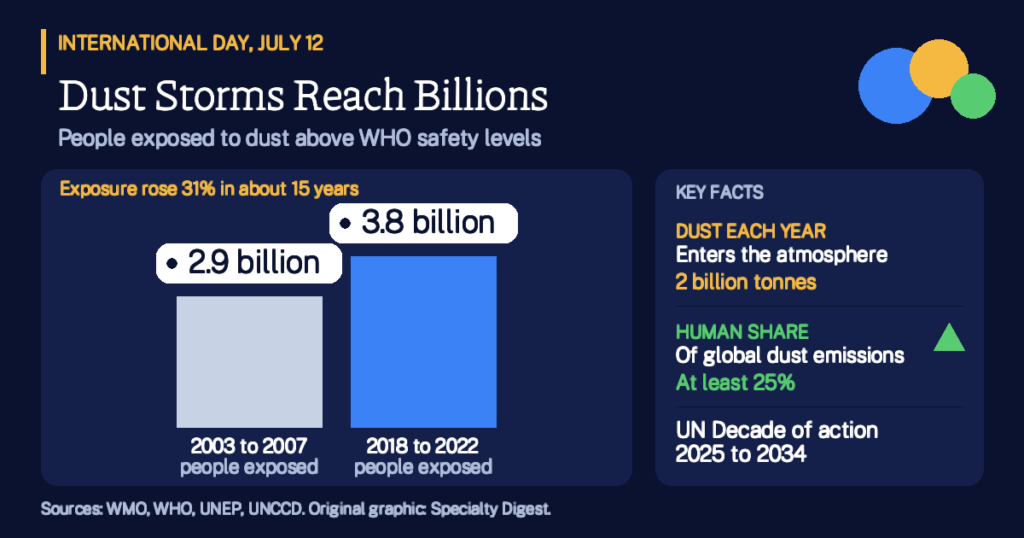
Nature supplies most of the dust, but not all of it. The UN and UNCCD say at least 25 percent of global dust emissions come from human activity. WHO lists the drivers as deforestation, land degradation, unsustainable land management, climate change and water mismanagement. A drained lake bed, an overgrazed pasture or a field left bare in a dry season can each become a source. That is the practical point of the day: the human share is the part that policy can change.
Example 1: a field left bare. Suppose a farm of 100 hectares normally yields 4 tonnes per hectare, or 400 tonnes in total. If storms and wind erosion trim yields by 10 percent, the farm loses 40 tonnes. FAO, as cited by UNCCD, says storms can cut yields by up to 25 percent in hard-hit regions, which on the same farm would mean 100 tonnes. The numbers are round and illustrative, but the arithmetic shows how quickly small percentages add up.
The numbers behind the day
Start with scale. About two billion tonnes of dust enter the atmosphere each year, according to UNEP. WMO puts the figure at around 2,000 million tons and compares it with the weight of 307 Great Pyramids of Giza. WMO’s 2025 Airborne Dust Bulletin adds that more than 80 percent of the global dust budget comes from the deserts of North Africa and the Middle East.
- 2 billiontonnes of dust enter the air each year (UNEP)
- 330 millionpeople affected across 150 countries (WMO, 2025)
- At least 25%of global dust emissions come from human activity
- $154 billionestimated US cost of dust and wind erosion in 2017
The storms reach many people. WMO and UN News report about 330 million people affected in 150 countries. A WMO and WHO indicator goes further: 3.8 billion people, nearly half the world’s population, were exposed to dust above WHO’s safety threshold in 2018 to 2022. That is up 31 percent from 2.9 billion, or 44.5 percent of people, in 2003 to 2007.
Single places can be extreme. In WMO’s 2024 data, Chad, near the Bodélé Depression, had mean surface dust of about 800 to 1,100 micrograms per cubic meter. East Asia saw 14 storms that year, and Beijing recorded PM10 above 1,000 micrograms per cubic meter. To track such events, WMO runs a Sand and Dust Storm Warning Advisory and Assessment System with regional centers in Jeddah, Barcelona, Beijing and Bridgetown.
What dust does to the body
WHO describes sand and dust storms as a growing public health concern, mainly for respiratory and cardiovascular disease, because they raise the concentration of airborne particulate matter. The UN observance page adds eye and skin irritation and meningitis to the list. WHO is candid about the limits: evidence on long-term effects is still limited, and measuring exposure across borders is hard. UNCCD counts 334 million people affected, including 14 percent of the world’s children.
Example 2: a dusty month. Imagine a city clinic that normally sees 20 breathing complaints a day. During 10 days of heavy dust it sees 30. Over those days that is 100 extra visits, a load of about 5 more working days for the clinic. The figures are round and made up, but they show why early warnings matter: a few days of notice lets people stay indoors and lets clinics prepare.
Farms, money and borders
The cost is not only medical. WMO, citing a study in Nature, reports that dust and wind erosion cost the United States an estimated $154 billion in 2017, more than four times the 1995 estimate. UNCCD, citing the World Bank, says global welfare losses from dust rose from $2.2 trillion in 1990 to about $3.6 trillion in 2013. UN News reports that in 2024 economic losses in the Middle East and North Africa reached 2.5 percent of regional GDP.
Example 3: a national budget. Take an economy of $200 billion. A loss of 2.5 percent would equal $5 billion in a year, which is money that could have paid for schools or clinics. The economy is hypothetical and the numbers are rounded, but the share follows the regional figure UN News reports.
Because dust crosses borders, no single country can fix it alone. A source in one place becomes a health and farming problem in another, which is why the UN treats the issue through cooperation among agencies and governments.
What progress needs, and how the day is marked
The day is marked through events and messages from the UN system and its partners, and the Decade now gives the work a ten-year frame. Progress rests on three things the evidence points to. The first is early warning, which is the job of networks like WMO’s regional centers. The second is land care, since restoring vegetation and managing soil and water better shrinks the human share of dust. The third is health protection, from clean-air guidance to clinics that are ready when a storm arrives. Each needs steady funding, shared data and attention that does not fade when the sky clears.
Key Takeaways
- Dust is a global hazard. About two billion tonnes enter the air each year, and storms affect people in 150 countries.
- The day is recent. Resolution 77/294 created it, with the first observance in 2023.
- People share the blame. At least 25 percent of dust emissions come from human activity, so choices on land and water matter.
- Exposure is growing. 3.8 billion people were exposed above WHO’s threshold in 2018 to 2022, up 31 percent from 2003 to 2007.
- Health and money both suffer. WHO links the storms to respiratory and cardiovascular disease, and losses run into the billions.
- A Decade is under way. From 2025 to 2034 the UN asks for a move from awareness to action, so ask how your region warns people and restores land.
How solid is this? Dust totals and exposure figures are modeled estimates from WMO, WHO, UNEP and UNCCD and are revised as data improve, and the UN observance page itself gives two different tonnage figures, so this article uses the billion-tonne figure that UNEP, WMO and UN News agree on. WHO says evidence on long-term health effects is limited. The three worked examples use round, made-up numbers to show an idea. See also World Day to Combat Desertification and Drought, the International Days hub and the International Days Calendar.
More in Nature
- United Nations. International Day of Combating Sand and Dust Storms.
- World Health Organization. Sand and dust storms fact sheet (23 April 2025).
- UNCCD. Sand and dust storms overview.
- UN News. Overlooked and underestimated: Sand and dust storms wreak havoc across borders (July 2025).
- WMO. WMO highlights hotspots, health hazards and economic cost of sand and dust storms (10 July 2025).
- WMO. Airborne Dust Bulletin No. 9 (July 2025).