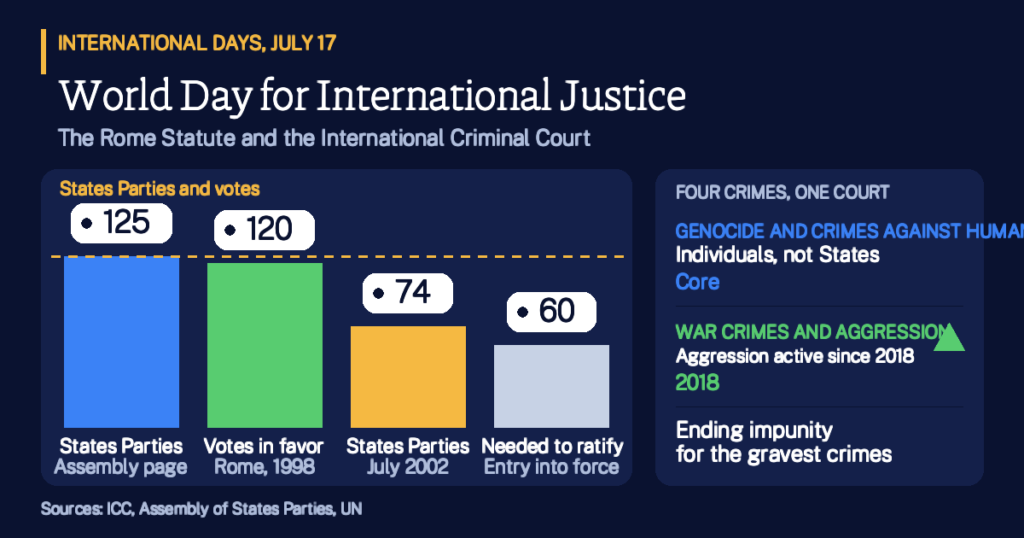
On July 17, 1998, delegates in Rome finished five weeks of negotiation with a vote that changed how the world answers its gravest crimes. The treaty they adopted, the Rome Statute, created the International Criminal Court, a permanent tribunal that can try individuals for genocide, crimes against humanity, war crimes and aggression. Each year the Court and its supporters mark that date as the Day of International Criminal Justice, also known as World Day for International Justice. It is an awareness day, not a United Nations observance. Its purpose, in the Court’s words, is to unite those who support ending impunity for the most serious crimes of international concern through the due process of law, promoting victims’ rights and contributing to the prevention of such crimes. For a related UN remembrance, see the International Day of Commemoration and Dignity of the Victims of the Crime of Genocide.
Five weeks in Rome
The Rome conference ran from June 15 to July 17, 1998. On its final day the package was agreed in its entirety by a vote of 120 in favor, 7 against and 21 abstentions, according to a United Nations question-and-answer paper issued after the conference. The vote was not recorded, so the names of the seven States that voted against are not on the record. The same paper names the next hurdle: sixty States had to ratify the Statute before the Court could come into existence.
That took just under four years. The Statute entered into force on July 1, 2002, and the UN Secretary-General noted that day that 74 States were already parties. An advance team of eight experts began work in The Hague the same day, while judges and a prosecutor were still to be elected and the first budget still to be adopted. The Court can only judge crimes committed on or after July 1, 2002.
What the Court can try
The Statute gives the Court jurisdiction over four main crimes: genocide, crimes against humanity, war crimes and aggression. The Court counts 15 forms of crimes against humanity in the Statute, and it describes war crimes as grave breaches of the Geneva Conventions in the context of armed conflict. Aggression was defined through an amendment adopted at the first Review Conference in Kampala, Uganda, in 2010. On December 15, 2017, the Assembly of States Parties adopted a resolution activating that jurisdiction as of July 17, 2018, the same date this day marks.
Three features set the Court apart. It tries individuals, not States. It treats national courts as the first line of justice, stepping in only when a country cannot or will not act, a principle known as complementarity. And it has no police force of its own, so it relies on States to carry out arrests. The Court also does not prosecute anyone who was under 18 at the time of the crime.
Example 1: the gap the Court fills. Imagine a country where a serious atrocity occurs. Its own courts open 40 cases and try them fairly, so there is no reason for an international court to step in. Now imagine its courts open none because the suspects are protected by officials. That is the kind of gap the Court exists to address, provided it has jurisdiction. The numbers are round and illustrative.
The numbers behind the day
The Assembly of States Parties lists 125 countries as States Parties to the Rome Statute. Its page gives a regional split of 33 African States, 19 from Asia and the Pacific, 20 Eastern European, 28 Latin American and Caribbean, and 25 Western European and other States. Membership changes as countries join, so the Assembly’s page is the place to check the current figure. On the judicial side, the Court has 18 judges working in three divisions: Pre-Trial, Trial and Appeals.
- 120 to 7Rome vote in favor and against, with 21 abstentions, 1998
- 125States Parties listed by the Assembly of States Parties
- 18judges in three divisions: Pre-Trial, Trial and Appeals
- 4core crimes: genocide, crimes against humanity, war crimes, aggression
The growth since the treaty began is the most telling number. Sixty ratifications were needed, 74 States were parties on the day the Statute entered into force, and the Assembly now lists 125. If that count is current, 51 more States have joined since 2002.
Example 2: treaty arithmetic. Suppose a new treaty gains about 15 members a year and needs 60 to start. It would take four years, close to what the Rome Statute needed. If that same treaty then added 2 members a year, it would take 25 years to add another 50. The figures are round and illustrative, but they show why a quick start can still be followed by slow growth.
Victims at the center
The Court is not only about defendants. Victims may apply, using a standard form, to take part in proceedings, and participation is voluntary. Under article 68(3) of the Statute, they may present their views and concerns directly to the judges, including in pre-trial proceedings and on appeal. They may act through a lawyer, and the Registry may afford some financial assistance for a legal representative. Victims are identified by a pseudonym in the proceedings.
After a conviction, the Trial Chamber may order the convicted person to pay reparations, which can be individual or collective and may be paid through the Trust Fund for Victims. The Assembly of States Parties created that fund in 2004 under article 79 of the Statute. Any individual can also send information to the Office of the Prosecutor about alleged crimes at any time, and the Victims Participation and Reparations Section in The Hague and the Office of Public Counsel for Victims are listed as contacts. People affected by violence should also reach out to local emergency services, a trusted health provider or a recognized humanitarian organization nearby.
Example 3: shared reparations. Suppose a judge orders a convicted person to fund $1 million in reparations for 500 victims. Shared equally, that would be $2,000 each. Real awards are set by judges case by case and may be collective, such as support programs, so this is only a round, illustrative sum.
Who is inside, and who is not
A court of this kind rests on consent. A treaty binds only the States that join it, and because the Court has no police force, cooperation from governments decides whether a warrant leads to an arrest. Not every country has joined, and like any criminal tribunal, the Court draws criticism as well as support. This article takes no side in any current case. It describes the structure the treaty set up and the purpose of the day.
The regional counts show how widely the treaty is spread. Using the Assembly’s figures, African States are about 26 percent of States Parties (33 of 125), Latin American and Caribbean States about 22 percent, Western European and other States 20 percent, Eastern European States 16 percent and Asia-Pacific States about 15 percent. Those shares are our own arithmetic from the Assembly’s counts.
How the day is marked and what progress needs
The Assembly of States Parties keeps a page of commemorations of July 17 that lists events from 2017 to 2024, and the Court has marked anniversaries such as the 20th anniversary of entry into force on July 1, 2022, and the 25th anniversary of adoption in 2023. The day is a chance to ask what the Court’s purpose requires in practice: wider membership, States willing to cooperate on arrests, real support for victims, and the prevention of crimes before they happen. A useful first step for any reader is to learn how the Court works and what it can and cannot do, so that debates about it rest on facts.
Key Takeaways
- The day marks a treaty. The Rome Statute was adopted on July 17, 1998, by a vote of 120 to 7 with 21 abstentions.
- It is an awareness day. The Court’s community observes it, and it is not a United Nations observance.
- The Court tries individuals. Its four core crimes are genocide, crimes against humanity, war crimes and aggression.
- National courts come first. The Court steps in when a country cannot or will not act, and it relies on States to make arrests.
- Membership has grown. Sixty ratifications were needed, 74 States were parties in 2002, and the Assembly lists 125.
- Victims have a voice. They may take part in proceedings and may receive reparations ordered by the Court.
How solid is this? The vote, dates and structure come from the Court, the Assembly of States Parties and the United Nations. The count of 125 States Parties comes from an undated Assembly page, so check it for the latest figure. The regional percentages are our own arithmetic, and the three worked examples use round, made-up numbers. See also the International Days hub and the International Days Calendar.
More in Society
- International Criminal Court, ICC marks 17 July, Day of International Criminal Justice
- United Nations Department of Public Information, International Criminal Court: Some Questions and Answers (1998)
- UN News, International Criminal Court statute enters force (July 1, 2002)
- Assembly of States Parties, The States Parties to the Rome Statute
- International Criminal Court, How the Court works
- International Criminal Court, Victims