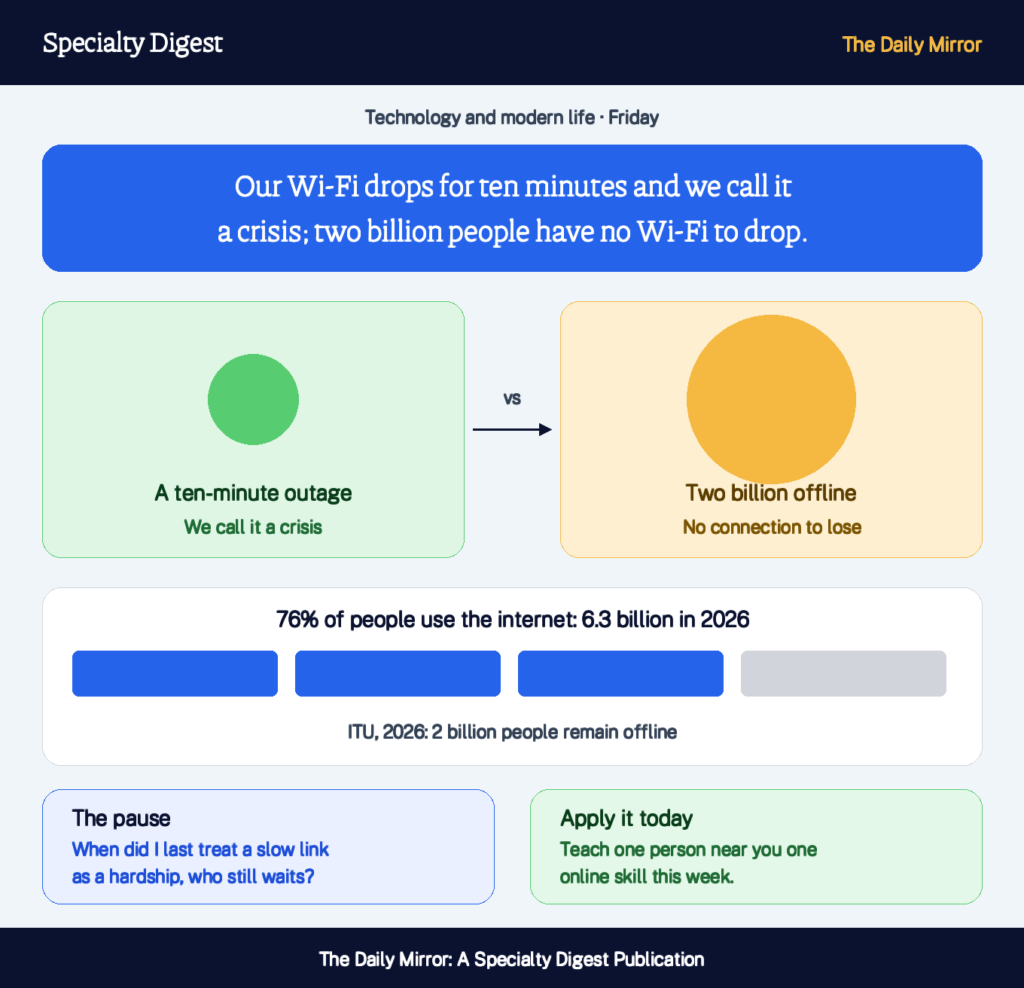
Our Wi-Fi drops for ten minutes and we call it a crisis; two billion people have no Wi-Fi to drop.
The Daily Mirror: A Specialty Digest Publication
Two billion have no Wi-Fi to drop because, in 2026, about 2 billion people still do not use the internet at all. A short outage feels like a crisis mainly to those who normally have a connection to lose.
The mirror
The router blinks amber, the video call freezes and the whole house declares an emergency. One person restarts the box, another blames the provider, and everyone checks the phone for proof. Ten minutes later the signal returns and the crisis is forgotten. For a great many people, though, the ordinary week has never included that connection to lose.
The fact behind it
The International Telecommunication Union (ITU), the United Nations agency for digital technologies, estimates that 6.3 billion people, or 76 per cent of the world, use the internet in 2026, while 2 billion remain offline. Use reaches 93 per cent in high-income countries but only 32 per cent in low-income countries.
Offline is not always a choice or a lack of signal: the World Bank notes that over 90 per cent of people live within reach of 3G or 4G networks, so the cost of devices and data, and missing skills, keep many away. See last year’s digital divide numbers, how Wi-Fi actually works, why connectivity has its own world day and what digital learning needs.
The pause
When did I last treat a slow connection as a hardship, and who is still waiting for any?
Apply it today
Teach one person near you one online skill this week, such as sending an email or filling in a form.
The Daily Mirror: A Specialty Digest Publication.
More in Technology
- n
- International Telecommunication Union. 6.3 billion people now online, yet digital divides persist. ITU, press release, 3 November 2026.
- World Bank. The global internet gap: What the data tells us. World Bank Data Blog, 7 July 2026.
n
n
n