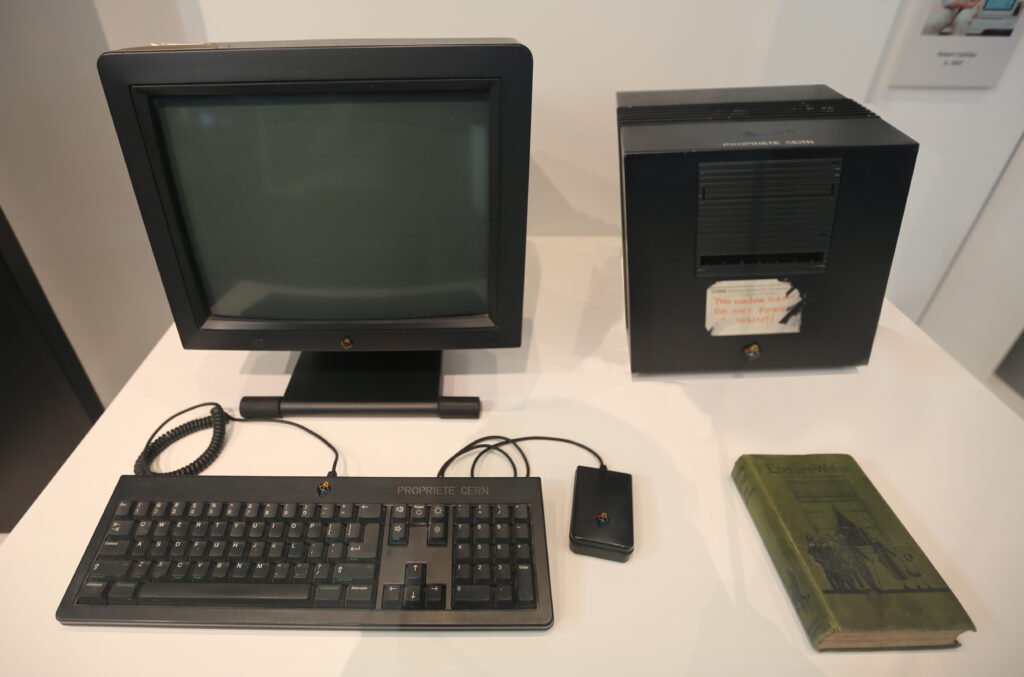
The World Wide Web is a system of linked documents and other resources that people reach through the internet using a browser. It was created by Sir Tim Berners-Lee at CERN, the European particle physics laboratory, between 1989 and 1991. The web is not the same as the internet: the internet is the global network of connected computers, and the web is one service that runs on top of it.
History of the World Wide Web
The web had intellectual ancestors. In 1945 Vannevar Bush described in the Atlantic Monthly a device called the Memex that could make and follow links between documents on microfiche. In the 1960s Doug Engelbart prototyped a system with hypertext browsing and editing and invented the mouse for it, and Ted Nelson coined the word hypertext in a 1965 paper. In 1967 Andy van Dam and others built the Hypertext Editing System.
Berners-Lee came to the problem while consulting at CERN in 1980. He wrote a notebook program called Enquire, short for Enquire-Within-Upon-Everything, which let him make links between arbitrary pieces of information.
In March 1989 he wrote Information Management: A Proposal and circulated it for comment at CERN. His supervisor, Mike Sendall, wrote on it the words vague, but exciting. The proposal was recirculated in May 1990.
In September 1990 Sendall approved the purchase of a NeXT computer, and in October Berners-Lee began writing a hypertext browser and editor on it. He named the program WorldWideWeb and used the same name for the whole project. The first web server ran on a machine at CERN, and the first page described the project itself.
Robert Cailliau of CERN joined as co-author of the revised proposal, and technical student Nicola Pellow wrote a simple line-mode browser. By Christmas 1990 both browsers could be demonstrated.
In March 1991 the line-mode browser was released to a limited audience, and on 17 May 1991 the web was released generally on central CERN computers. In August 1991 the software was announced to internet discussion groups, and on 12 December 1991 the first web server outside Europe was installed at the Stanford Linear Accelerator Center in California.
Inventor and origins of the World Wide Web
The World Wide Web Consortium (W3C) credits Berners-Lee with inventing the web in 1989. He coined the term, wrote the first web server, called httpd, and wrote the first client program, a browser and editor, in October 1990. He also wrote the first version of the HyperText Markup Language (HTML), and his initial specifications for URIs and the HyperText Transfer Protocol (HTTP) were refined as web technology spread.
The work was collaborative. Cailliau, Pellow and other CERN staff helped develop and spread the early software, and the idea of linking documents drew on decades of hypertext research. Berners-Lee’s contribution was to combine hypertext with the existing internet in a simple, open design.
A decisive step was a legal one. On 30 April 1993 CERN’s directors declared that web technology would be freely usable by anyone, with no fees payable to CERN. The W3C timeline calls it a milestone document.
How the World Wide Web works
Three inventions work together. A URI, commonly seen as a web address, names a resource. HTTP is the protocol by which a browser asks a server for that resource and the server replies. HTML is the markup language that describes a page and its links.
When a person enters an address or follows a link, the browser sends a request across the internet using the Internet Protocol and related standards. The server returns a file, and the web browser displays it. Any page can link to any other page, which is what makes it a web. Because the specifications were open and simple, other people could write their own servers and browsers, as several did in 1992 and 1993.
Types and variants of the web
Early browsers varied. Besides the line-mode browser and Berners-Lee’s WorldWideWeb program, graphical browsers for the X Window System appeared in 1992 and early 1993, including Erwise, Viola and Midas, and in February 1993 the National Center for Supercomputing Applications (NCSA) released an alpha version of Marc Andreessen’s Mosaic for X.
Beyond the web of documents, researchers have worked on a web of data. The Semantic Web and linked data aim to make information machine-readable so that programs can combine it across sites.
Impact of the World Wide Web
The web spread quickly. In November 1992 the project listed 26 reasonably reliable servers, and by January 1993 around 50 web servers were known. In February 1993 the University of Minnesota announced that it would charge licensing fees for its Gopher system, which led many volunteers and staff to switch to the web. In March 1993 an acceptable use policy that had barred commercial use of the internet was reinterpreted to allow it, and web traffic measured 0.1 percent of the US National Science Foundation backbone.
In 1994 the W3C was formed at the urging of many companies that were investing heavily in the web. Berners-Lee led the essential work of the consortium to foster a consistent architecture for the pace of progress in web standards.
The International Telecommunication Union estimates that 76 percent of the world’s population, about 6.3 billion people, is online in 2026, although 2 billion people remain offline.
Uses of the World Wide Web today
The web is used to publish and read information, to shop, to study, to run businesses and to deliver software. Many programs now run inside the browser, and the web connects to services on remote servers known as cloud computing.
Open standards keep it working across devices. The W3C continues to develop the standards used to build websites, browsers and devices, so that a page written once can be viewed on many kinds of equipment.
More in Software & the Web
Key facts
- Tim Berners-Lee submitted his information management proposal at CERN in March 1989 and began building the web on a NeXT computer in 1990.1
- He wrote the first web server, called httpd, and the first browser and editor, called WorldWideWeb, in October 1990.2
- CERN's directors declared on 30 April 1993 that web technology could be used freely by anyone, with no fees payable to CERN.1
- NCSA released the first alpha version of Mosaic for X in February 1993.1
- The World Wide Web Consortium was formed in 1994 and Berners-Lee led its essential early work.2
Related concepts
In the news
Quick checkIs the World Wide Web the same as the internet?Show answer
No. The internet is the global network of connected computers, while the World Wide Web is a system of linked documents and other resources that runs on it. Tim Berners-Lee created the web at CERN between 1989 and 1991 to work on top of the existing internet.
Sources
- World Wide Web Consortium, A Little History of the World Wide Web, https://www.w3.org/History.html
- World Wide Web Consortium, History, https://www.w3.org/Consortium/facts
- CERN, Tim Berners-Lee's proposal, https://info.cern.ch/Proposal.html
- International Telecommunication Union, Measuring digital development, https://www.itu.int/en/ITU-D/Statistics/Pages/stat/default.aspx
Editorially reviewed by Specialty Digest Editorial TeamLast reviewed November 4, 2026Researched and drafted with AI assistanceReport an issue