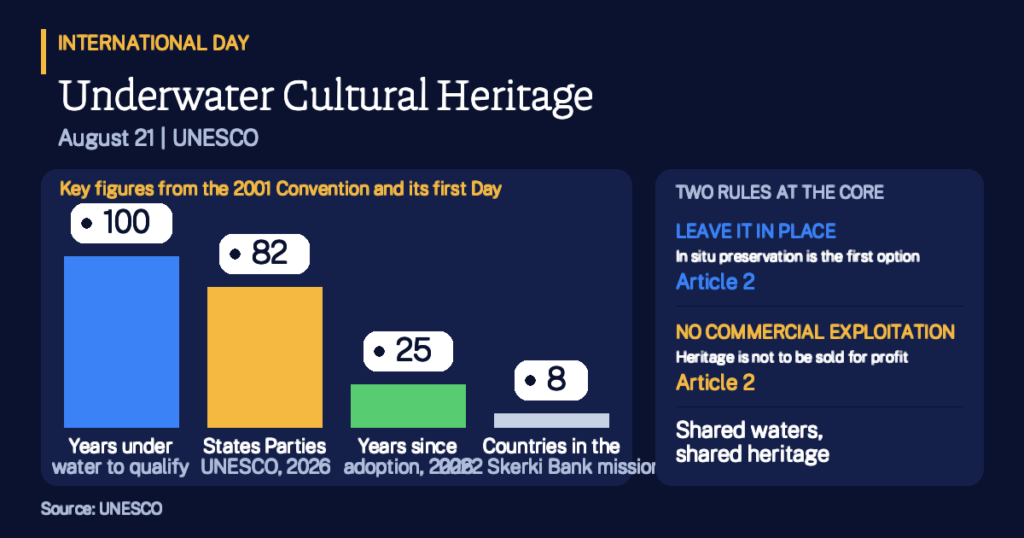
Beneath the sea lies a vast archive that almost nobody can visit. Shipwrecks, drowned settlements, sunken aircraft and ancient harbors rest on the seabed, in lakes and in rivers, many of them undisturbed for centuries. They hold evidence of how people traveled, traded, fought and lived. The International Day for Underwater Cultural Heritage, observed every August 21, asks the world to protect that evidence. It is a young observance: UNESCO proclaimed it in November 2025, and 2026 was the first year it was marked. It connects naturally to World Oceans Day, because the same waters that sustain life also guard human history.
One mission, one date
Why August 21? UNESCO explains that the date recalls August 21, 2022, when the first international underwater archaeological mission under the 2001 Convention took place at Skerki Bank, on the continental shelves of Tunisia and Italy. Eight countries took part. The choice is telling. The day does not honor a single wreck or a famous discovery. It honors cooperation, the idea that heritage lying far from any one nation’s easy reach is best studied and protected together.
The proposal came from the Arab Republic of Egypt. It followed a recommendation of the UNESCO Executive Board at its 220th session, and the General Conference proclaimed the day at its 43rd session in November 2025. The day rests on an older treaty, the Convention on the Protection of the Underwater Cultural Heritage, adopted in Paris on November 2, 2001, and in force since January 2, 2009. UNESCO describes the day as a global platform to raise awareness, encourage dialogue and strengthen cooperation.
What counts as underwater cultural heritage
The Convention gives the term a precise meaning. Underwater cultural heritage is all traces of human existence with a cultural, historical or archaeological character that have been partially or totally under water, periodically or continuously, for at least 100 years. Three families of things qualify: sites, structures, buildings, artifacts and human remains, together with their surroundings; vessels, aircraft and other vehicles, with their cargo; and objects of prehistoric character. Pipelines and cables on the seabed are excluded, as are other installations that are still in use.
The 100-year line does real work. It separates heritage from recent wreckage and gives governments a clear test. It also means the category quietly grows: a site submerged in 1926 reaches the line in 2026.
Example 1: the sorting test. Suppose a survey finds three things: a wooden trading vessel that sank 140 years ago, a steel cargo ship that sank 40 years ago, and a working cable laid last decade. Under the definition, only the first qualifies. The second is too recent and the third is excluded outright. The numbers are round and illustrative.
The rules at the heart of the treaty
Two rules stand out. Article 2 says that preserving heritage in situ, meaning where it lies, should be considered the first option. It also says that underwater cultural heritage shall not be commercially exploited. The reasoning is easy to follow. An object lifted from the seabed loses its setting, and the setting is what turns an object into evidence. A coin in a museum case tells a story; the same coin tucked beside a ship’s timbers, a cargo and a position on the seabed tells a far larger one.
UNESCO lists five duties for States that ratify: prevent commercial exploitation and dispersion; preserve the heritage for the future, in situ; assist the tourism industry involved; enable capacity building and knowledge exchange; and enable effective international cooperation. The Convention’s own preamble explains the worry behind them, citing concern about unauthorized activities and the increasing commercial exploitation of this heritage.
Example 2: the treasure hunt. Imagine a company finds a 300-year-old wreck and plans to sell its coins at auction to cover costs. The treaty’s rule against commercial exploitation points the other way: document the site carefully and study it, or leave it where it lies. The wreck is worth more to the public as knowledge than as a sale lot. The scenario and numbers are made up for illustration.
The numbers behind the day
A handful of figures show how far the treaty has traveled in 25 years. UNESCO’s anniversary page reports 82 ratifications, 12 expert missions and 72 global partners. The Convention entered into force on January 2, 2009 for States that had already deposited their instruments, and takes effect for later joiners three months after they deposit.
- 100 yearsminimum time under water to qualify
- 82countries have ratified the Convention, per UNESCO in 2026
- 8countries joined the 2022 Skerki Bank mission
- 2009year the Convention entered into force
Why this heritage needs a day
Heritage on land is easy to see and easy to guard. Heritage under water is out of sight, and what cannot be seen is easy to forget, to disturb or to sell. Yet it matters for the same reasons as any monument. It records ordinary life as well as grand events: the goods a ship carried, the harbor a town built, the tools a community left behind. Some sites also contain human remains, which is one reason the Convention treats them with care and asks for respect.
The heritage is not limited to shipwrecks. A UNESCO article on a 2026 seminar in Qatar points to tidal fish traps, pearling grounds and submerged freshwater springs as part of the coastal and maritime story. Much of it crosses borders, lies in international waters or ends up under the responsibility of several countries at once. That is why the first Day chose a joint mission as its anchor. Protecting what no single flag can guard alone takes shared rules, shared training and shared trust.
How the day is marked in 2026
The first observance arrived with a burst of activity. On August 20, 2026, an Alexandria Declaration on Underwater Cultural Heritage was endorsed at the Bibliotheca Alexandrina in Egypt, under the title “From Protection to Development.” It says protection remains the cornerstone of international action, and it links culture, nature, people and sustainable development. It also proposes judging progress by the knowledge, opportunities and benefits that protection creates, not only by how much heritage is safeguarded.
The year is also the 25th anniversary of the Convention, with the theme “A Shared Blue Heritage: 25 Years of Protecting Underwater Cultural Heritage.” A symposium on bringing marine and underwater cultural heritage into ocean governance was held at UNESCO headquarters on November 16, 2026.
Example 3: a town that keeps its wreck. A coastal town maps a 400-year-old wreck and leaves it in place. It builds a small visitor center and a guided dive trail. If 5,000 visitors each spend $40 locally in a year, that is $200,000 for the town, and not one artifact was sold. The figures are round and invented to show the idea, in the spirit of the Alexandria Declaration’s link between protection and development.
Key Takeaways
- The day is brand new. UNESCO proclaimed it in November 2025, and 2026 was the first observance on August 21.
- The date honors cooperation. It recalls the 2022 Skerki Bank mission, the first international mission under the 2001 Convention, with eight countries.
- One hundred years is the test. Traces of human life count once they have spent at least a century under water, partly or fully.
- Leave it in place first. The treaty makes in situ preservation the first option and bars commercial exploitation.
- Heritage is more than wrecks. Harbors, fish traps, pearling grounds and aircraft all belong to the story.
- Protection can feed development. The 2026 Alexandria Declaration links safeguarding to culture, nature and community benefit.
How solid is this? The dates, the treaty wording and the origin of the day come from UNESCO pages and the text of the Convention. UNESCO’s States Parties and anniversary pages give 82 ratifications in 2026, while another UNESCO page shows 81, so treat the count as more than 80 and check the current list. The three worked examples use round, made-up numbers. See also World Oceans Day, the International Days hub and the International Days Calendar.
More in History
- UNESCO. International Day for Underwater Cultural Heritage.
- UNESCO. Underwater Cultural Heritage, 2001 Convention.
- UNESCO. States Parties to the 2001 Convention.
- UNESCO. 25th anniversary of the 2001 Convention: A Shared Blue Heritage.
- UNESCO. Convention on the Protection of the Underwater Cultural Heritage (2001), text.
- UNESCO. From Protection to Development: The Alexandria Declaration on Underwater Cultural Heritage (2026).
- UNESCO. Qatar marks World Day for Underwater Cultural Heritage with a seminar on coastal and maritime heritage (2026).