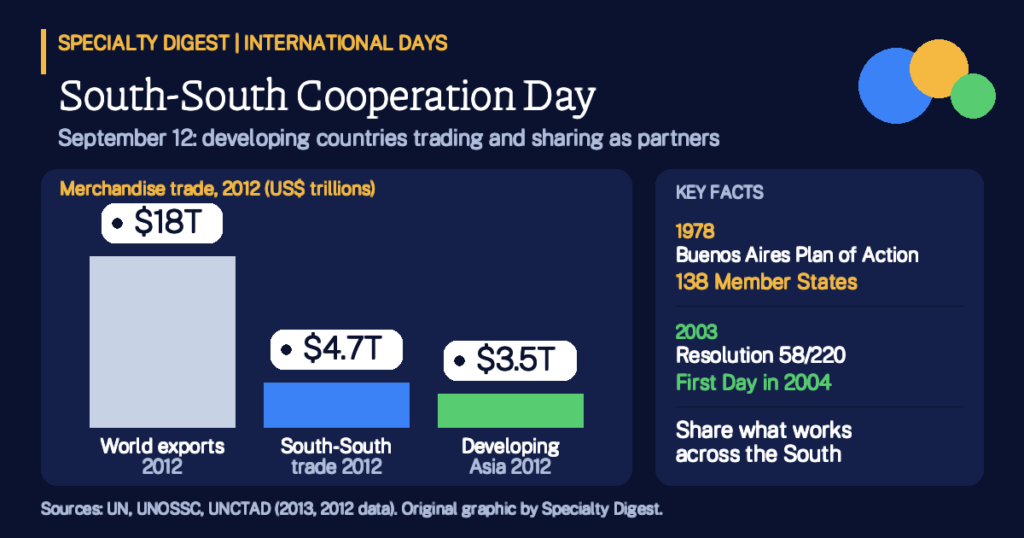
Most stories about development have a giver and a receiver. South-South cooperation tells a different one, in which developing countries trade, teach and invest with each other as partners. The United Nations marks that idea every year on September 12, the United Nations Day for South-South Cooperation. The date recalls a 1978 meeting in Buenos Aires that gave developing countries a shared plan for helping one another. This article explains where the day came from, what the term means, which numbers are solid, and why it still matters when the biggest development problems are shared ones. It pairs naturally with the day for landlocked developing countries, because the 1978 plan gave those countries special attention.
From Buenos Aires to a United Nations day
In 1978, a conference of the Global South on technical cooperation among developing countries met in Buenos Aires. It adopted the Buenos Aires Plan of Action, known as BAPA, for promoting and implementing technical cooperation among developing countries. UNOSSC counts 138 Member States among those who adopted it, and the United Nations describes BAPA as one of the main pillars of South-South cooperation. The General Assembly endorsed the plan the same year in resolution 33/134. BAPA identified 15 focal areas for cooperation and asked for special attention to the least developed countries, landlocked developing countries and small island developing States.
The Day itself came 25 years later. UNOSSC’s timeline records that in resolution 58/220, adopted in 2003, the General Assembly decided to declare a United Nations Day for South-South Cooperation, with the first observance to be held in 2004. The date has a wrinkle worth knowing. UNOSSC’s history page ties the Assembly’s endorsement of BAPA to December 19, while its 2025 concept note says September 12 marks the adoption of the 1978 plan. The date on the calendar today is September 12, and UNOSSC noted that 2018 fell on the exact 40th anniversary of the plan.
What the term means
“South” is shorthand for developing countries, many of them in the Southern Hemisphere but not all. South-South cooperation is collaboration among those countries in areas such as trade, technology, knowledge, skills and finance. Triangular cooperation adds a third partner, often a wealthier country or an international organization, that supplies funding or expertise while developing countries lead the exchange. The common thread is ownership. The partners set the agenda and share what they have learned, instead of receiving a ready-made package from outside.
The name of the 1978 plan is a clue to the original spirit. It spoke of technical cooperation, which means the exchange of skills and know-how. Today UNOSSC’s mandate is to promote, coordinate and support South-South and triangular cooperation globally and within the United Nations system. The office also hosts several funds, including the United Nations Fund for South-South Cooperation, the Pérez-Guerrero Trust Fund, the IBSA Fund and the India-UN Development Partnership Fund.
Example 1: a farming lesson that travels. Suppose one country develops a low-cost way to store seed through the dry season, and 1,000 farmers there raise their yields by about 20 percent. A neighboring country with a similar climate sends 20 extension workers to learn the method, adapts it to local crops and trains its own farmers. No large grant is needed, only travel, translation and time. The numbers are round and illustrative, but the pattern is the one South-South cooperation describes: proven solutions move between countries that face similar problems.
The numbers behind the day
Trade is the easiest place to see the scale. UNCTAD reported in 2013, using 2012 data, that world merchandise exports reached $18 trillion and that South-South trade reached a record $4.7 trillion, more than 25 percent of total world exports. Trade within developing Asia alone was $3.5 trillion, and China’s exports to other developing countries were $1 trillion. These figures are more than a decade old, so treat them as a snapshot of how large the exchange had already become, not as a current measure.
- 138Member States adopted the Buenos Aires Plan of Action in 1978
- 15focal areas identified in the plan for technical cooperation
- 800 million+people still live in extreme poverty as of 2025, per UNOSSC
- 950+solutions on the South-South Galaxy knowledge platform
Why it matters
Developing countries often face problems that look alike: building roads and power grids on a tight budget, adapting crops to heat, expanding health services, or training a young workforce. A solution that worked in a country with similar income, climate and institutions can be easier to adopt than one designed for a very different setting. That is the practical case for the day. It asks countries to share what already works, and it asks the wider system to make that sharing easier to finance.
The 2025 concept note frames the stakes plainly. It says more than 800 million people still live in extreme poverty as of 2025, and that the theme focuses on turning commitments into action and ensuring no country is left behind. It also calls for sustainable financing beyond ad hoc contributions, naming blended finance, debt swaps and impact investment as tools to consider.
Example 2: sharing a training bill. Imagine three countries each need to train 100 customs officers, and a regional institute can do all 300 at once for $600,000 in total. Training them separately at $3,000 each would cost $900,000. The saving of $300,000 comes from pooling a single course. The figures are round and illustrative, but they show why regional institutions and shared programs appear so often in South-South cooperation.
Who is meant to benefit
BAPA named the least developed countries, landlocked developing countries and small island developing States for special attention in 1978, and that emphasis remains the most important thing to remember about who the day is for. These are the countries with the fewest resources, the highest transport costs or the greatest exposure to shocks. For them, a partner with a similar story can offer something a distant donor cannot: advice from someone who solved the same problem recently, on a similar budget.
The idea also reaches beyond governments. The South-South Galaxy, the knowledge platform run by UNOSSC, features over 950 solutions from over 190 countries and 600 partner organizations, according to the 2025 concept note. That means universities, companies, civic groups and public agencies all take part, not only ministries.
How the day is marked
Each year UNOSSC leads a commemoration, usually a high-level event at United Nations Headquarters in New York, with partners marking the day in their own countries too. The 2025 event was held on September 12 at UN Headquarters as a high-level panel, in the run-up to the 80th session of the General Assembly. It built on the work of the 22nd session of the High-level Committee on South-South Cooperation.
- 2024Multilateral Solutions for a Better Tomorrow
- 2025New Opportunities and Innovation through South-South and Triangular Cooperation
Example 3: a triangle at work. Picture two developing countries that want to improve rural water systems. One has the engineering experience and the other has the need. A third partner, perhaps a development agency, covers $1 million of the cost while each developing country adds staff time worth $250,000. The developing countries run the project and the third partner supports it. The figures are illustrative, but the structure is what triangular cooperation means in practice.
Key Takeaways
- The day recalls a 1978 plan. The Buenos Aires Plan of Action was adopted by 138 Member States and endorsed by the General Assembly in resolution 33/134.
- The Day was created in 2003. Resolution 58/220 declared it, and the first observance followed in 2004.
- Partnership is the point. Developing countries share skills, technology and finance as partners, with or without a third supporter.
- Trade shows the scale. South-South trade reached $4.7 trillion in 2012, more than 25 percent of world exports.
- The most vulnerable come first. BAPA called for special attention to least developed, landlocked and island developing countries.
- Financing is the open question. The 2025 concept note asks for sustainable funding beyond ad hoc contributions.
How solid is this? The history comes from UN and UNOSSC pages, which give two dates (September 12 and December 19) for the 1978 events, so the article reports both. The trade figures are from a 2013 UNCTAD article using 2012 data and are not current. The 2025 statistics come from a UNOSSC concept note. The three worked examples use round, made-up numbers to show an idea. See also the International Days hub and the International Days Calendar.
More in Society
- United Nations, South-South Cooperation Day: Background
- UNOSSC, About UNOSSC
- UNOSSC, Concept Note: United Nations Day for South-South Cooperation 2025
- UNOSSC, 12 September 2018: the 40th anniversary of the BAPA signing
- UNCTAD, South-South trade continues to increase (December 17, 2013)
- United Nations, Day for South-South Cooperation 2024 event page