Most of us look after our bodies without much thought, yet the mind is often treated as something to hide until it breaks. World Mental Health Day, observed every year on October 10, exists to change that habit. It asks everyone, from health ministers to next-door neighbors, to talk about mental health openly, to fund care properly and to listen to the people who live with these conditions. The scale explains the urgency. WHO reported in 2025 that more than one billion people are living with a mental health condition, and many of them cannot easily reach care. The day sits naturally beside World Suicide Prevention Day, because both rest on the same foundations: early support, trained workers and communities willing to listen.
A day that grew from a movement
World Mental Health Day was first observed in 1992, at the initiative of the World Federation for Mental Health, a worldwide membership organization. The federation describes the day as its own program, and the United Nations recognizes it as a day marked by both the federation and the World Health Organization. Since 2013, WHO has also run a yearly global campaign around the date. Unlike many days created by a General Assembly vote, this one grew from advocacy first and gained wider institutional backing over time.
Each year the day carries a theme, and the themes tell a story of widening ambition. They have moved from rights, to the workplace, to crisis settings, and now to the voices of people with personal experience.
What a mental health condition is
Mental health is more than the absence of illness. It is the ability to cope with the normal stresses of life, to learn and work, and to take part in community life. A mental health condition is a disturbance in thinking, mood or behavior that causes distress or gets in the way of daily life. Anxiety and depressive disorders are the most common types among both men and women, and they are the second biggest reason for long-term disability worldwide, according to WHO.
These are health conditions, not weaknesses of character. Like diabetes or asthma, they vary in severity, they can often be treated, and they respond best to early, respectful care.
The numbers behind the day
WHO’s 2025 report, World mental health today, found that more than one billion people live with a mental health condition. In 2021 an estimated 727,000 people died by suicide, and suicide was the third leading cause of death among people aged 15 to 29. About 73 percent of suicide deaths occurred in low- and middle-income countries. Depression and anxiety alone cost the global economy an estimated $1 trillion each year, mostly through lost productivity.
- 1 billion+people living with a mental health condition, WHO report, 2025
- 727,000deaths by suicide worldwide in 2021
- $1 trillionyearly cost of depression and anxiety to the world economy
- 73%of suicide deaths in low- and middle-income countries, 2021
The care gap
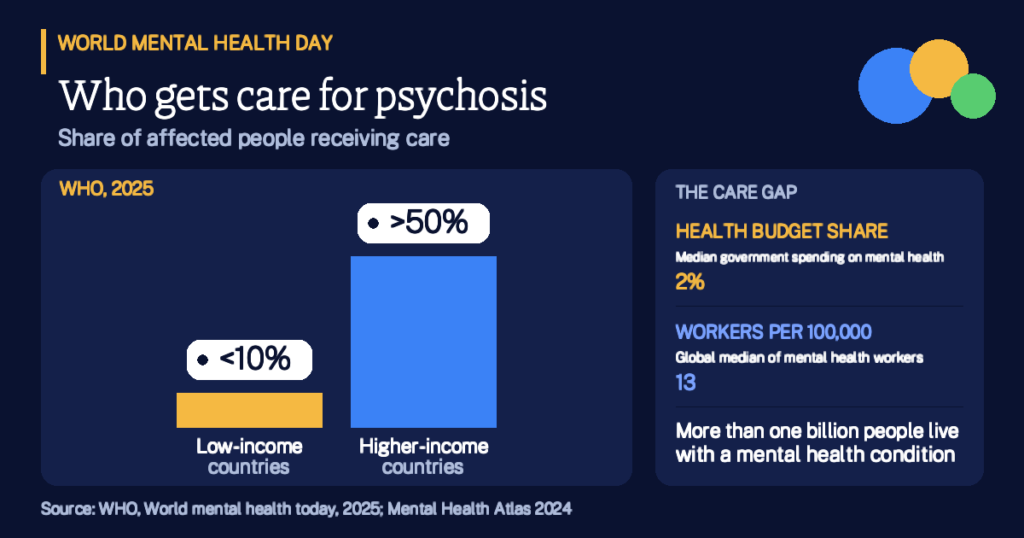
The most striking fact is how little is spent on mental health. WHO’s Mental Health Atlas 2024, which covers 144 countries, found that governments spend a median of just 2 percent of their health budgets on mental health, unchanged since 2017. High-income countries spend up to $65 per person, while low-income countries spend as little as $0.04. The global median is 13 mental health workers for every 100,000 people.
Example 1: what 2 percent looks like. Imagine a country that spends $1,000 million a year on health. A 2 percent share for mental health is $20 million, or $980 million for everything else. The numbers are round and illustrative, but they show how small the slice is compared with a burden that touches more than one in eight people on Earth.
Example 2: a thin workforce. At 13 workers per 100,000 people, a city of 500,000 would have about 65 mental health workers in total, including psychiatrists, nurses and counselors. Spread across a half million residents, each worker would be responsible for thousands of people. The figures are illustrative, but the arithmetic is what the median implies.
The gap shows most clearly in treatment. For psychosis, WHO reports that in low-income countries fewer than 10 percent of affected people receive care, compared with over 50 percent in higher-income countries. Only 22 countries had enough data to make that estimate, so it should be read as a signal rather than a precise measure.
A target the world is missing
Suicide prevention is part of the Sustainable Development Goals, which set a target of a one-third reduction in suicide rates by 2030. WHO’s 2025 report says that, on current trends, only a 12 percent reduction will be achieved by that deadline. This topic is sensitive, and it is worth saying plainly that suicide is preventable. Access to care, support from people nearby and responsible reporting all help.
From institutions to communities
The 2026 theme, “Lived experiences heard: real voices, real change,” was chosen by the World Federation for Mental Health. It supports WHO’s push to move care from large psychiatric hospitals to services in the community. In a release on October 9, 2026, WHO reported from its Mental Health Atlas that only 9 percent of reporting countries had fully shifted to community-based care, while 53 percent were still at an early stage of reform. It also noted that more than one in four people (28 percent) admitted to psychiatric hospitals stayed longer than six months.
Example 3: one hospital’s long stayers. Suppose a psychiatric hospital admits 100 people in a year. If the 28 percent figure applied there, 28 of them would stay beyond six months. Community services, such as home visits, supported housing and local clinics, aim to help many of those people recover closer to family and work. The numbers are round and illustrative.
Putting lived experience at the center means people who have been through these conditions help design the services meant for them. It is a simple principle: those who know the problem best should help shape the answer.
How the day is marked, and where to turn
Around October 10, governments, schools, employers and community groups hold talks, screenings and campaigns, and many treat the whole of October as a month for conversation. You do not need an event to take part. Ask a friend how they are doing and wait for the real answer. Learn the signs of distress. Support workplaces and schools that make it normal to ask for help.
If you or someone you know is in crisis or thinking about suicide, contact local emergency services or a crisis line right away. In the United States, you can call or text 988. Elsewhere, a local health service or trusted doctor can point you to support.
Key Takeaways
- The day began as advocacy. It was first observed in 1992 at the initiative of the World Federation for Mental Health, and WHO has run a yearly campaign since 2013.
- The burden is vast. More than one billion people live with a mental health condition, according to WHO’s 2025 report.
- Funding does not match need. Governments spend a median of 2 percent of health budgets on mental health, unchanged since 2017.
- There are too few workers. The global median is 13 mental health workers per 100,000 people.
- Prevention is behind schedule. Suicide rates are on track for a 12 percent cut by 2030, against a target of one third.
- Voices matter. The 2026 theme puts people with lived experience at the center of better, community-based care.
How solid is this? Figures come from WHO’s 2025 World mental health today report, the Mental Health Atlas 2024 and WHO’s October 2026 release on community care, whose Atlas year is not stated. Global counts are modeled estimates and are revised over time. The three worked examples use round, made-up numbers to show an idea. See also the International Days hub and the International Days Calendar.
More in Health
- WHO: Over a billion people living with mental health conditions, services require urgent scale-up (September 2, 2025)
- UN News: WHO sounds alarm as mental health conditions soar past one billion worldwide (September 2025)
- WHO: Mental Health Atlas 2024
- WHO: WHO urges shift from institutional to community-based mental health care (October 9, 2026)
- WHO: World Mental Health Day campaign page
- WHO South-East Asia: World Mental Health Day (2024)
- World Federation for Mental Health: World Mental Health Day 2026 theme