Every year on October 11, the world pauses to ask a plain question: what does it take for a girl to grow up safe, schooled and heard? International Day of the Girl Child exists because, for hundreds of millions of girls, the honest answer is still “more than they have.” The day is not a celebration of an abstract idea. It is a yearly check on whether promises made to girls have been kept, and a prompt to act where they have not. It sits naturally beside International Women’s Day, because the chances a girl gets at age 12 shape the life a woman leads at 40.
From Beijing to a day of their own
The story starts in 1995, when 189 governments endorsed the Beijing Platform for Action, the broad blueprint for women’s and girls’ rights. Sixteen years later, on December 19, 2011, the UN General Assembly adopted resolution 66/170, which declared October 11 the International Day of the Girl Child. The first observance followed in 2012, and UN News reported that day that the United Nations was calling for an end to child marriage, the theme of that first year. Since then the day has put one barrier after another in the spotlight, from girls’ education to girls caught in crises.
What the day is really asking for
Girls are children, and what happens during those years sets the course of a life: whether she finishes school, stays healthy, is protected from harm and has a say in decisions about her own future. The 2025 theme, “The girl I am, the change I lead: Girls on the frontlines of crisis,” treats girls not as a group to be rescued but as leaders already at work in their communities. That same year, UNICEF, UN Women and Plan International published “Girl Goals,” a review of 30 years since Beijing. UN Women’s summary of it carries a candid headline: 30 years of uneven progress for adolescent girls.
The numbers behind the day
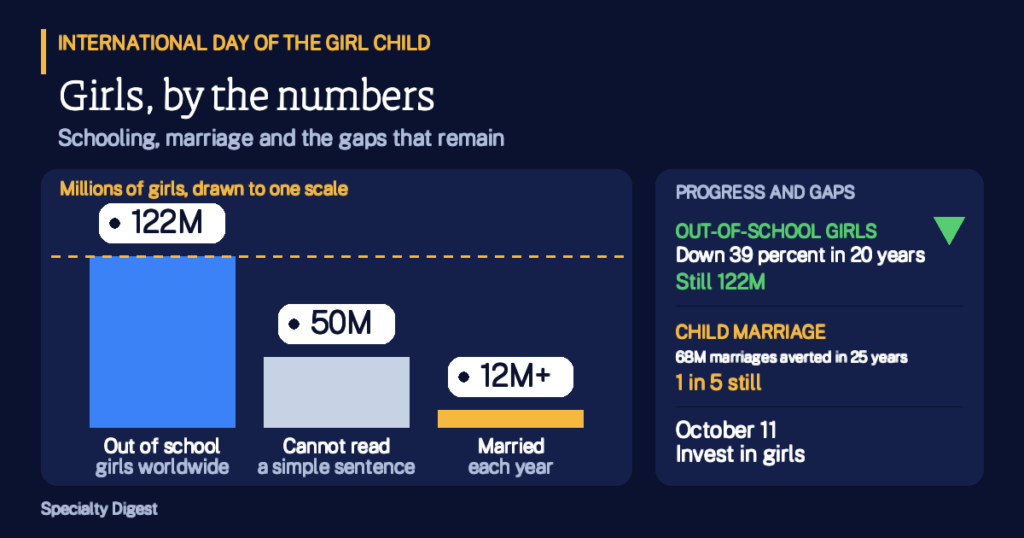
Progress is real. According to “Girl Goals,” the number of out-of-school girls fell 39 percent over the last 20 years, illiteracy among adolescent girls and young women has nearly halved in three decades, and the number of adolescent girls giving birth has nearly halved over 30 years. Yet the gaps remain large. About 122 million girls are still out of school. Nearly 4 in 10 adolescent girls and young women do not complete upper secondary school, and nearly 50 million cannot read a simple sentence. In low-income countries, 9 out of 10 adolescent girls and young women have no internet access, while their male peers are twice as likely to be online.
- 122 milliongirls remain out of school globally
- 1 in 5girls marry before age 18
- 12 milliongirls married each year, about one every three seconds
- 68 millionchild marriages estimated to have been averted over 25 years
Example 1: a village classroom. Picture a village where 1,000 girls reach the age to start upper secondary school. If nearly 4 in 10 do not finish, about 400 leave early, each with fewer options for work, income and health decisions. The numbers are round and illustrative, but they show why one statistic stands for many individual futures.
When school is closed by war or by law
Crisis hits girls’ schooling hard. UNICEF reports that in conflict-affected countries, girls are more than twice as likely to be out of school as girls in unaffected countries. Afghanistan is the starkest case of a ban by law. In August 2024, UNESCO reported that at least 1.4 million girls had been deliberately denied access to secondary education since 2021, and said Afghanistan is the only country in the world to prohibit education for girls over the age of 12 and for women. In August 2026, UNICEF reported that more than 2.6 million girls had been denied a secondary education since 2021. The two figures come from different dates and counts, so they should be read as separate estimates, not as a contradiction.
Marriage, motherhood and safety
Child marriage remains one of the clearest tests of whether girls’ rights are real. UNICEF’s 2026 estimates put the number of women and girls alive today who were married in childhood at about 650 million, or roughly 1 in 5 girls. More than 12 million girls are married before adulthood each year, and prevalence is highest in sub-Saharan Africa at 31 percent. There is good news: an estimated 68 million child marriages have been averted over the past 25 years. But UN Women notes that Latin America and the Caribbean has seen no progress in that time.
Early marriage often travels with other risks. UN Women reports that nearly 1 in 4 adolescent girls who have been married or partnered have experienced intimate partner violence, and that 50 million girls alive today have experienced sexual violence. Nearly 12 million girls aged 15 to 19 were expected to give birth in 2025, and complications of pregnancy and childbirth account for roughly 1 in every 23 deaths among girls in that age group. Female genital mutilation is declining, but the global rate of decline would need to be 27 times faster to meet the 2030 target. Where a girl or someone she knows is at risk of forced marriage or violence, local child protection services and national helplines are the place to turn.
Example 2: a classroom of 30. If one in five girls in a class of 30 will marry in childhood, that is about six girls. The figure is rounded and illustrative, and real rates differ widely by country and region, but it makes an abstract percentage easy to picture.
How the day is marked and what progress needs
Each year the observance has a theme, and many are led by girls themselves. UNICEF’s 2025 guidance, for example, encouraged “solidarity viewing parties” so girls and allies could watch and discuss the day’s events together. The common thread is that investment works best when girls help set the agenda: keeping them in school, delaying marriage, protecting them from violence and giving them the skills and connectivity to compete.
- 2012My Life, My Right, End Child Marriage
- 2013Innovating for Girls’ Education
- 2025The girl I am, the change I lead: Girls on the frontlines of crisis
- 2026End child marriage and invest in girls’ rights (UNICEF)
Example 3: the hardest part. Suppose a country had 100 out-of-school girls twenty years ago and cut that number by 39 percent. Now 61 remain. Those last girls tend to live in the most remote, poorest or most unstable places, so each one costs more effort to reach than the first. The numbers are illustrative, but the lesson is real: the final stretch of progress is the hardest.
Key Takeaways
- The day has a clear origin. UN resolution 66/170, adopted on December 19, 2011, set aside October 11 for girls.
- Progress is real but uneven. Out-of-school girls fell 39 percent in 20 years, yet 122 million remain out of school.
- Education is the lever. Nearly 4 in 10 adolescent girls and young women do not finish upper secondary school.
- Crisis widens the gap. Girls in conflict-affected countries are more than twice as likely to be out of school.
- Child marriage is slowing, not gone. About 1 in 5 girls marry in childhood, though 68 million marriages were averted over 25 years.
- Girls lead, not just receive. The 2025 theme puts girls’ own leadership at the center of the response.
How solid is this? Most figures come from the 2025 “Girl Goals” report as summarized by UN Women, and from UNICEF’s 2026 estimates; several are modeled and are revised with new data, and not every source gives a year for each figure. The two Afghanistan counts come from different dates. The three worked examples use round, made-up numbers to show an idea. See also the International Days hub and the International Days Calendar.
More in Society
- United Nations, International Day of the Girl Child
- UN News, On world’s first International Day of the Girl Child, UN calls for end to child marriage (2012)
- UN Women, Fast facts: 30 years of uneven progress for adolescent girls (March 2025)
- UNICEF, International Day of the Girl 2026
- UNICEF, Girls’ education
- UNESCO, Afghanistan: 1.4 million girls still banned from school by de facto authorities (2024)