Angola is a large country on the southwestern coast of Africa, with a long Atlantic coastline and a central plateau reaching inland to border Namibia, Zambia, the Democratic Republic of the Congo and, at its narrowest point, Botswana. Its capital is Luanda, a major Atlantic port city. Angola’s economy is shaped heavily by oil, and its history by a long and destructive civil war that followed independence from Portugal.
Where Is Angola Located?
Angola stretches across Southern Africa’s southwestern coast, with its principal cities, led by the capital Luanda, facing west across the South Atlantic toward Brazil, another Portuguese-speaking nation. Its territory rises from a coastal strip to a broad central plateau, and it borders Namibia to the south, Zambia to the east, and the Democratic Republic of the Congo to the north and northeast, according to the World Bank (World Bank).
A Brief History
Angola was a Portuguese colony for centuries before winning independence in 1975. Independence was followed almost immediately by a prolonged civil war between rival liberation movements that lasted, with interruptions, until 2002. The conflict devastated infrastructure and displaced large numbers of Angolans, and the country has spent the decades since rebuilding around its oil wealth while working to diversify an economy still closely tied to global oil prices.
Government and Economy Today
The World Bank reports that Angola has a population of more than 36.75 million, with about half of the population under age 18, giving the country significant demographic potential alongside real structural challenges. Oil accounts for around 20 percent of GDP, 60 percent of government tax revenues and 95 percent of exports, a dependence that has made growth highly sensitive to global oil prices. Real per capita income in 2025 remained about 24 percent below its 2014 level, though primary fiscal surpluses since 2018 have helped cut public debt from 116 percent of GDP in 2020 to roughly 52 percent in 2025, and unemployment fell from 30.8 percent in late 2024 to 26.9 percent a year later (World Bank).
Culture and People
Portuguese is Angola’s official language, a legacy of colonial rule, alongside a range of Bantu languages spoken across different regions and ethnic groups, including the Ovimbundu, Ambundu and Bakongo. Angola’s cultural life reflects this blend of Portuguese colonial influence and indigenous Bantu traditions, expressed in its music, including genres like semba that later influenced Brazilian samba, and in a growing contemporary arts and film scene centered on Luanda.
What Is Angola Known For?
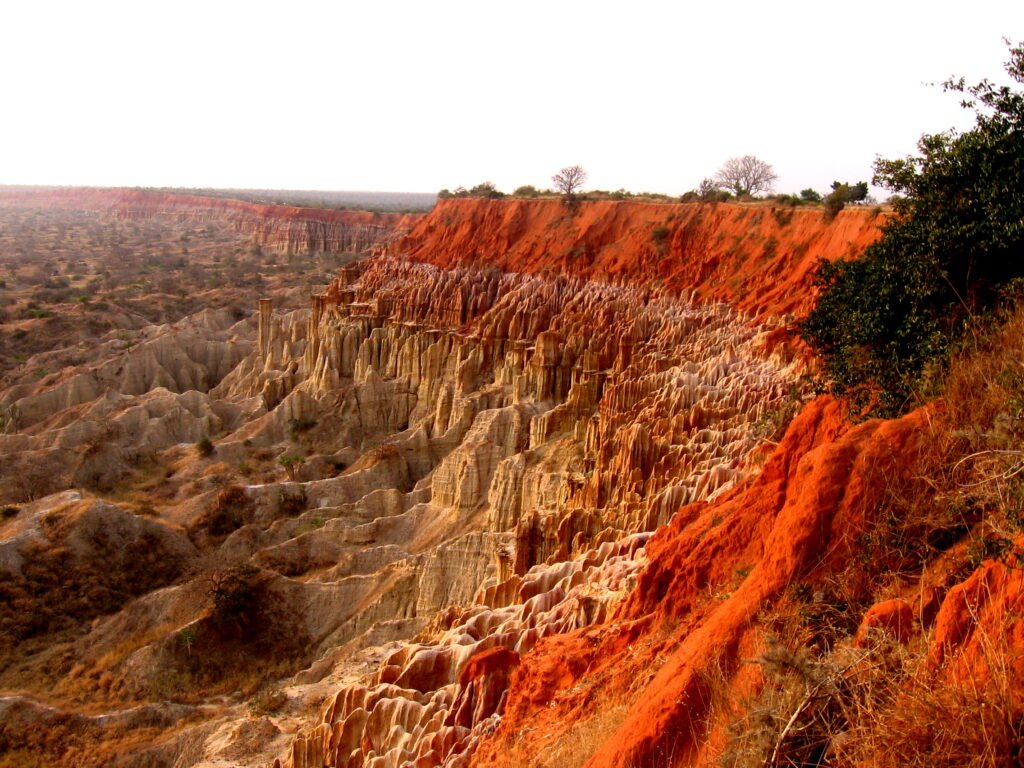
Angola is best known internationally for its oil wealth and its role as one of Sub-Saharan Africa’s major petroleum exporters, for its long and difficult civil war following independence from Portugal, and for striking natural landscapes such as the Miradouro da Lua, a set of dramatic eroded cliffs south of Luanda whose lunar appearance has made it a recognizable symbol of the country’s terrain.
Key Takeaways
- Angola is a large Southern African country on the Atlantic coast, with Luanda as its capital and oil as the backbone of its economy.
- It gained independence from Portugal in 1975, followed by a civil war that lasted, with interruptions, until 2002.
- The World Bank reports oil accounts for about 95 percent of Angola’s exports, making growth highly sensitive to global oil prices.
- Public debt fell from 116 percent of GDP in 2020 to about 52 percent in 2025 amid ongoing fiscal reform.
- Portuguese is the official language, alongside Bantu languages including those of the Ovimbundu, Ambundu and Bakongo peoples.
Key facts
Quick checkWhy is Angola's economic growth so sensitive to global oil prices?Show answer
Because oil accounts for around 95 percent of the country's exports and 60 percent of government tax revenue, according to the World Bank.
Sources
- World Bank. Angola Overview. Undated, accessed 2026 (accessed 2026)
Editorially reviewed by Specialty Digest Editorial TeamLast reviewed September 22, 2026Researched and drafted with AI assistanceReport an issue