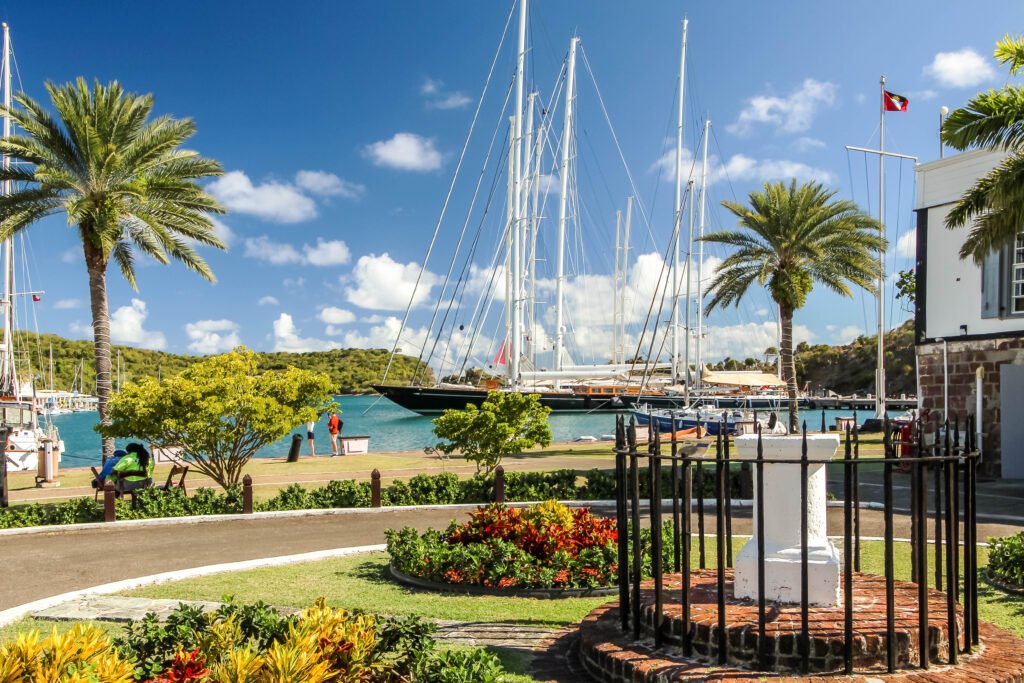
Antigua and Barbuda is a twin-island country in the Eastern Caribbean, part of the Leeward Islands chain, with a scattering of smaller islets. Its capital, St. John’s, sits on Antigua, the larger of the two main islands. A former British colony that gained independence in 1981, the country remains a member of the Commonwealth and depends heavily on tourism, drawing visitors to its beaches, sailing harbors and warm, dry climate.
Where Is Antigua and Barbuda Located?
Antigua and Barbuda lies in the Eastern Caribbean Sea, part of the Leeward Islands within the wider Lesser Antilles. Antigua, the more populous and developed island, is known for its coral reefs, natural harbors and beaches said to number 365, one for every day of the year. Barbuda, low-lying and more sparsely populated, lies roughly 30 miles north and is home to the Codrington Lagoon National Park, one of the Caribbean’s largest frigate bird sanctuaries.
A Brief History
Antigua and Barbuda were originally inhabited by Indigenous peoples, including the Siboney, Arawak and Carib. English settlers colonized Antigua in 1632, and the islands developed a plantation economy built on enslaved labor and sugar production during the colonial period. The country gained full independence from the United Kingdom on November 1, 1981, becoming a sovereign state within the Commonwealth, with the British monarch remaining as ceremonial head of state.
Government and Economy Today
Antigua and Barbuda is a parliamentary constitutional monarchy, governed by a prime minister and a bicameral Parliament, with a governor-general representing the head of state. Its economy is one of the most tourism-dependent in the Caribbean, with services, hospitality and financial services forming the bulk of economic activity; the country also markets an economic citizenship-by-investment program. Barbuda’s economy and infrastructure remain smaller and more vulnerable, and the island was devastated by Hurricane Irma in 2017, which forced a full evacuation of its population, underscoring the country’s exposure to increasingly severe Atlantic hurricanes.
Culture and People
English is the official language, with Antiguan Creole widely spoken. The population is predominantly of African descent, tracing ancestry to those enslaved during the colonial sugar era, alongside smaller communities of European, Middle Eastern and South Asian descent. Cricket holds a central place in national life, and the country has produced internationally renowned cricketers. Carnival, held each summer, is the country’s largest cultural festival, celebrating emancipation from slavery with music, costume and dance.
What Is Antigua and Barbuda Known For?
Antigua and Barbuda is best known internationally for its beaches, sailing culture and luxury tourism, anchored by English Harbour and Nelson’s Dockyard, a UNESCO World Heritage Site that preserves a working Georgian-era naval dockyard. Barbuda’s frigate bird sanctuary and pink-sand beaches add an unspoiled counterpoint to Antigua’s more developed resorts, while the country’s cricketing tradition and Carnival remain central to its cultural identity.
Key Takeaways
- Antigua and Barbuda is a twin-island nation in the Eastern Caribbean’s Leeward Islands, with St. John’s, on Antigua, as its capital.
- It gained independence from the United Kingdom on November 1, 1981, and remains a Commonwealth realm.
- Tourism, hospitality and financial services anchor the economy, alongside a citizenship-by-investment program.
- Barbuda was devastated by Hurricane Irma in 2017, highlighting the country’s vulnerability to Atlantic hurricanes.
- English Harbour’s Nelson’s Dockyard, a UNESCO World Heritage Site, and Barbuda’s frigate bird sanctuary are among its best-known landmarks.
Key facts
- Capital: St. John's, on Antigua
- Independence: November 1, 1981, from the United Kingdom
- Government: Parliamentary constitutional monarchy, Commonwealth realm
- Barbuda was evacuated after Hurricane Irma in 2017
Quick checkWhen did Antigua and Barbuda gain independence from the United Kingdom?Show answer
Antigua and Barbuda became independent on November 1, 1981.
Sources
- Government of Antigua and Barbuda. Official government portal. Accessed 2026 (accessed 2026)
Editorially reviewed by Specialty Digest Editorial TeamLast reviewed September 22, 2026Researched and drafted with AI assistanceReport an issue