Where Is the Bahamas Located?
The Bahamas, formally the Commonwealth of The Bahamas, is an archipelagic country in the western Atlantic Ocean, southeast of the Florida peninsula and north of Cuba. It is made up of more than 700 islands, cays, and islets, of which only about thirty are inhabited, spread across roughly 10,010 square kilometers of land area within a much larger stretch of ocean and shallow banks. The capital, Nassau, sits on New Providence Island and is home to most of the country’s population, estimated at about 403,000 people as of 2025.
Geography and the Islands
The Bahamian archipelago rises from two large shallow platforms, the Great Bahama Bank and the Little Bahama Bank, whose clear, light-colored waters result from thin layers of ocean over pale limestone and sand rather than deep water close to shore. The largest and best-known islands include New Providence (home to Nassau), Grand Bahama, Andros, Eleuthera, the Abacos, the Exumas, Cat Island, Long Island, and Great Inagua in the far south. The terrain across the islands is low and flat, built almost entirely of limestone, with the highest point in the country, Mount Alvernia on Cat Island, reaching only about 63 meters. The islands lie along the hurricane belt of the western Atlantic and are regularly affected by tropical storms during the June to November season.
A Brief History of the Bahamas
Indigenous Settlement and European Contact
Before European contact, the islands were inhabited by the Lucayan people, a branch of the Taino who had settled the archipelago by roughly the eleventh century. San Salvador Island, in the southeastern Bahamas, is traditionally identified as the site of Christopher Columbus’s first landfall in the Americas on October 12, 1492, an event that opened the region to sustained European contact. Within a few decades, Spanish slave raids and introduced disease had largely depopulated the islands of their original Lucayan inhabitants.
Piracy, British Settlement, and Emancipation
England established the first permanent European settlement in the Bahamas at New Providence in the 1640s, and the islands became a British crown colony later in the seventeenth century. In the early eighteenth century, weak colonial governance and the archipelago’s maze of shallow channels made Nassau a base for pirates and privateers, an era ended when the crown appointed Woodes Rogers as royal governor in 1718 with a mandate to suppress piracy. Enslaved Africans were brought to the islands under British rule to work cotton and other plantations, and the colony’s economy and society were shaped by that system until slavery was abolished throughout the British Empire in 1834, a change that reshaped the demographic and social makeup of the islands.
Independence and Modern Nationhood
The Bahamas remained a British colony until it achieved self-government in 1964 and full independence on July 10, 1973. It is a parliamentary democracy and a member of the Commonwealth of Nations, with the British monarch as ceremonial head of state represented locally by a Governor General, an elected Prime Minister as head of government, and a bicameral Parliament made up of an appointed Senate and an elected House of Assembly.
Government and Economy in Brief
The Bahamas operates under a Westminster-style constitutional framework adopted at independence, with an independent judiciary and regular multiparty elections for the House of Assembly. The World Bank classifies the Bahamas as a high-income country, with gross national income per capita estimated at about US$37,020 in 2024. Because the country does not participate in World Bank lending, it does not have the detailed development-financing profile that the Bank maintains for many of its borrowing member countries; this entry accordingly draws its economic figures from the World Bank’s cross-country statistical database rather than a narrative country overview. The Bahamian economy rests primarily on tourism, which accounts for the large majority of economic activity and employment, and on financial services, with Nassau functioning as a significant international banking and offshore financial center. The Bahamian dollar is pegged one to one with the United States dollar, and the US dollar circulates alongside it.
Culture and People
The population of the Bahamas is predominantly of African descent, the legacy of the plantation era, alongside smaller European, Asian, and mixed-heritage communities, and the country is religiously majority Christian, with Baptist, Anglican, and Roman Catholic congregations especially prominent. English is the official language, and Bahamian Creole English is widely spoken in everyday life. Junkanoo, a street parade of costumed dancers, drummers, and brass and cowbell musicians held most prominently on Boxing Day and New Year’s Day, is the country’s signature cultural festival and traces its roots to celebrations held by enslaved Africans in the colonial period. Bahamian cuisine centers on seafood, particularly conch, prepared in dishes such as conch salad and cracked conch, alongside peas and rice and other staples shared across the wider Caribbean and southeastern Atlantic region.
What Is the Bahamas Known For?
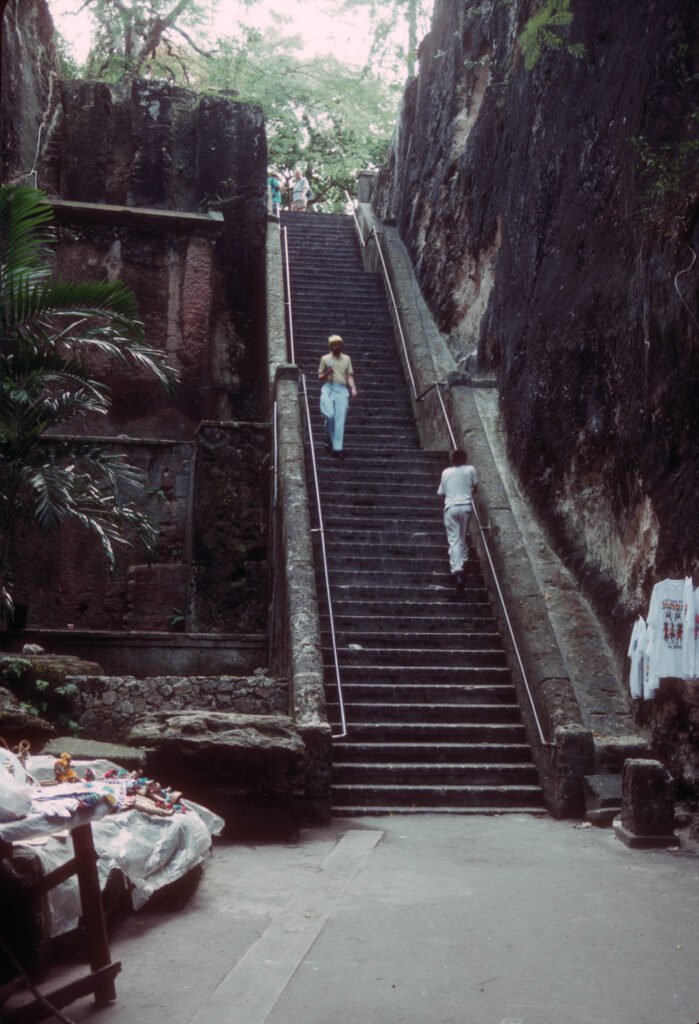
The Bahamas is best known internationally for its shallow, light-colored coastal waters and extensive coral reef and cay systems, which have made it one of the most recognized destinations for marine tourism and sport fishing in the Atlantic. In the capital, Nassau, the Queen’s Staircase stands as one of the country’s most visited and photographed historic monuments: a sixty-five-step passage carved directly into solid limestone in the late eighteenth century by enslaved laborers, connecting the city to Fort Fincastle above it. The staircase is popularly said to be named for Queen Victoria in recognition of her sixty-five-year reign, and it remains a widely used symbol of Nassau’s colonial-era history. Great Inagua, the country’s southernmost major island, hosts Inagua National Park, home to one of the largest breeding colonies of West Indian flamingos in the world; the flamingo is the Bahamas’ national bird. Inagua National Park and the country’s historic lighthouses are both on the Bahamas’ UNESCO World Heritage Tentative List, submitted in 2015, though the country does not yet have a property inscribed on the full World Heritage List.
Why the Bahamas Matters Globally
The Bahamas holds a distinct place in the history of contact between Europe and the Americas as the traditional site of Columbus’s first landfall in the Western Hemisphere, a single event with lasting consequences for the hemisphere’s subsequent history. As a small island state, it is also a frequently cited example of the economic and environmental vulnerabilities facing low-lying coastal nations, including exposure to hurricanes and to long-term sea-level rise, issues the country has raised repeatedly in international climate forums as a member of the Alliance of Small Island States. Its role as an international tourism hub and offshore financial center, meanwhile, has made it economically significant well beyond what its small population and land area would suggest.
Key Takeaways
- The Bahamas is an archipelagic country of more than 700 islands, cays, and islets in the Atlantic Ocean, southeast of Florida, with a land area of about 10,010 square kilometers and a population estimated at roughly 403,000 in 2025.
- San Salvador Island is traditionally identified as the site of Christopher Columbus’s first landfall in the Americas in 1492, and the islands were previously home to the Lucayan people.
- The Bahamas became a British crown colony, passed through an early eighteenth-century period as a pirate haven, and gained full independence on July 10, 1973, while remaining a member of the Commonwealth of Nations.
- The economy is built primarily on tourism and financial services, and the World Bank classifies the Bahamas as a high-income country, with GNI per capita of about US$37,020 in 2024.
- The Bahamas is best known for its clear coastal waters and reefs, for Nassau’s Queen’s Staircase, and for Inagua National Park, home to one of the world’s largest breeding colonies of West Indian flamingos, the national bird.
Sources
- World Bank, “World Bank Open Data: The Bahamas,” data updated July 13, 2026, https://data.worldbank.org/country/bahamas-the, accessed September 22, 2026.
- UNESCO World Heritage Centre, “States Parties: Bahamas,” undated live record, https://whc.unesco.org/en/statesparties/bs, accessed September 22, 2026.
- Government of The Bahamas, official government portal, undated, https://www.bahamas.gov.bs, accessed September 22, 2026.
Key facts
- Capital: Nassau, on New Providence Island1
- Population: approximately 403,000 (2025)1
- Land area: about 10,010 square kilometers across 700+ islands and cays1
- Independence from the United Kingdom: July 10, 1973
- GNI per capita (Atlas method): approximately US$37,020 (2024), classified high income by the World Bank1
Quick checkWhat event is San Salvador Island in the Bahamas traditionally associated with?Show answer
It is traditionally identified as the site of Christopher Columbus's first landfall in the Americas, on October 12, 1492.
Sources
- World Bank. World Bank Open Data: The Bahamas. Updated 2026-07-13 (accessed 2026-09-22)
- UNESCO World Heritage Centre. States Parties: Bahamas. Undated (accessed 2026-09-22)
- Government of The Bahamas. Official Government Portal. Undated (accessed 2026-09-22)
Editorially reviewed by Specialty Digest Editorial TeamLast reviewed September 22, 2026Researched and drafted with AI assistanceReport an issue