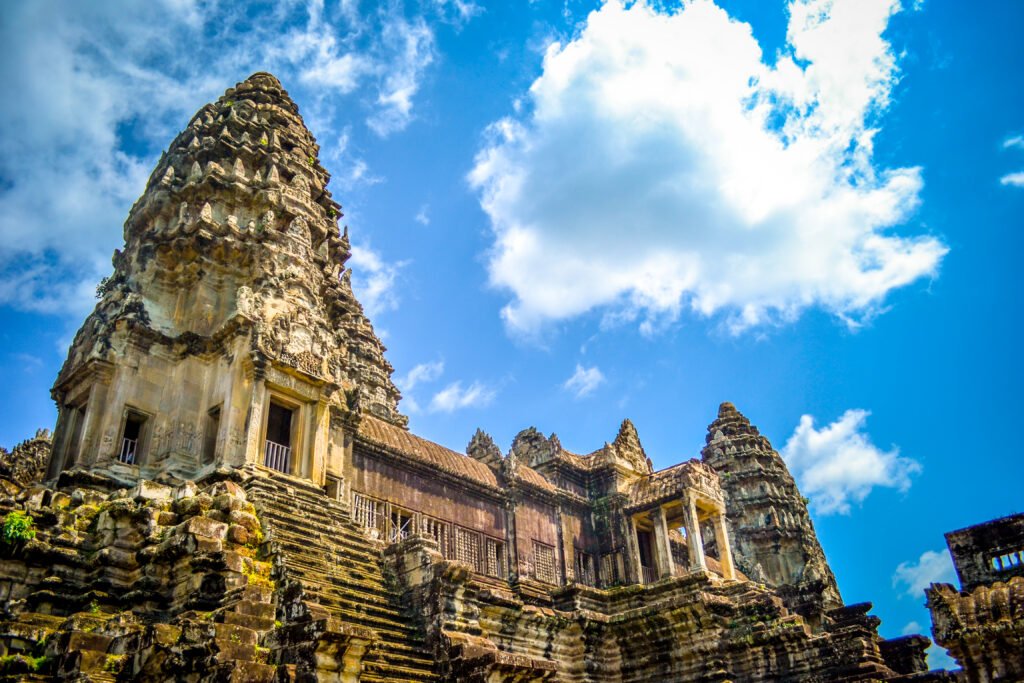
Where Cambodia Is
Cambodia is a country in mainland Southeast Asia, bordered by Thailand to the west and northwest, Laos to the northeast, Vietnam to the east and southeast, and the Gulf of Thailand to the southwest, according to Encyclopaedia Britannica. Its capital and largest city is Phnom Penh. A constitutional monarchy with a population of roughly 17.9 million people as of 2025, Cambodia is known globally above all for Angkor, the sprawling complex of stone temples built by the Khmer Empire, which once ruled much of mainland Southeast Asia from this same territory.
Key Takeaways
- Cambodia is a Southeast Asian country of about 17.9 million people, bordered by Thailand, Laos, Vietnam and the Gulf of Thailand, with its capital at Phnom Penh.
- It covers roughly 176,520 square kilometers (68,155 square miles) and is centered on the Tonle Sap, Southeast Asia’s largest freshwater lake, and the Mekong River.
- The Khmer Empire, founded in 802 CE, built Angkor into a capital of temples and reservoirs that may have supported over a million residents before its decline in 1431.
- Cambodia became a French protectorate in 1863 and regained independence in 1953, then endured the Khmer Rouge genocide of 1975 to 1979, in which more than a million people died.
- Today Cambodia is a constitutional monarchy and lower-middle-income economy that grew an average of 8.2 percent a year between 2000 and 2019.
- It is best known internationally for Angkor Wat, the largest religious monument in the world and a UNESCO World Heritage site.
Geography
Cambodia covers about 176,520 square kilometers (68,155 square miles), according to World Bank data, making it somewhat smaller than the U.S. state of Oklahoma. The country forms a lowland basin drained by the Mekong River, which crosses Cambodia from north to south on its way to Vietnam, and centered on the Tonle Sap, described by the International Union for Conservation of Nature (IUCN) as the largest lake in Southeast Asia and the world’s most productive freshwater fishing ground. Each monsoon season, rising water in the Mekong pushes back into the Tonle Sap River and reverses its flow, a rare hydrological event that lets the lake swell to roughly six times its dry-season area before draining again as the rains ease, the IUCN notes. Mountain ranges frame the lowland core: the Cardamom and Elephant mountains rise along the southwest coast, and the Dangrek range marks the northern border with Thailand. Cambodia has a tropical monsoon climate, with a wet season from roughly May to October and a drier period the rest of the year.
Brief History
The Angkorian Era (802-1431)
Cambodia’s history is inseparable from the Khmer Empire, which the ruler Jayavarman II founded in 802 CE when he was proclaimed a devaraja, or god-king, in a ceremony on Mount Mahendraparvata, according to the National Library of Australia. Later kings built the empire’s capital at Angkor, near modern Siem Reap, where a network of temples, reservoirs and canals may have supported over a million residents at its height. Angkor remained the empire’s political and spiritual center for roughly six centuries before its decline in 1431. Its greatest monument, Angkor Wat, was built by King Suryavarman II in the early twelfth century as a temple dedicated to the Hindu god Vishnu before gradually becoming a Buddhist site, and it covers about 162.6 hectares (402 acres), which the Cambodian government’s Angkor Enterprise describes as the largest religious monument in the world. Its silhouette appears on Cambodia’s national flag.
Colonial Period and Independence
France established a protectorate over Cambodia in 1863, incorporating it into French Indochina alongside Vietnam and Laos. Cambodia remained under French rule, with a brief interruption during the Japanese occupation of World War II, until King Norodom Sihanouk led a diplomatic campaign that secured full independence on November 9, 1953.
The Khmer Rouge Era (1975-1979)
Cambodia’s postcolonial stability collapsed amid the wider conflict in Indochina, and on April 17, 1975, the communist Khmer Rouge, led by Pol Pot, took power in Phnom Penh. Over the next three years and eight months, until the regime’s fall on January 6, 1979, the Khmer Rouge emptied cities, abolished money and private property, and subjected the population to forced labor, starvation and mass execution. According to the Extraordinary Chambers in the Courts of Cambodia (ECCC), a hybrid tribunal established jointly by the Cambodian government and the United Nations, more than one million people died under the regime, which the tribunal found responsible for genocide, crimes against humanity and war crimes. Operating from 2006 to 2022, the ECCC convicted several senior Khmer Rouge leaders, including a former head of state found guilty of genocide, the first such conviction by an internationally supported domestic tribunal.
Modern Cambodia
Vietnamese forces ended Khmer Rouge rule in 1979, but conflict and international isolation continued through the 1980s. A United Nations-supervised peace process led to elections in 1993 and the restoration of the constitutional monarchy. Since then, Cambodia has pursued reconstruction and economic development, joining ASEAN in 1999 and the World Trade Organization in 2004, while continuing to reckon with the Khmer Rouge period through the ECCC and public memorials such as Phnom Penh’s Tuol Sleng genocide museum.
Government and Economy
Cambodia is a constitutional monarchy: a king serves as head of state while an elected National Assembly and a prime minister who leads the Council of Ministers hold executive and legislative power under the 1993 constitution. The World Bank classifies Cambodia as a lower-middle-income economy, with GDP per capita of roughly $2,872 in 2025. Cambodia’s economy grew at an average of 8.2 percent a year between 2000 and 2019, among the fastest growth rates in the world over that period, driven largely by garment and footwear manufacturing, construction and tourism centered on Angkor. The COVID-19 pandemic caused the country’s first recession in 25 years in 2020, and growth has since recovered to an estimated 6.0 percent in 2024, supported by exports, tourism and consumer spending, per the World Bank. Cambodia achieved lower-middle-income status in 2015 and has set a goal of reaching upper-middle-income status by 2030.
Culture and People
The great majority of Cambodians are ethnic Khmer, and Khmer is the official language, written in a script that descends from ancient Indian scripts used across mainland Southeast Asia. Theravada Buddhism is the dominant religion and shapes daily life, from the saffron-robed monks seen throughout the country to the temple architecture that runs from ancient Angkor to village pagodas. Cambodian classical dance, known for its slow, sculptural hand and body movements, survived the Khmer Rouge era through performers and teachers who rebuilt the tradition afterward, and it remains a living link to the courtly arts depicted in Angkor’s stone carvings. Cambodian cuisine centers on rice, freshwater fish from the Tonle Sap and Mekong, and fermented condiments distinct from those of neighboring Thailand and Vietnam.
What Cambodia Is Best Known For Globally
Internationally, Cambodia is defined above all by Angkor, inscribed by UNESCO as a World Heritage site in 1992 for representing the full range of Khmer art and architecture from the ninth to the fourteenth centuries across roughly 400 square kilometers of temples and hydraulic works. Angkor Wat, its single largest and best-preserved monument, draws visitors and researchers from around the world and stands as the most recognizable symbol of Khmer civilization. Cambodia is also widely known, more somberly, for the Khmer Rouge genocide of 1975 to 1979, a period that continues to shape how the country is discussed in the fields of human rights, genocide studies and international law, particularly through the ECCC’s tribunal work.
Why Cambodia Matters
Cambodia matters as the direct heir to one of premodern Southeast Asia’s most sophisticated civilizations: Angkor’s temple and water-management complex remains a reference point for archaeologists and engineers studying how a preindustrial state organized land, labor and religion at scale. Cambodia also matters as a case study in postconflict recovery and transitional justice, since the ECCC represents one of the few internationally supported tribunals to secure a genocide conviction and remains closely studied by scholars of international law. Economically, Cambodia’s rapid, manufacturing-led growth since the 1990s and its exposure to global supply chains and climate pressures on the Mekong and Tonle Sap make it a closely watched example of development in the wider Mekong region.
Sources
- World Bank | Cambodia Overview | Undated (continuously updated) | Accessed 2026-09-22
- World Bank Open Data | Land Area: Cambodia | 2023 | Accessed 2026-09-22
- World Bank Open Data | GDP Per Capita: Cambodia | 2025 | Accessed 2026-09-22
- World Bank Open Data | Country Data: Cambodia | Undated | Accessed 2026-09-22
- UNFPA World Population Dashboard | Cambodia | 2025 | Accessed 2026-09-22
- UNESCO World Heritage Centre | Angkor | Inscribed 1992 | Accessed 2026-09-22
- National Library of Australia | The Rise of Angkor and the Khmer Empire | Accessed 2026-09-22
- EBSCO Research Starters | Cambodia Gains Independence from France | Accessed 2026-09-22
- Extraordinary Chambers in the Courts of Cambodia (ECCC) | Official Site | Accessed 2026-09-22
- IUCN | Locally Managed Fish Conservation Areas Build Drought Resilience in Tonle Sap | 2020 | Accessed 2026-09-22
- Angkor Enterprise, Royal Government of Cambodia | Angkor Wat | Accessed 2026-09-22
- Encyclopaedia Britannica | Cambodia | Last updated September 19, 2026 | Accessed 2026-09-22
Key facts
- Population approximately 17.9 million as of 20255
- Land area approximately 176,520 square kilometers (68,155 square miles) as of 20232
- Capital and largest city: Phnom Penh4
- Constitutional monarchy; lower-middle-income economy with GDP per capita around $2,872 in 202534
- Angkor inscribed as a UNESCO World Heritage site in 1992, covering roughly 400 square kilometers of temples6
Quick checkWhat UNESCO World Heritage site is Cambodia most famous for globally?Show answer
Angkor, the temple complex built by the Khmer Empire between the ninth and fourteenth centuries, including Angkor Wat, the largest religious monument in the world.
Sources
- World Bank. Cambodia Overview. Undated (continuously updated) (accessed Accessed 2026-09-22)
- World Bank Open Data. Land Area: Cambodia. 2023 (accessed Accessed 2026-09-22)
- World Bank Open Data. GDP Per Capita: Cambodia. 2025 (accessed Accessed 2026-09-22)
- World Bank Open Data. Country Data: Cambodia. Undated (accessed Accessed 2026-09-22)
- UNFPA World Population Dashboard. Cambodia. 2025 (accessed Accessed 2026-09-22)
- UNESCO World Heritage Centre. Angkor. Inscribed 1992 (accessed Accessed 2026-09-22)
- National Library of Australia. The Rise of Angkor and the Khmer Empire. Undated (accessed Accessed 2026-09-22)
- EBSCO Research Starters. Cambodia Gains Independence from France. Undated (accessed Accessed 2026-09-22)
- Extraordinary Chambers in the Courts of Cambodia (ECCC). Official Site. Undated (accessed Accessed 2026-09-22)
- IUCN. Locally Managed Fish Conservation Areas Build Drought Resilience in Tonle Sap. 2020 (accessed Accessed 2026-09-22)
- Angkor Enterprise, Royal Government of Cambodia. Angkor Wat. Undated (accessed Accessed 2026-09-22)
- Encyclopaedia Britannica. Cambodia. Last updated September 19, 2026 (accessed Accessed 2026-09-22)
Editorially reviewed by Specialty Digest Editorial TeamLast reviewed September 22, 2026Researched and drafted with AI assistanceReport an issue