Cameroon is a country in Central Africa on the Gulf of Guinea, bordered by Nigeria to the west, Chad to the north, the Central African Republic to the east, and the Republic of the Congo, Gabon, and Equatorial Guinea to the south. It covers about 475,442 square kilometers and is often called “Africa in miniature” because its territory bridges West and Central Africa, holding coastal plains, dense rainforest, volcanic mountains, and semi-arid savanna within a single country. The capital is Yaoundé, while the port city of Douala serves as the country’s main economic and commercial hub, and the population reached roughly 28.4 million in 2023.
Key Takeaways
- Cameroon covers about 475,442 square kilometers and borders six countries: Nigeria, Chad, the Central African Republic, the Republic of the Congo, Gabon, and Equatorial Guinea.
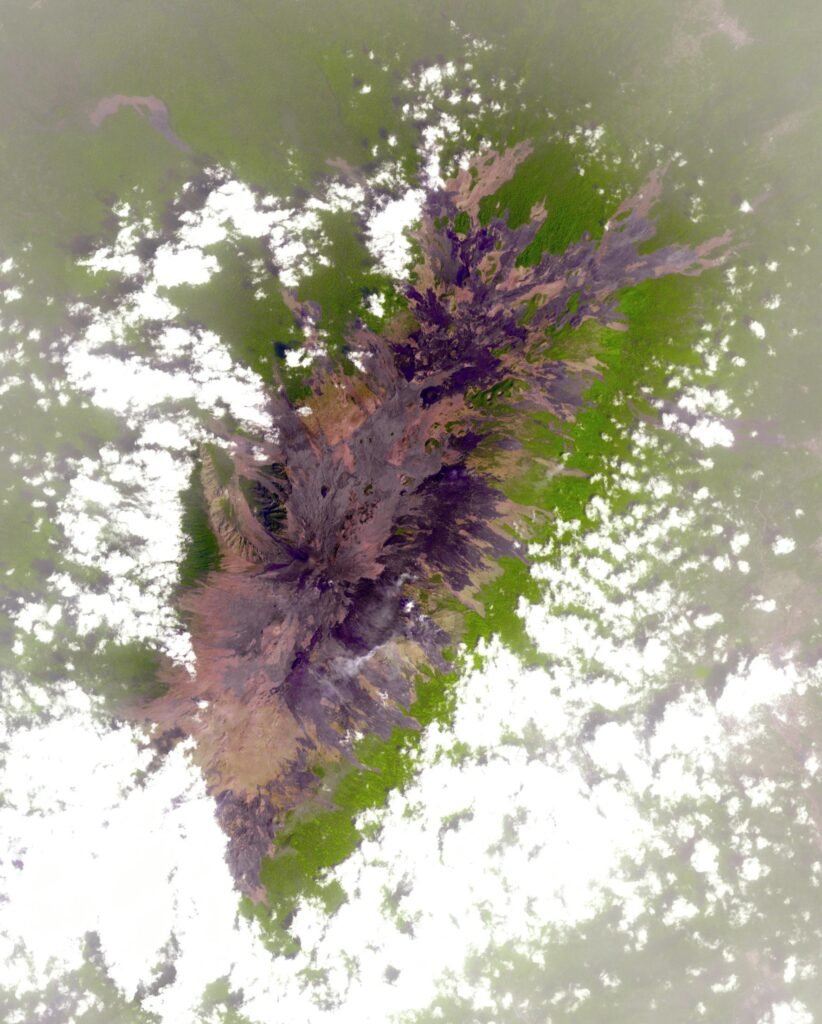
- Mount Cameroon, an active stratovolcano rising to 4,095 meters near the Gulf of Guinea coast, is the highest point in West and Central Africa and last erupted in 2000.
- French and English are co-official languages, spoken by about 70 percent and 30 percent of the population respectively, alongside an estimated 250 or more local languages.
- More than 1 million people remain internally displaced by overlapping conflicts in the Far North, Northwest, and Southwest regions, according to 2025 humanitarian assessments.
- The Dja Faunal Reserve, a UNESCO World Heritage Site since 1987, protects about 526,000 hectares of rainforest and more than 100 mammal species.
- The Indomitable Lions became the first African football team to reach a World Cup quarterfinal, in 1990.
Geography
Cameroon’s terrain rises from a narrow Atlantic coastline in the southwest to a volcanic highland belt running northeast across the country, then flattens into the semi-arid Sahel fringe near Lake Chad in the Far North. This span gives Cameroon four of Africa’s major climate zones within one border: equatorial in the south, tropical along the coast, temperate in the western highlands, and semi-arid in the north.
The country’s signature landform is Mount Cameroon, an active stratovolcano that rises 4,095 meters above the Bight of Biafra near the coastal town of Limbe, making it the highest peak in West and Central Africa. Built largely from basaltic lava and studded with more than 100 small cinder cones, the volcano has erupted repeatedly over the past century, most recently in 2000.
Tropical forest covers close to 40 percent of Cameroon’s land area, part of the wider Congo Basin, the world’s second-largest contiguous rainforest. In the south and east, the Dja Faunal Reserve, a UNESCO World Heritage Site since 1987, protects roughly 526,000 hectares of largely undisturbed primary forest that shelters western lowland gorillas, chimpanzees, forest elephants, and at least 14 primate species.
Brief History
Long before European contact, the region was home to a succession of kingdoms and societies, including the Sao civilization near Lake Chad and, later, the Bamum and Fulani states of the north and west. German explorer Gustav Nachtigal claimed the Douala coast for Germany in July 1884, establishing the protectorate of Kamerun. German colonial rule lasted just over three decades before World War I ended it; the territory was then split into separate French and British mandates under the League of Nations in 1919.
French Cameroun gained independence on January 1, 1960, with Ahmadou Ahidjo becoming the republic’s first president. In February 1961, the United Nations supervised a plebiscite in the neighboring British Cameroons: the southern part voted to unite with the newly independent republic, forming the Federal Republic of Cameroon, while the northern part voted to join Nigeria. The federation gave way to a unitary state in 1972, a structural shift that still shapes tension between the country’s Francophone majority and Anglophone minority today.
Government and Economy
Cameroon is a republic with a strong presidential executive. The president serves as head of state and commander of the armed forces, appoints the prime minister and cabinet, and is elected to seven-year terms. Parliament is bicameral, combining a directly elected National Assembly with a Senate that mixes indirectly elected and presidentially appointed members. The country moved from one-party rule to a multiparty system through a 1990 constitutional revision and is organized into ten administrative regions.
Agriculture employs close to 60 percent of the workforce and anchors the economy, with cocoa, coffee, cotton, cassava, and maize among the leading products alongside oil, gas, and timber exports. Real GDP grew 3.5 percent in 2024, and GDP per capita reached about $1,467, surpassing pre-pandemic levels. Even so, growth has consistently trailed national development targets, close to 40 percent of Cameroonians live below the national poverty line, and the economy faces recognized structural challenges, including infrastructure gaps and declining export diversification.
Since 2016, overlapping crises have strained the country: non-state armed groups linked to the Lake Chad Basin insurgency operate in the Far North, while a separatist conflict in the Northwest and Southwest regions, rooted in longstanding disputes over the status of the Anglophone minority, has driven large-scale displacement. As of early 2025, humanitarian agencies estimated that more than 1 million people remained internally displaced and about 3.3 million people needed humanitarian assistance nationwide.
Culture and People
Cameroon is one of Africa’s most ethnically diverse countries, with more than 200 distinct ethnic groups and over 250 local languages spoken alongside French and English, the co-official languages inherited from colonial administration. About 70 percent of the population speaks French and about 30 percent speaks English as a primary official language, a divide that maps closely onto the country’s eight Francophone and two Anglophone regions. Religious life is similarly mixed: an estimated 71 percent of the population is Christian and 24 percent is Muslim, with the remainder following indigenous or other belief systems; Islam is concentrated mainly in the northern regions.
This diversity extends into music: Cameroon helped shape modern African popular music through makossa, a genre that grew out of Douala’s urban dance scene and reached international audiences from the 1970s onward, and through bikutsi, a rhythm rooted in the traditions of the country’s Beti communities.
What Cameroon Is Best Known for Globally
Internationally, Cameroon is probably best known for two things: its environmental range and its football team. The national side, nicknamed the Indomitable Lions, became the first African team to reach a World Cup quarterfinal, at the 1990 tournament in Italy, a run driven in part by 38-year-old substitute Roger Milla, who scored four goals and popularized a corner-flag goal celebration that influenced players worldwide. Mount Cameroon and the Dja Faunal Reserve give the country a parallel reputation among scientists and conservationists as one of the most biologically significant parts of Central Africa.
Why Cameroon Matters
Cameroon sits at a genuine hinge point on the African continent: geographically, linguistically, and economically. Its position linking West and Central Africa, its bilingual French-English system of government, and its role hosting more than 400,000 refugees from neighboring Chad, the Central African Republic, and Nigeria make it a regional stabilizer even as it manages internal conflict. Its share of the Congo Basin rainforest contributes to a carbon sink with significance well beyond Cameroon’s borders, and its long record of ethnic and religious coexistence, despite real and documented strains in its Anglophone regions, makes it a useful case study in how diverse societies govern themselves.
Sources
- World Bank: Cameroon Overview
- World Bank: Cameroon Country Page
- UNESCO World Heritage Centre: Dja Faunal Reserve
- Smithsonian Global Volcanism Program: Cameroon (Mount Cameroon)
- UN OCHA: Cameroon Humanitarian Needs Overview 2025
- UNFPA: Cameroon Situation Report #29
- Encyclopaedia Britannica: Cameroon, Moving Toward Independence
- Encyclopaedia Britannica: Cameroon, German Kamerun 1884-1916
- Encyclopaedia Britannica: Cameroon, Government and Society
- Presidency of the Republic of Cameroon: Official Country Profile
- UNEP Interactive Country Fiches: Cameroon
- US Commission on International Religious Freedom: Religious Freedom in Central Africa Factsheet
- Encyclopaedia Britannica: Roger Milla
Key facts
- Cameroon covers about 475,442 square kilometers and borders six countries: Nigeria, Chad, the Central African Republic, the Republic of the Congo, Gabon, and Equatorial Guinea1011.
- Mount Cameroon, an active stratovolcano rising to 4,095 meters near the Gulf of Guinea coast, is the highest point in West and Central Africa and last erupted in 20004.
- The population reached approximately 28.4 million in 2023, with French spoken by about 70 percent and English by about 30 percent as co-official languages110.
- More than 1 million people remain internally displaced by overlapping conflicts in the Far North, Northwest, and Southwest regions, per the 2025 humanitarian needs assessment5.
- The Dja Faunal Reserve, a UNESCO World Heritage Site since 1987, protects roughly 526,000 hectares of rainforest and more than 100 mammal species3.
Quick checkWhat is Cameroon best known for?Show answer
Cameroon is best known as 'Africa in miniature' for packing rainforest, savanna, coastline, and Mount Cameroon, the region's tallest volcano, into one country, and for its Indomitable Lions football team, the first African side to reach a World Cup quarterfinal (1990).
Sources
- 1. World Bank. Cameroon Overview. 2025 (accessed 2026-09-22)
- 2. World Bank. Cameroon Country Page. 2025 (accessed 2026-09-22)
- 3. UNESCO World Heritage Centre. Dja Faunal Reserve. n.d. (accessed 2026-09-22)
- 4. Smithsonian Global Volcanism Program. Cameroon (Mount Cameroon). n.d. (accessed 2026-09-22)
- 5. UN OCHA. Cameroon Humanitarian Needs Overview 2025. January 2025 (accessed 2026-09-22)
- 6. UNFPA. Cameroon Situation Report #29. February 2025 (accessed 2026-09-22)
- 7. Encyclopaedia Britannica. Cameroon: Moving Toward Independence. n.d. (accessed 2026-09-22)
- 8. Encyclopaedia Britannica. Cameroon: German Kamerun 1884-1916. n.d. (accessed 2026-09-22)
- 9. Encyclopaedia Britannica. Cameroon: Government and Society. n.d. (accessed 2026-09-22)
- 10. Presidency of the Republic of Cameroon. Official Country Profile. n.d. (accessed 2026-09-22)
- 11. UNEP. Interactive Country Fiches: Cameroon. n.d. (accessed 2026-09-22)
- 12. US Commission on International Religious Freedom. Religious Freedom in Central Africa Factsheet. 2023 (accessed 2026-09-22)
- 13. Encyclopaedia Britannica. Roger Milla. n.d. (accessed 2026-09-22)
- 14. NASA/JPL-Caltech. Mount Cameroon (PIA18825). 2015 (accessed 2026-09-22)
Editorially reviewed by Specialty Digest Editorial TeamLast reviewed September 22, 2026Researched and drafted with AI assistanceReport an issue