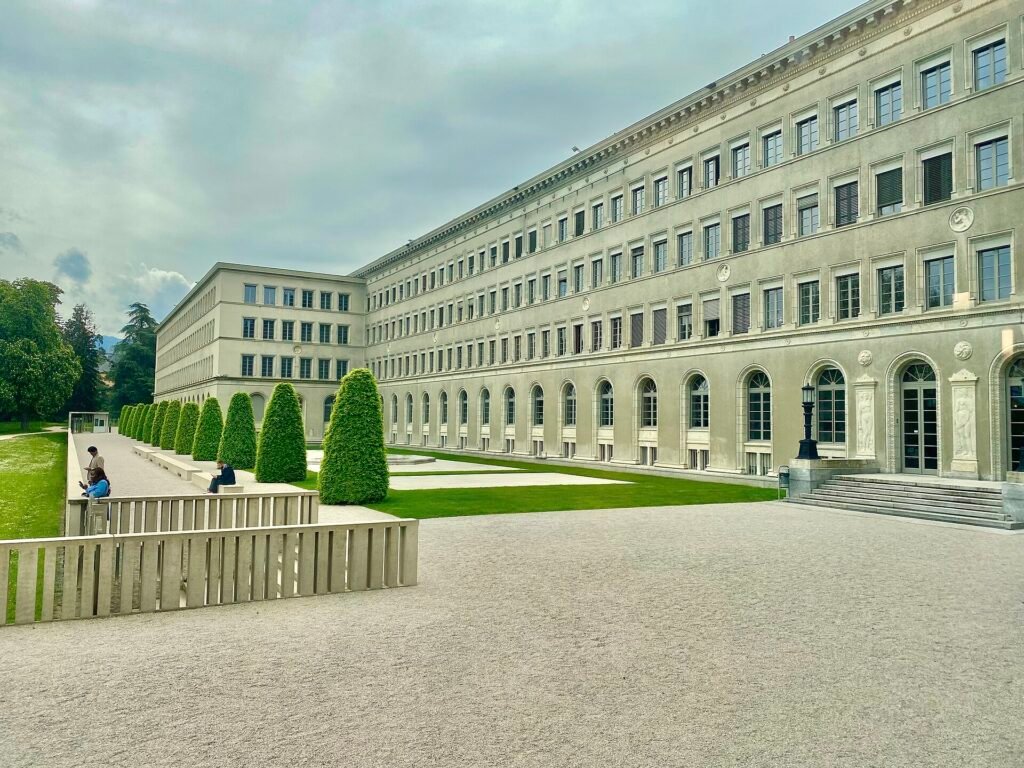
The World Trade Organization, or WTO, is an intergovernmental organization that administers the rules of trade between nations, hosts trade negotiations and settles trade disputes among its members. It began operating on 1 January 1995 and is based in Geneva, Switzerland. It has 166 members, which together account for 98 percent of world trade.
History of the WTO
The WTO’s roots lie in the aftermath of World War II. More than 50 countries negotiated a charter for an International Trade Organization, planned as a specialized agency of the United Nations and as a third pillar beside the World Bank and the International Monetary Fund. The draft charter was ambitious and went beyond trade to cover employment, commodity agreements, restrictive business practices, international investment and services. The charter was to be adopted at a United Nations conference in Havana, Cuba, but the attempt failed in 1948 and the organization never came into being.
Meanwhile, 15 countries had opened talks in December 1945 to reduce and bind customs tariffs. Their first round produced a package of rules and 45,000 tariff concessions covering $10 billion of trade, about one fifth of the world total. The group had grown to 23 countries by 30 October 1947, when the deal was signed. The concessions took effect by 30 June 1948 through a Protocol of Provisional Application, and the General Agreement on Tariffs and Trade, known as GATT, was born with 23 founding contracting parties.
GATT was meant to be temporary, but it governed much of world trade from 1948 to 1994. Negotiating rounds moved through Annecy, Torquay, Tokyo, Punta del Este, Montreal and Brussels before ending in Marrakesh, Morocco, in 1994. By the 1980s the system needed an overhaul, and the Uruguay Round of 1986 to 1994 produced the WTO. Its creation on 1 January 1995 was the biggest reform of international trade since the end of the war.
Structure and membership
Every WTO member joined through negotiation, so membership is a balance of rights and obligations. The WTO reports that more than 20 other countries are negotiating to join. Unlike the World Bank and the IMF, the WTO does not delegate power to a board of directors or to its head.
The main decision-making body is the Ministerial Conference, which usually meets every two years. Below it sits the General Council, which meets several times a year in Geneva and acts for the conference in between. The General Council also meets as the Dispute Settlement Body and as the Trade Policy Review Body, and many councils, committees and working groups handle individual agreements and topics such as the environment, development and membership applications.
The Secretariat had 623 staff in 2024, drawn from about 80 nationalities and made up mostly of economists, lawyers and trade specialists. It is led by a Director-General. Ngozi Okonjo-Iweala, the seventh person to hold the post, took office on 1 March 2021 as the first woman and the first African in the role. The working languages are English, French and Spanish.
What the WTO does
The WTO lists six functions: administering trade agreements, serving as a forum for trade negotiations, handling trade disputes, monitoring national trade policies, giving technical assistance and training to developing countries, and cooperating with other international organizations. The Secretariat supports these tasks by servicing committees, analyzing trade developments, giving technical help to developing countries and organizing ministerial conferences. It also provides legal assistance in the dispute process and advises governments that want to join.
Negotiations continue between the big rounds. In February 1997, 69 governments agreed to wide-ranging liberalization in telecommunications services, and in the same year 40 governments concluded a deal for tariff-free trade in information technology products.
How the WTO settles disputes
The WTO calls dispute settlement the central pillar of the multilateral trading system. Members agree that if they think another member is breaking the rules, they will use the shared procedure instead of acting alone. A dispute begins when one member adopts a measure that another considers a breach of WTO agreements, and other interested members can join as third parties.
A panel makes the first ruling, which the full membership then endorses or rejects, and appeals on points of law are possible. The stated priority is to settle disputes, through consultations if possible, rather than to pass judgment. By January 2008, only about 136 of nearly 369 cases had reached the full panel process, and the rest were mostly settled out of court or remained in long consultation. The Uruguay Round added fixed timetables and a more structured process, which the old GATT system lacked.
Funding and budget
The WTO draws most of its income from member contributions. These follow a formula based on each member’s share of international trade. Larger trading economies therefore carry a bigger share of the cost. The budget for 2024 was 205 million Swiss francs, and the Secretariat is funded from it.
Criticism and challenges
The best-documented challenge concerns appeals. The Appellate Body, a standing body of seven persons created in 1995, hears appeals from panel reports and can uphold, modify or reverse legal findings. Its reports are adopted unless all members decide against it. The WTO states that the body is currently unable to review appeals because of vacancies, and the term of the last sitting member expired on 30 November 2020. Until the vacancies are filled, the appeal stage of the dispute process cannot function as designed.
Legacy and impact
The WTO describes the postwar trading system as one that helped produce exceptional growth. Merchandise exports grew by an average of 6 percent a year over the 50 years to 2000, and total trade in 2000 was 22 times the level of 1950. The system rests on a simple idea, that agreed rules and a neutral way to settle quarrels make trade more predictable. Many of its details, from the tariff schedules to the dispute timetables, remain a product of negotiation among its members.
Key facts
- The WTO was established on 1 January 1995 and is based in Geneva.1
- It has 166 members, which account for 98 percent of world trade.1
- Its predecessor, GATT, was signed on 30 October 1947 by 23 countries.2
- Its 2024 budget was 205 million Swiss francs, funded by member contributions based on trade shares.1
- The Appellate Body cannot review appeals, and its last sitting member's term expired on 30 November 2020.3
Related concepts
Quick checkWhat was the WTO's predecessor?Show answer
The General Agreement on Tariffs and Trade, or GATT, signed in 1947 and in operation from 1948 to 1994, was replaced by the WTO on 1 January 1995.
Sources
- World Trade Organization, Who we are, https://www.wto.org/english/thewto_e/whatis_e/who_we_are_e.htm
- World Trade Organization, The GATT years: from Havana to Marrakesh, https://www.wto.org/english/thewto_e/whatis_e/tif_e/fact4_e.htm
- World Trade Organization, Dispute settlement: Appellate Body, https://www.wto.org/english/tratop_e/dispu_e/appellate_body_e.htm
- World Trade Organization, Settling disputes: a unique contribution, https://www.wto.org/english/thewto_e/whatis_e/tif_e/disp1_e.htm
- World Trade Organization, The WTO in brief, https://www.wto.org/english/thewto_e/whatis_e/inbrief_e/inbr01_e.htm
Editorially reviewed by Specialty Digest Editorial TeamLast reviewed November 4, 2026Researched and drafted with AI assistanceReport an issue