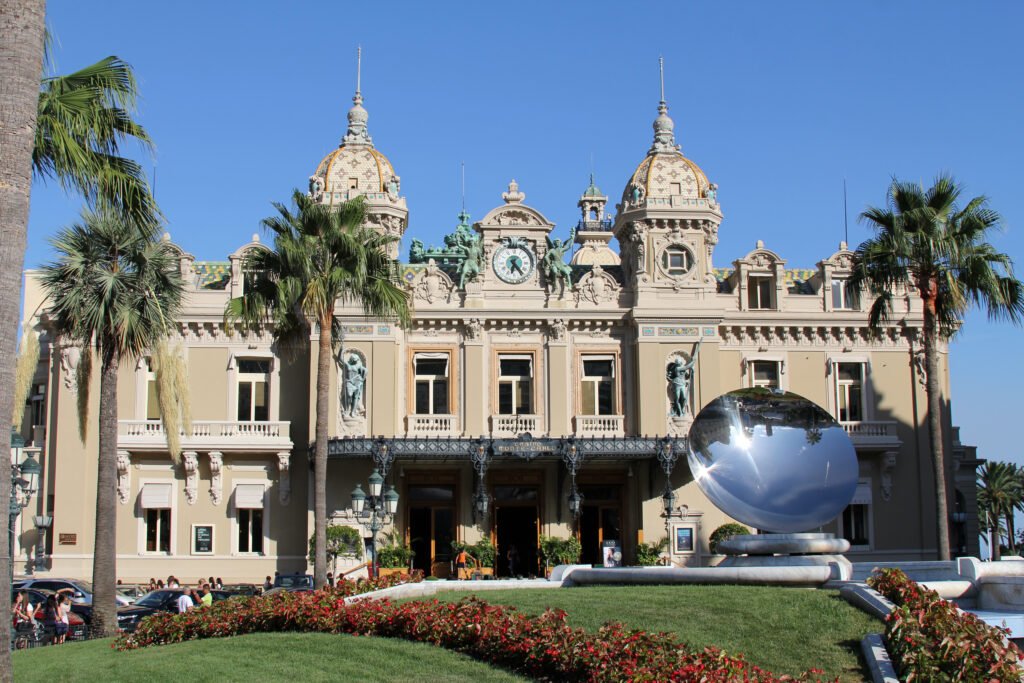
Monaco is a sovereign city-state on the Mediterranean coast of southwestern Europe, almost entirely surrounded by France and bordering the sea to its south. Covering only about two square kilometers, it is the world’s second smallest sovereign state after Vatican City, yet with a population of roughly 38,000 people it is also, by most measures, the most densely populated country on earth.
Where Is Monaco Located?
Monaco sits on a narrow strip of the French Riviera, wedged between the Mediterranean Sea and the hills of southeastern France, close to the Italian border. Its entire territory is urbanized, divided into a handful of districts including Monaco-Ville, the old town on a rocky promontory, and Monte Carlo, its famous district of casinos, hotels, and harbor front development. Because it has almost no undeveloped land left, Monaco has expanded its footprint over the past century through land reclamation from the sea.
A Brief History of Monaco
Monaco has been ruled by the House of Grimaldi since 1297, when Francois Grimaldi seized the fortress on the rock of Monaco, making it one of the longest ruling royal families in the world. The principality was placed under French protection in the seventeenth century and later under the protection of the Kingdom of Sardinia, before a treaty with France in 1861 confirmed its independence in exchange for ceding most of its surrounding territory. Its modern prosperity dates largely to the opening of the Monte Carlo Casino in 1863, which transformed Monaco from a small, financially struggling principality into a resort destination for European aristocracy.
Government and Economy
Monaco is a constitutional monarchy ruled by the Prince of Monaco, with an elected National Council responsible for legislation. The World Bank classifies Monaco as a high income economy. Its finances rest heavily on tourism, banking and financial services, and real estate, supported by a tax regime that levies no personal income tax on residents, a policy that has long attracted wealthy individuals and helped fund the state’s public services without broad-based direct taxation.
Culture and People
French is Monaco’s official language, though Monegasque, a language related to the Ligurian dialects of nearby Italy, is recognized as the national language and taught in schools alongside French. Monaco’s population is unusually international, with citizens of Monaco, known as Monegasques, forming only a minority of residents alongside large French, Italian, and other foreign communities. The principality’s cultural calendar centers on high profile events, including the Monaco Grand Prix, a Formula One race run through the streets of the city since 1929, and the Monte Carlo Casino, one of the most recognized gambling venues in the world.
What Is Monaco Known For?
Monaco’s single most recognizable landmark is the Monte Carlo Casino, an ornate Belle Epoque building opened in 1863 and expanded over subsequent decades, designed in part by Charles Garnier, the architect of the Paris Opera. Perched above the harbor in the Monte Carlo district, the casino’s gilded facade and gardens have become the visual shorthand for Monaco worldwide, appearing throughout film and popular culture as a symbol of European luxury and high stakes gaming, even though Monegasque citizens themselves are barred by law from gambling inside it.
Why Monaco Matters
Monaco’s significance lies less in its size than in what it represents: a functioning sovereign state built almost entirely on finance, tourism, and reputation rather than natural resources or agriculture. Its combination of extreme population density, a centuries old ruling dynasty, and a globally recognized luxury brand makes it a distinctive case study in small state economics and governance.
Key Takeaways
- Monaco is a constitutional monarchy on the French Riviera and the world’s second smallest sovereign state, covering about two square kilometers.
- It has been ruled by the House of Grimaldi since 1297, one of the longest reigning dynasties in the world.
- The World Bank classifies Monaco as a high income economy built on tourism, banking, and real estate, with no personal income tax on residents.
- Its population of about 38,000 makes it the most densely populated country on earth.
- The Monte Carlo Casino, opened in 1863, is Monaco’s single most iconic landmark.
Sources
Key facts
Quick checkWhich royal family has ruled Monaco since 1297?Show answer
The House of Grimaldi.
Sources
- The World Bank. World Development Indicators, Monaco. 2025 (accessed 2026-09-28)
Editorially reviewed by Specialty Digest Editorial TeamLast reviewed September 28, 2026Researched and drafted with AI assistanceReport an issue