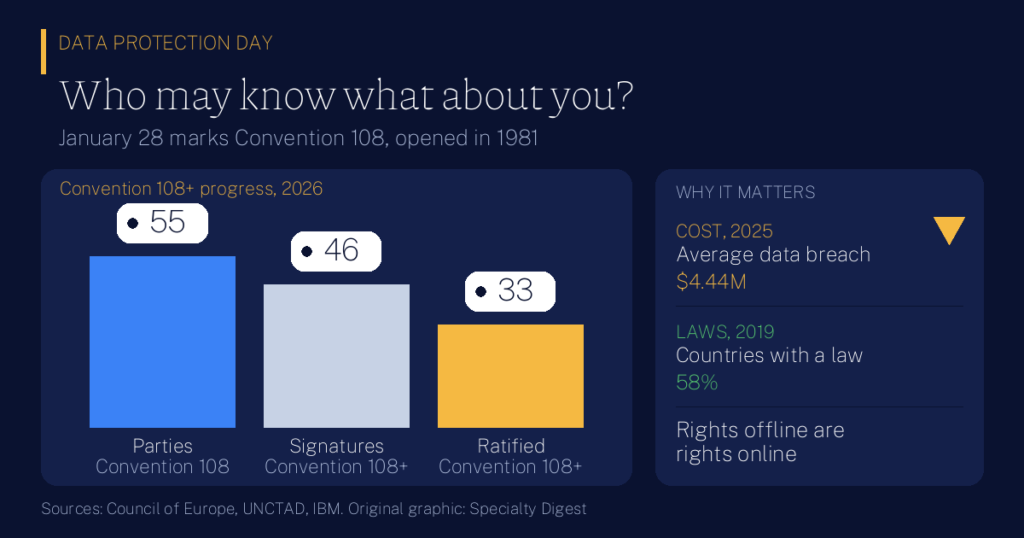
Every time an app asks for your location, a clinic stores your records or a bank checks your identity, a quiet question sits underneath: who may know what about you, and what may they do with it? Data Protection Day, observed every year on January 28, exists to put that question in front of the public. It is led by the Council of Europe, the organization whose treaty on the subject opened for signature on that very date in 1981. In many countries the same day is known as Data Privacy Day.
A treaty written before the web
The story starts in Strasbourg. On January 28, 1981, the Council of Europe opened Convention 108 for signature. The Council describes it as the first ever binding international treaty addressing the need to protect personal data. At the time, large computers in government offices and banks were beginning to hold records about millions of people, and lawmakers saw that old privacy rules did not cover the new reality.
The idea of privacy is older still. The Universal Declaration of Human Rights, adopted in 1948, says in Article 12 that no one should face arbitrary interference with their privacy, family, home or correspondence. Convention 108 turned that principle into practical rules for the handling of personal information.
The date later became a day of public awareness. In 2021 the Council marked both the 40th anniversary of the Convention and the 15th Data Protection Day, which places the first observance in 2007. The 2026 edition is the 20th.
What counts as personal data
Personal data is any information that relates to an identified or identifiable person. A name and a photograph obviously qualify, but so do an ID number, a home address, a health record, a device identifier or a location trail. Privacy is the broad idea of being left alone. Data protection is the narrower, practical set of rules about how organizations may collect, use, store and share that information.
Modern data protection laws tend to rest on a few shared principles. Data should be collected fairly and for a stated purpose, limited to what is needed, kept accurate, stored no longer than necessary and guarded against loss or theft. People are usually given rights too, such as seeing the data held about them, asking for corrections and objecting to certain uses.
Example 1: the flashlight app. Imagine a free flashlight app that asks for your contacts and location. A data protection mindset asks a simple question: does a flashlight need either one? If the answer is no, collecting them breaks the idea of limiting data to what is needed. The app and its numbers here are invented for illustration, but the test applies to real services every day.
The treaty today
Convention 108 has grown well beyond its European origins. In its 2026 Data Protection Day statement, the Council of Europe says the Convention brings together 55 countries and 41 observers. In 2021 it already described 55 parties on four continents.
The treaty was updated to keep pace with technology. The modernized version, known as Convention 108+, dates from 2018. The Council reports that it has received 46 signatures and 33 ratifications, and is only five ratifications away from entering into force. That implies a threshold of 38 ratifications, which is our arithmetic from the Council’s figures.
How many countries have a law
Treaties help, but protection in daily life depends on national law. A survey published by the UN Conference on Trade and Development (UNCTAD) in January 2019 found that only 58 percent of the countries it tracked reported having data protection and privacy laws, and another 10 percent were working on draft legislation. The tracker covered 194 member countries at the time. These figures are now several years old, and the share with laws has probably risen, so treat them as a snapshot of the early gap rather than today’s count.
Why it matters: the cost of getting it wrong
When protection fails, the damage is concrete. IBM’s yearly study of breached organizations put the global average cost of a data breach at $4.88 million in 2024, a rise of 10 percent on the year before. In 2025 the average fell to $4.44 million, down 9 percent, and the mean time to identify and contain a breach was 241 days, the lowest in nine years. Those are costs to organizations, and they do not capture the harm to the people whose information was exposed, such as fraud, stolen identities or embarrassment.
- 55countries in Convention 108, 2026
- 41observers to the Convention
- 33ratifications of Convention 108+
- $4.44Maverage cost of a breach, 2025
Example 2: the cost of a small leak. Suppose a small clinic loses 1,000 patient files. If each file leads to a modest cost for notices, monitoring and repairs, say $100, the clinic faces a bill of about $100,000 before any fines or lost trust. The numbers are round and made up, but they show how quickly a modest leak becomes expensive, and why collecting less data to begin with is the cheapest protection.
Rights online, and who is left behind
The United Nations has also weighed in. In December 2013 the General Assembly adopted by consensus a resolution on the right to privacy in the digital age, crafted by Brazil and Germany. According to UN News, it affirmed for the first time that the same rights people have offline must also be protected online. It called on states to respect and protect the right to privacy in digital communication and to maintain independent, effective domestic oversight, and it asked the High Commissioner for Human Rights to report on the subject.
The gaps that remain are about who can actually use these rights. Where no law exists, a person who finds their data misused has fewer places to turn. Even where laws exist, people with limited internet experience may not know what they have agreed to. That is a reasoned observation rather than a statistic, but it explains why awareness days matter: a right nobody knows about is hard to exercise.
How the day is marked, and what you can do
Each January 28 the Council of Europe and its partners hold events, publish statements and encourage schools, companies and public bodies to talk about privacy. In 2026 the Council used the 20th edition to urge more countries to ratify the modernized Convention.
You do not need a conference to take part. Review which apps have access to your contacts, camera and location. Look for the settings that let you download or delete the data a service holds. Use a different strong password for each important account. Ask a business why it needs a piece of information before you hand it over.
Example 3: a ten-minute check. Say you review 20 apps on your phone and find that 5 have location access they do not need. Switching those off takes a few minutes and removes a quarter of that exposure. The apps here are hypothetical, but the habit of an annual check on January 28 is easy to keep.
Key Takeaways
- The day marks a landmark treaty. Convention 108 opened for signature on January 28, 1981, as the first binding international treaty on personal data.
- Data protection is about rules, not secrecy. It governs how personal information is collected, used, kept and shared.
- The treaty keeps growing. In 2026 it brought together 55 countries and 41 observers, and 108+ is five ratifications from entering into force.
- Laws were uneven. A 2019 UNCTAD survey found 58 percent of countries reported a data protection law.
- Failures are costly. IBM put the average breach at $4.44 million in 2025, and people bear harms that figure does not count.
- Rights apply online. The UN General Assembly affirmed in 2013 that offline rights must also be protected online.
- Small habits help. Share less, check app permissions and ask why data is needed.
How solid is this? Treaty counts come from Council of Europe statements dated 2021 and 2026 and change as states ratify. The UNCTAD shares date from 2019 and are self-reported. The IBM figures are survey-based estimates of organizational cost. The three worked examples use round, made-up numbers to show an idea. See also the International Days hub and the International Days Calendar.
More in Society
- Council of Europe, Data Protection Day
- Council of Europe, Data Protection Day: 40 years of Convention 108 (2021)
- Council of Europe, 20th Data Protection Day (2026)
- UNCTAD, Map sheds light on state of data protection around the globe (2019)
- UN News, General Assembly backs right to privacy in digital age (2013)
- IBM, Cost of a Data Breach Report 2024
- IBM, Cost of a Data Breach Report 2025