Most people want to live among neighbors they can trust, yet history shows how quickly fear of difference can turn into suspicion, discrimination and violence. The International Day of Human Fraternity, observed every year on February 4, asks a simple question: what would it take to treat every person, whatever their faith or background, as a member of one human family? The United Nations answers with a day devoted to dialogue, mutual respect and the daily work of living together. It sits naturally beside the International Day for Tolerance, but it asks for more than putting up with others. It asks for solidarity.
From Abu Dhabi to the General Assembly
The day grows out of a single meeting. On February 4, 2019, Pope Francis and the Grand Imam of Al-Azhar, Ahmad al-Tayyib, met in Abu Dhabi and signed a document titled “Human Fraternity for World Peace and Living Together.” The United Nations records that it was co-authored by the two leaders, one the head of the Catholic Church and the other a leading figure in Sunni Islam.
Less than two years later the idea became a global observance. In December 2020 the General Assembly adopted resolution 75/200, which proclaimed February 4 as the International Day of Human Fraternity. UN News reports that Egypt and the United Arab Emirates co-sponsored it. The date was chosen to mark the anniversary of the Abu Dhabi meeting. The first observance took place on February 4, 2021, with a message from the Secretary-General calling for more work on cultural and religious tolerance, understanding and dialogue. At that first event, the High Representative of the UN Alliance of Civilizations described human fraternity as the best antibody against hate.
What “fraternity” asks of us
Fraternity is an older word than tolerance and a warmer one. Tolerance says “I will not interfere with you.” Fraternity says “your wellbeing is bound up with mine.” The resolution takes note of initiatives at every level, international, regional, national and local, that promote this spirit, and it invites everyone, from governments to schools and faith communities, to take part. In practice this means three habits: listening before judging, sharing public spaces on equal terms, and standing up when someone else is targeted for who they are.
None of this requires anyone to give up their own beliefs. The idea is not that all faiths or cultures are the same, but that differences can sit alongside a shared respect for human dignity. A person can hold deep convictions and still treat a neighbor with fairness, curiosity and care. That balance is the quiet daily work the observance celebrates.
Example 1: the shared playground. Imagine a town where families of three different faiths live on the same street but their children attend separate schools and rarely meet. A local group invites all of them to build a playground together. Within a year, say, 40 children from 30 households play there each week. The numbers are round and illustrative, but the idea is real: contact on equal terms is how strangers become neighbors.
Why the day is still needed
The Secretary-General’s message for the 2025 observance warned of “a surge of discrimination, xenophobia and intolerance driving people apart,” and urged leaders, including religious leaders, to seek dialogue over division and to confront hatred before it takes hold and spreads.
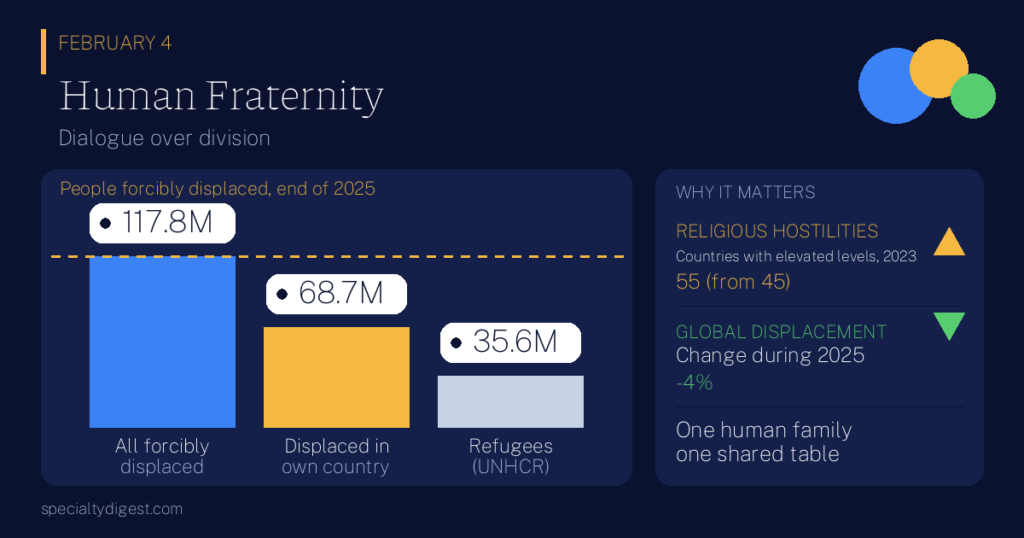
Research points the same way. The Pew Research Center, which scored 198 countries and territories, reported in June 2026 that 55 countries had elevated levels of social hostilities involving religion in 2023, up from 45 the year before. It also found 58 countries with high or very high levels of government restrictions on religion in 2023, close to the peak of 59 in 2022.
These counts measure religion only, and they say nothing about every form of prejudice. But they show why a day devoted to dialogue is not a luxury. They also show that the pressures on peaceful coexistence are measurable and that they can rise within a single year.
People on the move
Hostility and conflict often force people from their homes, and the newcomers can face suspicion in the places where they land. UNHCR estimated that 117.8 million people were forcibly displaced worldwide at the end of 2025. That is 5.4 million fewer than a year earlier, a decline of 4 percent, and the first fall in a decade. Even so, the total includes 68.7 million people displaced inside their own countries and 35.6 million refugees under UNHCR’s mandate.
Example 2: the welcome table. Picture a city of 100,000 that receives 1,000 newcomers. If a few hundred residents volunteer to share meals, language lessons and job tips, the newcomers shift from “strangers” to “neighbors” far faster. These numbers are made up for illustration, yet they capture what fraternity looks like when it becomes a habit rather than a slogan.
How the day is marked
The UN invites governments, schools, faith groups and civil society to mark February 4 with events, classroom lessons and public conversations. The 2026 theme, Dialogue Over Division, echoes the Secretary-General’s call. Each year the Zayed Award for Human Fraternity is presented in Abu Dhabi on or around the day, and the 2026 ceremony was held there on February 4. The 2026 honorees, announced in January 2026, were the Armenia-Azerbaijan peace agreement and Afghan girls’ education advocate Zarqa Yaftali, described as the first recipients from the Caucasus and Afghanistan. Since 2019 the award has honored 19 recipients from 19 countries. At the first observance in 2021, Secretary-General Guterres was among the honorees and said he would donate the $500,000 prize to UNHCR.
- 2019year the Abu Dhabi document was signed
- 75/200General Assembly resolution that created the day
- 55countries with elevated religious hostilities, 2023
- 117.8Mforcibly displaced people, end of 2025
Example 3: the classroom pledge. A teacher asks 30 students to interview one person from a community different from their own and to write down three things they share. If each student brings back just three, the class collects about 90 common points in one afternoon. It is a small, round-number exercise, but it turns an abstract idea into a concrete habit.
Key Takeaways
- The day has a clear origin. It marks the February 4, 2019 Abu Dhabi document, and resolution 75/200 made it a UN observance.
- Fraternity goes beyond tolerance. It asks people to care for the wellbeing of others, not merely avoid conflict.
- The need is measurable. Pew counted 55 countries with elevated religious hostilities in 2023, up from 45 a year earlier.
- Displacement tests our welcome. UNHCR counted 117.8 million forcibly displaced people at the end of 2025, a 4 percent drop.
- 2026 asks for dialogue. The theme, Dialogue Over Division, calls on everyone to talk first and confront hatred early.
- Small acts count. Shared playgrounds, meals and classroom conversations are how fraternity becomes real.
How solid is this? The origin, resolution number, theme and award details come from the United Nations, UN News and the Zayed Award. The December 2020 adoption month is given in UN reporting without an exact day. Pew figures cover 2023 and UNHCR figures are estimates for the end of 2025. The three worked examples use round, made-up numbers. See the International Days hub and the International Days Calendar.
More in Society
- United Nations, International Day of Human Fraternity
- UN News, First-ever International Day of Human Fraternity focuses on tolerance (2021)
- UN Press, Secretary-General message on Human Fraternity (2025)
- Zayed Award for Human Fraternity, 2026 honorees
- Pew Research Center, restrictions on religion report (June 2026)
- UNHCR, Global Trends: Forced Displacement in 2025