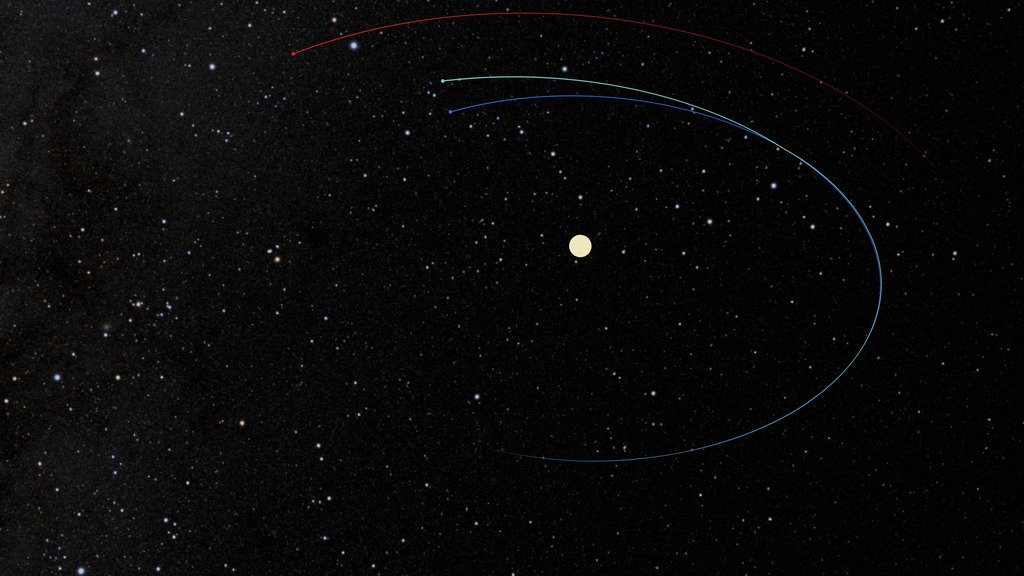
The ESCAPADE Earth flyby is scheduled for November 7 and 9, 2026, when NASA’s twin Mars-bound spacecraft swing past Earth using a powered gravity assist. A NASA mission blog published on November 2 says each spacecraft will fire its engine for about nine minutes at closest approach. This article summarizes NASA’s description, explains the terms and flags what is not yet known. It was written before the flybys took place.
What is ESCAPADE?
ESCAPADE stands for Escape and Plasma Acceleration and Dynamics Explorers. It is a pair of spacecraft, each about the size of a standard refrigerator, that launched in November 2025. At Mars, NASA says, ESCAPADE will be the first multi-spacecraft mission to fly in formation around the planet. Its science goal is to study how the solar wind, a stream of solar material moving at about a million miles per hour, interacts with Mars and strips away its atmosphere.
When will the flybys happen?
NASA gives these times for the two spacecraft:
- Spacecraft 1: closest approach at 4:51 a.m. EST on Saturday, November 7, 2026, with the engine burn starting then
- Spacecraft 2: burn beginning at 5:51 a.m. EST on Monday, November 9, 2026
Each burn lasts about nine minutes and takes place over southern Australia. Closest approach is 600 to 1,100 miles above Earth’s surface.
What does a powered flyby do?
In a gravity assist, a spacecraft passes a planet and borrows some of its energy to change speed and direction. NASA says a powered flyby adds an engine burn at closest approach, a technique also called an Oberth maneuver. The burn raises each spacecraft’s speed by more than 1,000 miles per hour, from about 6.3 miles per second to about 6.7. By our own arithmetic, the difference of 0.4 miles per second equals about 1,440 miles per hour. NASA says no agency spacecraft has flown this maneuver before, and that no Mars-bound spacecraft has completed a powered flyby successfully.
Why is the spacecraft going around Earth first?
After launch, the twins looped around the Earth-Sun Lagrange point 2 in what NASA calls a loiter orbit, because Earth and Mars were on opposite sides of the Sun at launch. The Earth flyby sends them toward Mars on a cruise of about 10 months. Arrival is planned for September 7, 2027 for the first spacecraft and September 9, 2027 for the second. By our arithmetic, that matches a trip of about 10 months from the November flybys.
What bonus science did the loiter produce?
NASA says the spacecraft flew through a distant part of Earth’s magnetotail, the region of Earth’s magnetic field stretched away from the Sun, which no spacecraft had directly explored before. Scientists observed some interesting activity and structure, and the blog says findings will be shared soon. Our article on TRACERS first results covers another NASA mission studying how the Sun and Earth’s magnetic field interact.
Can people see the spacecraft?
NASA says the spacecraft will be faint and that a telescope will most likely be needed to see them as dim points moving against the stars. From the western United States, the first is brightest from midnight to 1 a.m. Pacific time on November 7, and the second from 1 to 2 a.m. on November 9. Each takes several hours to cross the sky from east to west. NASA points to its Horizons System for coordinates at any location.
Why fly two spacecraft?
Two spacecraft can measure the same environment from two places at once, which helps separate changes over time from differences between locations. That is a general reason for paired missions, and it is not quoted from NASA. For ESCAPADE, the pair is meant to fly in formation around Mars, so the solar wind can be sampled at two points together.
How do the two schedules line up?
The two flybys are two days apart, on November 7 and 9, and the two Mars arrivals are also two days apart, on September 7 and 9, 2027. By our own arithmetic, the gap between the spacecraft stays at two days from the Earth flyby to the arrival. NASA does not describe the gap in those terms, and it gives no distance between the spacecraft at Mars in the blog we read.
How to read the news
The dates and times are plans, and a burn can slip if the spacecraft needs adjustment. NASA’s description comes before the event, so it cannot say whether the maneuver worked. Check NASA’s mission blog for results.
How does ESCAPADE connect to other coverage?
ESCAPADE joins a busy period for Mars exploration. Our articles cover the CHAPEA simulated Mars mission, the Perseverance dust study, the MMX launch to Mars’s moons and a new Mars helicopter blade design. The Sun’s activity, covered in our solar maximum report, also shapes the solar wind that ESCAPADE studies.
What should readers watch for next?
The next milestones are the results of the two burns, trajectory correction maneuvers during the cruise and arrival at Mars in September 2027. NASA lists several correction maneuvers but gives no dates in the blog.
Glossary
- Gravity assist: using a planet’s gravity to change a spacecraft’s speed or direction
- Oberth maneuver: an engine burn at a close approach to a planet, which makes the burn more effective
- Lagrange point: a place where the gravity of two bodies balances
- Solar wind: a stream of charged particles flowing from the Sun
- Magnetotail: the long tail of Earth’s magnetic field on the night side
These definitions are general explanations and are not quoted from NASA.
What is not covered here?
We read the NASA blog only and did not read the mission’s science papers. The blog quotes no named person, and we report no results from the flybys.
Key facts at a glance
- Flybys: November 7 and 9, 2026
- Burn length: about nine minutes, over southern Australia
- Speed gain: more than 1,000 miles per hour
- Closest approach altitude: 600 to 1,100 miles
- Mars arrival: September 7 and 9, 2027
Frequently asked questions
What is the ESCAPADE Earth flyby?
A pass of Earth by each of the two spacecraft, with an engine burn, to send them to Mars.
When do they reach Mars?
NASA lists September 7 and 9, 2027.
Can I see them?
Only faintly, and most likely with a telescope.
More in Science
- CRS-25 Launch: Northrop Grumman Cygnus XL Heads for the Space Station on November 29
- Extreme Debris Disks: Webb Studies 21 Young Systems Showing Planetary Collisions
- Second-Generation Planet Suspected Around White Dwarf as Hubble Data Reveal Niobium
- NGC 7129: Webb Image Shows Stellar Jets and Shocked Gas in a Stellar Nursery