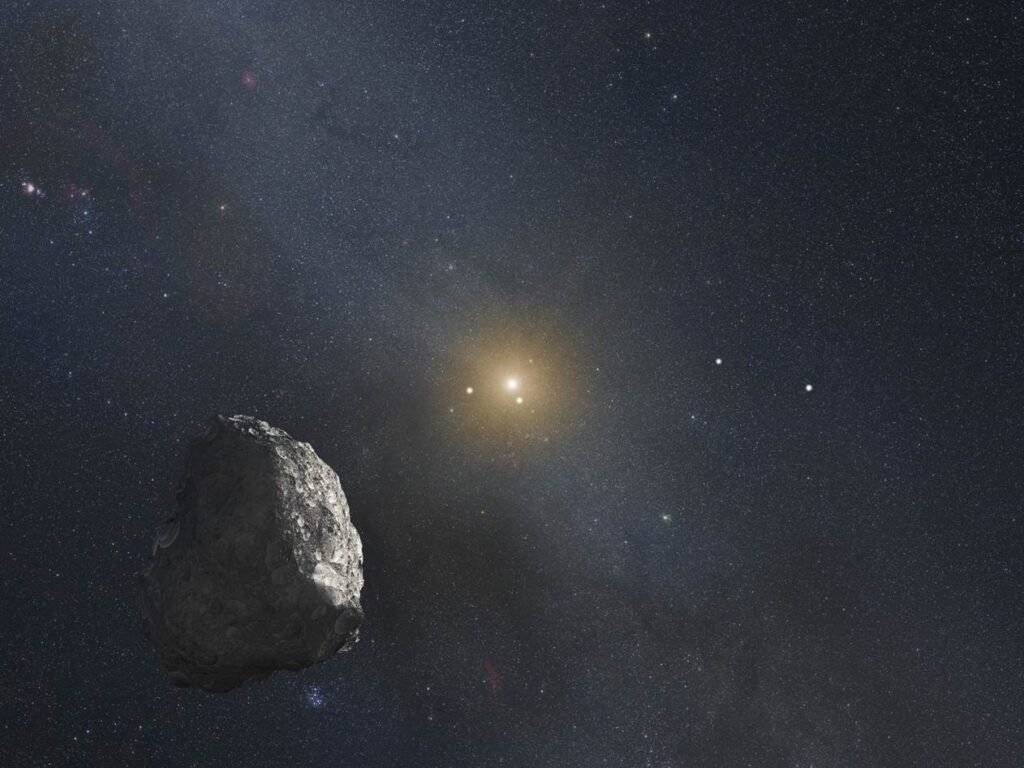
Trans-Neptunian objects are small icy bodies beyond Neptune, and a combined Hubble and Webb survey has found 27 previously unknown ones. The NASA release, republished by ScienceDaily on November 1, 2026, calls it the deepest survey of such objects to date. The smallest is about 3 miles across. This article summarizes the release, explains the terms and flags what the researchers have not yet resolved.
What did the survey find?
The teams discovered 27 previously unknown trans-Neptunian objects. They are more than 100 million times fainter than what the naked eye can see. The smallest is about 3 miles, or 5 kilometers, across, roughly five times smaller than what the most sensitive ground telescopes can detect. By our own arithmetic, that puts the faintest ground-detectable object at about 15 miles across. Hubble provided visible-light imaging and Webb provided infrared imaging of the same patch of sky at the same time.
Who did the work?
Research teams led by doctoral candidates at the University of Victoria in Canada, under the guidance of the National Research Council of Canada, and at Northern Arizona University in Flagstaff took part. Named coauthors include Marielle Eduardo, Anastasia Morgan, David Trilling and William Grundy. Two related papers appeared in The Astronomical Journal in 2026, in volume 172, issue 4: one on the luminosity function of ultrafaint objects detected by Webb, and one on combined Webb and Hubble deep imaging of the smallest known objects.
What are cold and hot populations?
Astronomers split these objects into two groups by orbit. Cold objects have circular orbits close to the plane of the planets. Hot objects have elongated, inclined orbits and were scattered outward from between Uranus and Neptune. The two groups formed in different regions. The new survey found that they have remarkably similar size distributions, which was not expected. The release does not explain why.
What about their colors?
Even the smallest objects have surface colors resembling those of larger objects. That suggests collisions altered their surfaces less than expected. The authors have not determined whether these objects experienced fewer impacts than assumed or whether their surface composition survives collisions.
Are there too few small objects?
There are fewer very small objects than some planet-formation models predict. The release notes the deficit but does not identify its cause. This is a useful result because models of how the outer solar system formed are tested against counts like these. A shortage could mean small bodies were destroyed, never formed or were ejected, but the release does not choose among those options.
How firm are the results?
Detecting these objects is very difficult, so measurements of size and color are hard to pin down. The sample of 27 is small. The release is a condensed version of NASA’s text, and the uncertainties, detailed statistics and methods are in the two journal papers, which we did not read. Readers should treat the headline numbers as the researchers’ best present estimate.
Why study small distant objects?
Small bodies in the outer solar system are leftovers of planet building. Their sizes show how matter clumped together, and their colors hint at what has happened to their surfaces over billions of years. In general terms, a small object is a better record of collisions than a large one, because fewer survive. That is why a count of the smallest ones matters.
Why observe with two telescopes at once?
Hubble works in visible light and Webb works in infrared light. Observing the same patch of sky with both at the same time gives each faint object a color measurement across a wide range of wavelengths. Color is one of the few clues to the makeup of an object too small and too far away to be imaged in detail. The release credits this pairing for the depth of the survey, and it is the reason the smallest objects could be compared with larger ones.
What is the Kuiper Belt?
The Kuiper Belt is the region beyond Neptune where many trans-Neptunian objects orbit. In general terms, it is a leftover from the early solar system that holds icy bodies too small to have grown into planets. Pluto is its best-known member. This description is general and is not quoted from NASA, and the release does not say how many of the 27 new objects belong to the belt itself.
What do the two papers cover?
One paper is led by Eduardo and the other by Morgan. One addresses the luminosity function of ultrafaint objects Webb detected, and the other addresses combined Webb and Hubble deep imaging of the smallest known objects. We have not matched each topic to each paper, and we did not read the papers, so the details of their methods and error bars are not covered here.
How to read the numbers
The statement that the objects are 100 million times fainter than the naked eye can see is a statement about brightness, not size. A size of 3 miles describes the smallest object this survey found and is not a universal limit. The ratio of five times smaller than ground telescopes refers to the most sensitive ground instruments.
How does this connect to other coverage?
Small icy bodies link to several of our reports. See the Lucy mission to the Jupiter Trojan asteroids, the James Webb Space Telescope and the interstellar comet 3I/ATLAS.
What should readers watch for next?
Readers can watch for follow-up surveys that check whether the small-object shortage holds in other patches of sky.
Glossary
- Trans-Neptunian object: a small icy body that orbits beyond Neptune
- Luminosity function: a count of objects by brightness
- Cold population: objects on near-circular, flat orbits
- Hot population: objects on elongated, tilted orbits
- Infrared: light with wavelengths longer than visible light
These definitions are general explanations and are not quoted from NASA.
What is not covered here?
We do not report orbital elements, magnitudes or the statistical fits, which are in the journal papers.
Key facts at a glance
- New objects: 27
- Smallest: about 3 miles (5 km) across
- Brightness: over 100 million times fainter than the naked eye can see
- Telescopes: Hubble and Webb, observing together
- Journal: The Astronomical Journal, 2026
Frequently asked questions
How many new objects were found?
27 previously unknown trans-Neptunian objects.
How small is the smallest?
About 3 miles, or 5 kilometers, across.
What puzzles remain?
Why the objects have similar colors and why very small ones are scarcer than models predict.
More in Science