Ask an adult what they remember best about being seven years old, and the answer is rarely a lesson. It is a game, a hiding place, a made-up rule. Play looks like the opposite of serious work, which is exactly why it is easy to cut when schedules fill up and screens multiply. The International Day of Play, observed every year on June 11, exists to push back on that habit. It asks governments, schools and families to treat play as a basic part of childhood and not as a reward for finishing everything else.
A right written in 1989, a day created in 2024
The idea is older than the day. The UN Convention on the Rights of the Child, adopted in 1989, includes Article 31, which recognizes the right of the child to rest and leisure, to engage in play and recreational activities, and to take part in cultural life and the arts. The Committee on the Rights of the Child later gave that article its own detailed interpretation in General Comment No. 17. For decades, though, play stayed the quiet right, mentioned less often than schooling or health care.
That changed in March 2024, when the UN General Assembly adopted a resolution establishing June 11 as the International Day of Play. A core group of member states tabled it: Bulgaria, El Salvador, Jamaica, Kenya, Luxembourg and Viet Nam. UNICEF and UNESCO joined the effort, supported by the LEGO Foundation and the LEGO Group. The first observance took place on June 11, 2024.
What counts as play
Play is not one activity. It covers climbing, pretending, building, chasing, singing, and quiet games with a friend. What unites these is that the child chooses them, enjoys them and sets the rules. That is why UNESCO describes the observance as a way to champion the essential role of play, and why the 2024 launch organized its message around four ideas: time to play, space to play, quality of play, and the fact that play never ends. The last one is a reminder that adults need play too, although the day is built around childhood.
Example 1: the shrinking break. Suppose a school trims its daily break from 40 minutes to 25 to make room for test practice. That is 15 minutes a day, or about 75 minutes a week, taken from the one part of the day when children decide for themselves what to do. The numbers are round and illustrative, but they show how a single scheduling choice can quietly remove play.
The numbers behind the day
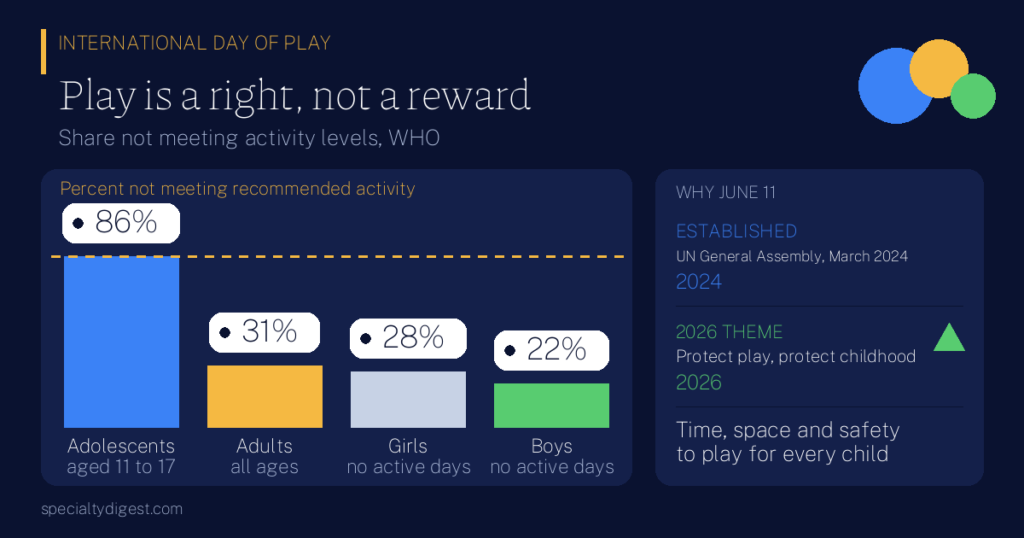
Data on play itself is thin, and the 2026 concept note for the UN high-level event points to a planned global data report on play for that reason. What we do have is a closely related picture: how much children and adolescents move. In its 2026 fact sheet on physical activity, the World Health Organization reports that 86 percent of adolescents and 31 percent of adults do not meet the recommended levels of physical activity. The adult figure refers to 1.8 billion people in 2022, and WHO projects it will rise to 35 percent by 2030.
- 86%of adolescents do not meet recommended activity levels
- 240 millionadolescents, one in four, reported no active days last week
- 1.8 billionadults were physically inactive in 2022, 31%
- 28% vs 22%of girls and boys with no active days
These figures measure activity, not play, and the two overlap without being the same. A game of tag counts as both; a sports drill is exercise but not always play. Still, the gap is a useful warning. Where children have little time, safe space or freedom, both play and movement shrink together.
Why the world treats play as serious
UNICEF has described play as essential for learning, health and resilience, and the day was built on that view. Through play, children test ideas, practice language, manage disappointment and learn to cooperate. Very young children learn their first lessons about the world through games with caregivers, which is one reason the day’s campaign emphasizes parents and early childhood education alongside playgrounds.
Example 2: the playful hour. Imagine a parent who spends 20 minutes each evening building towers and telling invented stories with a four-year-old. Over a year that adds up to roughly 120 hours of shared attention, with no special equipment. The number is round and illustrative, but it shows why advocates talk about playful parenting as something that costs time, not money.
Who is left out
Not every child gets the same chance to play. The WHO figures above show a gap between girls and boys in adolescence. The 2026 concept note also calls for safe and environmentally healthy places to play, a reminder that traffic, pollution, crowded housing, unsafe neighborhoods and conflict can take away the open space a child needs. Children who are caring for siblings, working, or living in emergencies often have the least time of all. The right in Article 31 applies to every child, which is why the day is framed around universal access.
How the day is marked, and what progress needs
The day is marked by a high-level event at UN headquarters in New York and by local activities around the world, from school play days to community street closures. The 2026 theme, Protect play, protect childhood, is built around three accelerators for governments and partners.
Example 3: a safer street. Picture a neighborhood of 200 children where a single busy road cuts off the only open field. If a town closes that road for two hours each Saturday, every child gains a safe place to play for about 100 hours a year. The figures are round and illustrative, but they show how small local choices can add up to real space for play.
Past themes and focus areas show how the message has developed.
- 2024Time to play, space to play, quality of play, play never ends
- 2026Protect play, protect childhood
The day also connects to other observances about children and their well-being. If this subject interests you, our article on World Toilet Day explains how basic services shape whether children can attend school and take part in daily life.
Key Takeaways
- Play is a recognized right. Article 31 of the 1989 Convention on the Rights of the Child names play and leisure.
- The day is new. The General Assembly created it in March 2024, and the first observance was June 11, 2024.
- Play is not a luxury. UNICEF describes it as essential for learning, health and resilience.
- Activity data is a warning sign. WHO reports that 86 percent of adolescents do not meet recommended levels.
- Girls often get less. 28 percent of adolescent girls had no active days, against 22 percent of boys.
- Three levers for 2026. Parenting support, early education and safe places to play.
- You can act locally. Protect break time at school, make space at home and ask your community for safe places to play.
How solid is this? The history and themes come from UN, UNICEF and UNESCO pages. Activity figures come from WHO’s fact sheet, are survey-based estimates and measure physical activity, not play. Reliable global data on play itself is limited. The three worked examples use round, made-up numbers to show an idea. See also the International Days hub and the International Days Calendar.
More in Society
- United Nations, International Day of Play
- UNESCO, Celebrating the first-ever International Day of Play
- United Nations, International Day of Play 2026 concept note
- UNICEF, First-ever International Day of Play
- UNICEF, Convention on the Rights of the Child text
- World Health Organization, Physical activity fact sheet