The most powerful medical tool in a hospital costs almost nothing and is attached to your wrist. Clean hands stop germs from traveling between people, and that simple act protects newborns, surgical patients, cooks, teachers and children at school. World Hand Hygiene Day, marked every May 5, exists because the tool is so cheap and so often unused. It is a close cousin of World Toilet Day, since safe sanitation and clean hands work as a pair.
A campaign that became a calendar fixture
Unlike many observances in this series, this one did not begin as a General Assembly resolution. It grows out of WHO’s annual global campaign, SAVE LIVES: Clean Your Hands, which WHO’s campaign page says has run each year since 2009. The date is fixed at May 5, so it does not move from year to year. The 2026 edition is the 18th, and its message is short: “Action saves lives.” The year’s focus is that health care-associated infections, known as HAIs, are preventable, and that preventing them takes action by governments, hospital leaders, health workers and patients alike.
The campaign has two audiences. The first is the health system, where hand hygiene protects patients who are already vulnerable. The second is the community, where the same habit protects families, schools and markets. In October 2025 WHO issued its first guidelines on community hand hygiene, aimed at helping governments cut the spread of infectious diseases outside hospitals.
What “hand hygiene” actually means
The phrase covers more than a quick rinse. In health care it means cleaning hands with an alcohol-based hand rub, or with soap and water when hands are visibly dirty. WHO’s community guidance recommends hand rub with at least 60 percent alcohol when hands are not visibly dirty. In homes, the standard used by the WHO/UNICEF Joint Monitoring Programme is a handwashing facility with both soap and water, which it calls a basic hygiene service.
In hospitals, WHO teaches “My 5 Moments for Hand Hygiene”: before touching a patient, before a clean or aseptic procedure, after exposure to body fluids, after touching a patient, and after touching a patient’s surroundings. At home, the guidelines highlight key times such as before preparing food, before eating or feeding others, and after using the toilet.
The numbers inside the hospital
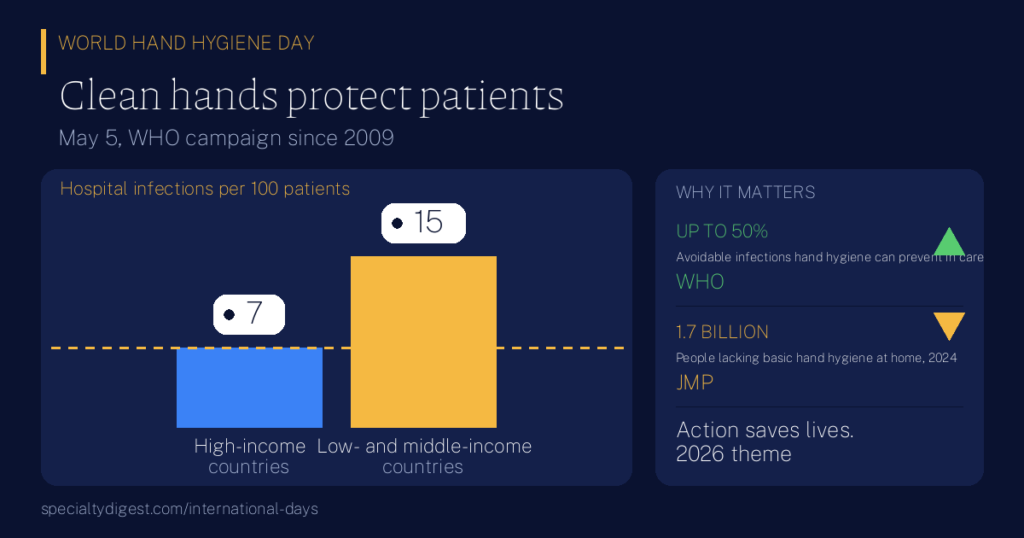
Hospitals are meant to heal, yet they are also places where infections spread. According to WHO’s 2023 key facts, of every 100 patients in acute care hospitals, 7 in high-income countries and 15 in low- and middle-income countries acquire at least one HAI during their stay. WHO also reports that, on average, 1 in 10 patients affected by an HAI dies from it, and that deaths are two to three times higher when the infection is resistant to antimicrobial drugs.
Hand hygiene is one of the main defenses. WHO states that improving it can prevent up to 50 percent of avoidable infections acquired during health care delivery. WHO also reports a return of about US$16.5 in health spending avoided for each US$1 invested in improving hand hygiene, and a return of 7 to 16 times on investment in infection prevention and control more broadly.
Example 1: one ward, one year. Imagine a ward that treats 1,000 patients a year, with 10 percent catching an infection, or 100 patients. If better hand hygiene prevented half of those infections, 50 patients would be spared illness, extra days in bed and extra treatment. The numbers are round and illustrative, but they show how a small habit scales across a busy ward.
Where the habit breaks down
Knowing what to do is not the same as doing it. WHO’s hand hygiene page reports that compliance in intensive care units averaged 59.6 percent up to 2018, with 64.5 percent in high-income countries and only 9.1 percent in low-income countries. The gap is not about caring less. It reflects missing supplies, crowded wards and a lack of hand rub at the bed.
Infrastructure matters just as much. WHO and UNICEF reported in 2020 that 1 in 3 health care facilities lacked hand hygiene facilities where care is provided. A WHO global survey from 2019, cited by WHO, found that only 16 percent of facilities met all minimum requirements for infection prevention and control programs, and none in low-income countries did. This is why the 2026 campaign page points to a WHO target: hand hygiene monitoring and feedback in at least reference hospitals by 2026, within a wider action plan aimed at 2030.
- 1 in 3health care facilities lacked hand hygiene where care is given (2020)
- 16%of facilities met every minimum infection control requirement (2019)
- 59.6%average ICU hand hygiene compliance, up to 2018
- 1 in 10patients with an HAI dies from it, on average (WHO, 2023)
Clean hands at home and at school
Outside the hospital, the problem begins with a basic fixture: a place to wash. The WHO/UNICEF Joint Monitoring Programme reports that coverage of basic hygiene services rose from 66 percent of the world’s people in 2015 to 80 percent in 2024. That is real progress. Yet in 2024 some 1.7 billion people still lacked basic hand hygiene services at home, including 611 million with no handwashing facility at all.
Schools face the same gap. WHO and UNICEF reported in 2021 that 818 million children lacked a handwashing facility with water and soap at school, and 462 million attended schools with no handwashing facilities at all. The health stakes are concrete. WHO’s October 2025 guidelines state that hand hygiene reduces diarrhea by 30 percent and acute respiratory infections by 17 percent. Because both illnesses take a heavy toll on young children, a school sink with soap is also a health program.
Example 2: a classroom of 40. Suppose a classroom of 40 children has 10 sick days each year per child from diarrhea and coughs, or 400 days in total. If clean hands trimmed that by a quarter, the class would recover 100 days of learning. The figures are round and made up to show the logic, not to predict a specific school.
Closing the gap
WHO’s 2025 guidelines say that meeting the 2030 hand hygiene target needs about a doubling in the global rate of progress, and up to 11-fold progress in the least developed countries and 8-fold in fragile settings. In hospitals, the answer starts with the basics: hand rub at the point of care, running water and soap, trained staff, and regular monitoring with feedback so teams can see how they are doing. Leadership matters, because a habit is easier to keep when managers supply the tools and treat clean hands as a mark of quality.
The economics are friendly. If a hospital spends US$10,000 on supplies and training, and WHO’s estimate of US$16.5 saved per dollar held, the savings would be about US$165,000. That is a thought experiment, since returns vary by setting, but it explains why WHO calls hand hygiene a high-return investment.
Example 3: a clinic budget. A small clinic buys hand rub and soap for US$2,000 a year. If infection prevention at that scale saved even five times the cost in avoided treatment, it would save US$10,000. The numbers are illustrative only, but the direction of the arithmetic is the point.
- 2009SAVE LIVES: Clean Your Hands campaign begins
- 2023Focus on accelerating action together
- 2025Community hand hygiene guidelines issued in October
- 2026Action saves lives, the 18th year of the day
Key Takeaways
- Clean hands are a medical tool. WHO says better hand hygiene can prevent up to half of avoidable infections in care.
- Hospitals are not risk free. 7 in 100 patients in high-income countries and 15 in 100 in low- and middle-income countries acquire an infection in acute care.
- Habit needs hardware. Compliance in ICUs was 9.1 percent in low-income countries, where supplies and sinks are often missing.
- Home access is improving, not finished. Basic hygiene coverage rose from 66 to 80 percent between 2015 and 2024, yet 1.7 billion people still lack it.
- Schools are a health setting. 818 million children lacked a handwashing facility with soap and water at school in 2021.
- The payoff is large. Hand hygiene cuts diarrhea by 30 percent and respiratory infections by 17 percent, according to WHO.
- Act at the right moments. Clean your hands before eating, before preparing food, after using the toilet and, in care, at WHO’s five moments.
How solid is this? Health care figures come from WHO pages dated 2023 and earlier, and some carry no single survey year, so the years given are those WHO states. Household figures are modeled estimates from the WHO/UNICEF Joint Monitoring Programme for 2024. The three worked examples use round, made-up numbers. See also World Toilet Day, the International Days hub and the International Days Calendar.
More in Health
- WHO, World Hand Hygiene Day 2026: Action saves lives
- WHO news, 5 May 2026
- WHO, New guidelines on community hand hygiene, 15 October 2025
- WHO, World Hand Hygiene Day 2023: Key facts and figures
- WHO, Hand hygiene in health care
- UNICEF Data, Hygiene and handwashing statistics (WHO/UNICEF JMP)
- UN-Water, Handwashing and hand hygiene