Governments are easy to criticize and hard to picture. Behind the word stand people: the nurse at a district clinic, the clerk who registers a birth, the teacher, the inspector who checks the water, the engineer who keeps a bridge safe. United Nations Public Service Day, observed every year on June 23, exists to put a face on that work. It celebrates the value and virtue of public service, and it asks a practical question: what does it take for public institutions to serve everyone well? The question touches many other observances. World Toilet Day, for example, is really about sewers, treatment plants and the public workers who keep them running.
A day created by the General Assembly
On December 20, 2002, the UN General Assembly designated June 23 as Public Service Day by adopting resolution 57/277. The UN states four aims for the day: to celebrate the value and virtue of public service to the community, to highlight the contribution of public service in the development process, to recognize the work of public servants, and to encourage young people to pursue careers in the public sector.
The day has a companion. The UN Public Service Awards began in 2003 and honor institutions that deliver creative and effective services. Since that first edition, over 300 initiatives have received an Award. UN DESA runs the awards and the annual UN Public Service Forum, which gathers officials around the date. The 2025 Forum met in Samarkand, Uzbekistan, under the theme “Five Years to 2030: Accelerating Public Service Delivery for a Sustainable Future.” The 2026 Forum met in Tbilisi, Georgia, from June 23 to 25.
What public service really means
A public servant is anyone who works for a government body to deliver something the community shares: a teacher in a state school, a nurse in a public clinic, a clerk who registers births and land, a firefighter, an inspector, an analyst at a statistics office. The work is rarely noticed when it goes well. A birth is recorded, a pension arrives, a road is cleared after a storm, and nobody writes a headline. Because the product is trust rather than profit, the day asks societies to judge the whole system, not only the person at the counter.
A UN DESA article published ahead of the 2026 Forum describes public servants as the people who “turn global commitments into real services,” and it names three principles for rebuilding trust: accountability, participation and inclusion, and responsiveness. Promises made at summits become real only when someone staffs the clinic, answers the phone and processes the claim.
The numbers behind the public workforce
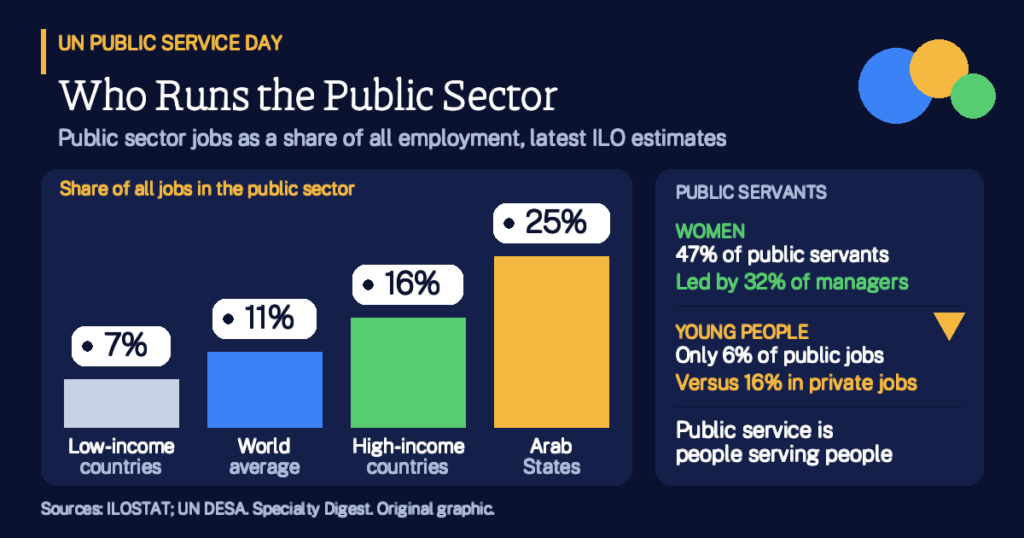
The International Labour Organization (ILO) offers a rare global picture. According to its latest estimates, reported by ILOSTAT, just over one tenth of the world’s employment, 11 percent, is in the public sector. The share varies sharply with national income. It is 16 percent in high-income countries and 7 percent in low-income countries, and it reaches 25 percent in the Arab States. Public work matters most in the professions that shape a child’s future: on average, 70 percent of teaching professionals work in the public sector.
The trend deserves attention. ILOSTAT notes that most governments have not raised the public sector share of employment to meet demand, and that over the past decade the share fell in 58 of the 94 countries with data. That alone does not prove worse service, but it shows the strain the day draws attention to.
- 11%of the world’s employment is in the public sector
- 47%of public servants are women
- 70%of teaching professionals work in the public sector, on average
- 58 of 94countries with data saw the public share fall over a decade
Example 1: the invisible clerk. Imagine a district clinic that serves 10,000 people and employs 20 public workers, including 4 records and registration clerks. If two clerks leave and are not replaced, each remaining clerk handles twice the paperwork, and nurses begin to spend hours on forms instead of patients. The numbers are round and made up, but they show how unseen roles hold up the visible ones.
Trust, and the digital divide
More services now arrive through screens. The UN E-Government Survey 2024 measures how well governments use digital tools. It reports that the proportion of the world’s population lagging in digital government development fell from 45.0 percent in 2022 to 22.4 percent in 2024, an encouraging shift. Yet the same survey states that 1.73 billion people remain on the wrong side of the digital divide, and that around 22 percent of the cities assessed show no evidence of an operational official website.
A digital service helps only the people who can reach it. An online tax form saves one family an afternoon and shuts out another with no phone, no signal or little confidence reading the page. That is why inclusion sits beside innovation in the 2026 Forum theme.
Example 2: the permit portal. A town of 1,000 households moves a permit application online, and each household that uses it saves 2 hours of travel and waiting. If 800 households can get online, the town gains 1,600 hours. The other 200 households, or 20 percent, still need a counter, so the office must keep staff and hours for them. The figures are round and illustrative, and the lesson is that a good digital service keeps a door open for everyone.
Who serves: women, young people and pay
ILOSTAT also shows who holds these jobs. Women are 47 percent of public servants. Women are also more likely to work in the public sector than men: 13 percent of employed women, against 10 percent of employed men. Women hold 32 percent of public sector managerial positions, compared with 27 percent in the private sector. The median gender pay gap is 12 percent in the private sector and close to zero in the public sector.
Young people are the weak point. Those aged 15 to 24 make up just 6 percent of public sector employment, against 16 percent in the private sector. That gap links directly to the day’s fourth aim, which is to encourage young people to pursue careers in the public sector. A workforce that does not renew itself cannot keep its skills or its trust.
Example 3: the ministry team. If a ministry of 200 staff mirrored the global figure, about 94 would be women. At 32 percent of managerial posts, a management team of 10 would include about three women. The numbers are round and illustrative, and they show that fairness depends on the ladder as well as on the headcount.
How the day is marked: forum and awards
Around June 23, UN DESA holds the Forum and the Awards. In 2012, a total of 471 nominations from more than 80 Member States were received, and 44 public organizations from 29 countries received recognition in categories that included prevention of corruption, improving service delivery and citizen participation. In 2026, the awards drew over 700 applications from 62 countries. Twelve initiatives were honored, 9 Award winners and 3 Honourable Mentions, from Azerbaijan, Brazil, Cambodia, the Dominican Republic, Indonesia, the Philippines, Saudi Arabia and Thailand. The ceremony closed the Forum on June 25, 2026 in Tbilisi.
Anyone can join in. Thank a public servant by name, read your local agency’s service standards, or ask how your city handles complaints. The day is a reminder that institutions are made of people, and that people respond when the public pays attention.
Key Takeaways
- The day has a clear legal origin. The General Assembly set June 23 as Public Service Day in resolution 57/277 on December 20, 2002.
- Public servants deliver the promises. They turn global commitments into clinics, classrooms and records people can use.
- The public workforce is large but uneven. It is 11 percent of world employment, from 7 percent in low-income countries to 16 percent in high-income ones.
- Digital progress still leaves people out. The lagging share fell from 45.0 to 22.4 percent, yet 1.73 billion people remain on the wrong side of the divide.
- Women are well represented, young people are not. Women are 47 percent of public servants, while those aged 15 to 24 are only 6 percent of public sector employment.
- Recognition spreads good ideas. Since 2003, over 300 initiatives have received a UN Public Service Award.
How solid is this? Employment shares come from ILO estimates reported by ILOSTAT without a stated year, and the digital figures come from the 2024 E-Government Survey. The 2012 and 2026 award figures count entries differently and should not be read as a trend. The three worked examples use round, made-up numbers to show an idea. See also the International Days hub and the International Days Calendar.
More in Society
- United Nations, United Nations Public Service Day
- ILOSTAT, Who powers the public sector?
- UN DESA, E-Government Survey 2024
- UN DESA, UN Public Service Awards to honor 12 initiatives (2026)
- UN DESA, UN awards 44 organizations for public service excellence (2012)
- UN DESA, The essential role of public servants in an uncertain world (2026)