Most instruments we know are centuries old, shaped slowly by court orchestras, village traditions and trade routes. The steelpan is different. It was born in living memory, in the neighborhoods of Trinidad and Tobago, from discarded oil drums and the stubborn creativity of people who had no money for instruments. World Steelpan Day, observed every August 11, honors that story. It is a day about music, but also about how ordinary materials, community effort and ingenuity can create something the whole world now plays and loves. It sits comfortably beside the World Music Day tradition of celebrating music for everyone.
A day proposed by the instrument’s home
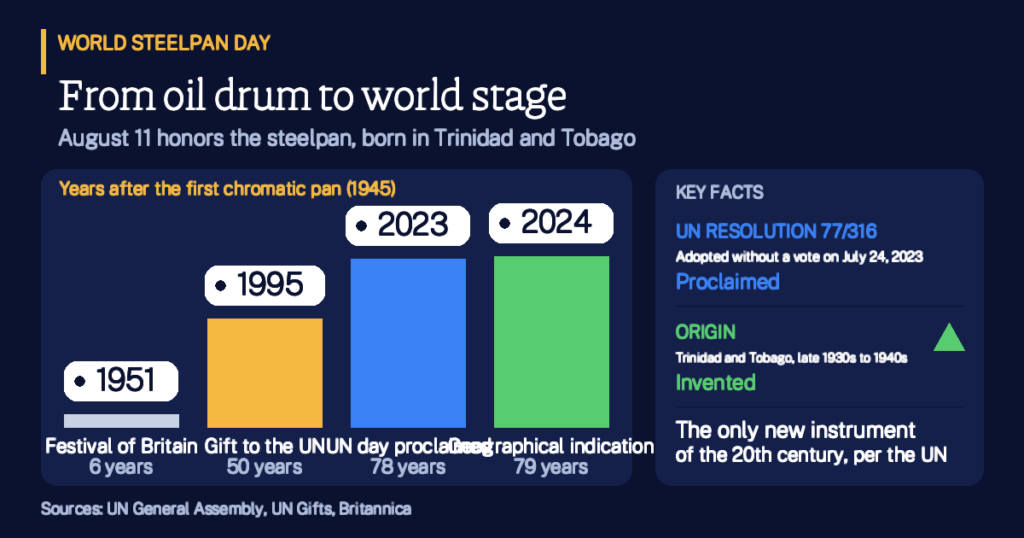
The idea came from Trinidad and Tobago. A draft resolution, document A/77/L.80, was introduced at the General Assembly by Randall Mitchell, the country’s Minister for Tourism, Culture and the Arts. On July 24, 2023, the Assembly adopted it without a vote as resolution 77/316, deciding to proclaim August 11 as World Steelpan Day, to be observed annually. Trinidad and Tobago’s foreign ministry has noted that Japan co-sponsored the resolution.
The UN says it recognizes the steelpan for its cultural and historical significance and for its role in promoting sustainable development and diversity. The Assembly encourages activities that raise awareness of that significance and of the instrument’s link to the Sustainable Development Goals. In other words, the day is meant to be played, taught and shared, not only remembered.
How an oil drum became an orchestra
The steelpan grew out of Carnival. According to Britannica, early ensembles combined bamboo stamping tubes, called tamboo bamboo, with metal buckets, cans and other containers. In 1939, a group called Alexander’s Ragtime Band paraded through Port of Spain’s streets with an all metal, nonmelodic set of instruments. Carnival was suspended during World War II, and in those years players kept experimenting. The UN Gifts site describes early materials as buckets, dustbins and oil pans, and says the first fourteen note chromatic pan was developed in 1945.
The leap from rhythm to melody mattered most. In March 1946, at celebrations marking Victory in Europe Day, Winston “Spree” Simon played popular melodies on a single tuned pan he called the ping pong. After that, steel bands moved to the center of Carnival. By the late 1940s they were prominent, and by the early 1950s the tradition had spread to other islands, most notably Antigua and St. Thomas.
What a steelpan actually is
A steelpan is made from the bottom of a 55 gallon oil barrel. The bottom is hammered inward into a shallow bowl, and the surface is shaped into separate zones that each sound a different pitch. Standardizing the barrel was a turning point. In 1950 the government formed the Trinidad All Steel Percussion Orchestra, known as TASPO, whose members included Ellie Mannette and Anthony Williams, and Britannica credits them with standardizing the 55 gallon drum.
Example 1: sharing the work. Imagine a school band of 30 players that rehearses 3 hours a week for 20 weeks. That is 1,800 player hours in one season, all spent learning to listen, count and cooperate. The numbers are round and illustrative, but they show why bands are as much about teamwork as about notes.
From neighborhood to national instrument
The steelpan is now the national instrument of Trinidad and Tobago. In 1951 TASPO performed at the Festival of Britain, and in 1952 a steel band category was added to Trinidad’s biennial music festival. After independence in 1962 came the Panorama competition, and in 1987 Phase II Pan Groove became the first band to win it with a tune of its own, “This Feelin’ Nice.” Steel bands entered schools from the 1970s, and in 2005 Northern Illinois University hired Liam Teague and Cliff Alexis to co-direct the first steel pan degree program in the United States.
The instrument also sits inside the United Nations itself. In 1995, on the organization’s 50th anniversary, the Caribbean Community gave the UN two steel drums, which are recorded in its gifts collection. The National Steel Symphony Orchestra of Trinidad and Tobago later performed at UN Headquarters in 2023.
Protecting a cultural inheritance
Recognition has also arrived through law. On August 9, 2024, at the inaugural World Steelpan Conference in Port of Spain, the Trinidad and Tobago Intellectual Property Office conferred geographical indication rights on Pan Trinbago, the national steelband organization. At the World Intellectual Property Organization Assemblies in July 2025, the delegation announced the registration of the steelpan as a geographical indication, and the meeting closed with a steelpan performance in place of the usual gavel. A geographical indication ties a product’s identity to the place that produced it, which helps the community that created the instrument keep a voice in how its name is used.
Example 2: why a name matters. Suppose a maker sells 100 instruments a year at $500 each, for $50,000 in sales. If buyers can only trust the “steelpan” label when it points to authentic makers, even a modest premium of 10 percent adds $5,000 a year. These numbers are made up for illustration, but they show how protecting a name can protect livelihoods.
Culture, sustainability and the wider world
The UN links the day to sustainable development, and the steelpan fits that theme well. It reuses scrap metal, gives young people a skill and an income, and brings neighbors together. The reach is global. Trinidad and Tobago’s foreign ministry reports that Japan has over 30 steelbands, and that the country’s pavilion at Expo 2025 in Osaka welcomed over 600,000 visitors, with the day marked during its National Day there in 2025.
- 1945year the first 14 note chromatic pan was developed
- 2023year the UN General Assembly proclaimed the day
- 30+steelbands in Japan, per Trinidad and Tobago’s foreign ministry
- 600,000+visitors to the Trinidad and Tobago pavilion at Expo 2025
Example 3: a festival weekend. Imagine a town hosts a steelpan concert that draws 5,000 visitors, and each spends about $40 on food, travel and souvenirs. That is $200,000 flowing through local businesses in a weekend. The figures are round and illustrative, not a measurement of any real event.
How the day is marked
There is no single official program. Schools hold workshops, orchestras give free concerts, embassies host performances, and families simply listen. Trinidad and Tobago’s missions and cultural groups lead many events, while fans abroad join in through bands, classes and online streams. The simplest way to take part is to find a local steel band, attend a rehearsal and ask a player how the notes are laid out. Few instruments reward curiosity so quickly.
Key Takeaways
- The steelpan is young. The UN describes it as the only new instrument invented in the 20th century.
- It grew from Carnival. Bamboo tubes, buckets and cans led to oil drum pans in Trinidad.
- 1945 and 1946 were turning points. A chromatic pan arrived, then players showed it could carry a melody.
- The UN proclaimed the day in 2023. Resolution 77/316 was adopted without a vote on July 24.
- Law now protects the name. Pan Trinbago received geographical indication rights in 2024.
- It reaches far beyond one island. Japan alone has more than 30 steelbands.
- The best way to mark it is to listen. Attend a rehearsal, take a class or play a note.
How solid is this? Dates and quotations come from the UN General Assembly, UN Gifts, UN News, Britannica and Trinidad and Tobago government pages. Sources differ slightly on origins: the UN says the late 1930s, while Britannica says about 1940. The three worked examples use round, made-up numbers to show an idea. See also International Jazz Day, the International Days hub and the International Days Calendar.
More in Society
- UN Meetings Coverage, General Assembly (2023)
- UN General Assembly, 77th session resolutions list (A/RES/77/316)
- United Nations, UN Gifts: Steel Pans
- UN News, World News in Brief (August 11, 2025)
- Encyclopaedia Britannica, Steel band
- Trinidad and Tobago Ministry of Foreign and CARICOM Affairs (2025)
- Trinidad and Tobago Intellectual Property Office (2025)