Denali National Park and Preserve is a protected area of about 6 million acres in Interior Alaska, centered on Denali, the highest mountain in North America at 20,310 feet (6,190 m). Established in 1917 as Mount McKinley National Park and enlarged and renamed in 1980, it combines glaciated peaks, subarctic forest, tundra and wildlife such as grizzly bears, wolves, caribou, moose and Dall sheep. A single 92-mile park road is the main route into the interior [1].
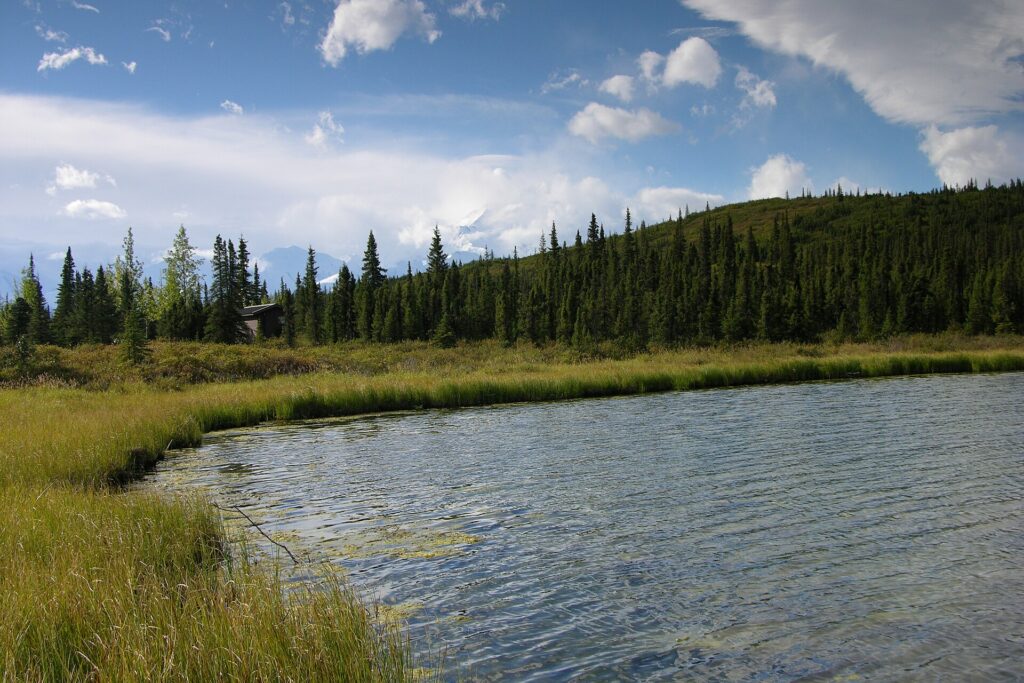
| Location | Interior Alaska, about 11 miles south of Healy |
|---|---|
| Established | February 26, 1917 (as Mount McKinley National Park) |
| Renamed and enlarged | 1980, under ANILCA |
| Area | 6,045,153 acres (park 4,740,911; preserve 1,304,242) |
| Highest point | Denali, 20,310 ft (6,190.5 m) |
| Park road | About 92 miles; first 15 paved |
| Visitors | 543,300 recreational visits (2025) |
Geography and Landscape
The park lies in Interior Alaska and spans the Alaska Range, an arc of mountains that includes Denali. The entrance is roughly 11 miles south of the community of Healy. Together the park and preserve cover 6,045,153 acres, an area larger than the state of New Hampshire, and the Denali Wilderness accounts for 2,146,580 acres of it [1]. Glaciers cover about 16 percent of the protected area, and the 44-mile Kahiltna Glacier is the longest in the park and in the Alaska Range [1].
The mountain itself has a base-to-summit rise of about 18,000 feet, greater than that of Mount Everest, and its core is biotite granite of the McKinley pluton. Surveys indicate the peak is still rising by about 1 millimeter a year [1][2]. The Denali Fault runs the length of the park, and a magnitude 7.9 earthquake struck along it in 2002 [1].
History
The park owes its existence largely to Charles Alexander Sheldon, a hunter and naturalist who proposed protecting the area in 1906. Congress created Mount McKinley National Park on February 26, 1917 [1]. The Mount McKinley Park Hotel opened in 1921 and was destroyed by fire in 1972, and the Denali Park Road was completed in 1938 after 17 years of construction [1].
In 1980 the Alaska National Interest Lands Conservation Act merged the park with Denali National Monument and added preserve lands, creating Denali National Park and Preserve [1]. The name Denali, from the Koyukon language, was formally adopted for the mountain by federal authorities in 2015, and the park’s name already reflected it [2].
Climate
Denali has a subarctic climate. The southern side of the range is influenced by maritime weather, while the north side is more continental, with warm summers and cold winters. The mean daily high in January is about 10°F and in July about 66°F. Recorded temperatures have ranged from 91°F to −54°F, and average annual precipitation is roughly 16 inches [1].
Plants and Ecosystems
The lowest elevations support forest, including deciduous taiga, while most of the park above the treeline at about 2,500 feet is tundra [1]. These ecosystems form the habitat for a large, relatively intact community of subarctic wildlife. Snow, permafrost and short growing seasons shape the vegetation, and the park is valued for scientific study as well as recreation.
Wildlife
Park monitoring has estimated roughly 300 to 350 grizzly bears on the north side of the Alaska Range and about 2,700 black bears. A 2014 count found about 51 wolves in 13 packs, a 2013 survey counted 2,230 caribou, and a 2011 survey counted 1,477 moose. Dall sheep are often seen on mountainsides [1]. Visitors on the park bus system commonly watch for these animals from the road, and the park’s policies emphasize giving wildlife space.
The Park Road
The Denali Park Road runs about 92 miles into the park, and only the first 15 miles are paved. Private vehicles are limited beyond the Savage River area, so visitors use shuttle and tour buses to reach the interior. Key stops include the Toklat River Contact Station at mile 53 and the Eielson Visitor Center at mile 66, which offers views of Denali on clear days. Wonder Lake and Kantishna lie about six hours by bus from the Denali Visitor Center [1].
Since August 2021 the road beyond about mile 43 has been closed by the Pretty Rocks landslide near Polychrome Pass. Officials have said they intend to reopen it in summer 2027 [1].
Sled Dogs
Denali has the only federal government-owned sled dog kennel in the United States. Sled dogs were first used in the park in 1922, and the kennels still support patrols and demonstrations for visitors [1].
Visitation
Denali received 543,300 recreational visits in 2025. Attendance peaked at 601,152 visits in 2019 [1]. Most visitors come in the short summer season and see the park by bus, though hiking, backpacking, mountaineering and camping are also popular.
Conservation and Management
The park is managed by the National Park Service, and the 1980 expansion placed millions of acres under wilderness and preserve designations. The Denali Wilderness protects more than 2 million acres, while the preserve areas allow certain uses that are not permitted in the park proper [1]. Management focuses on keeping ecosystems intact, which is one reason private vehicle access on the park road is restricted and why the bus system has become the standard way to see the interior.
Climbing Denali
Because Denali rises about 18,000 feet from its base, it draws mountaineers from around the world, who typically approach by glaciers such as the Kahiltna. The mountain’s height, latitude and cold make weather conditions severe, and expeditions are planned over several weeks [1][2]. Most visitors, however, experience the mountain from the road or from viewpoints such as Eielson, where the peak is visible only on clear days.
Planning a Visit
Visitors usually arrive by road from Anchorage or Fairbanks, or by rail, and the main visitor facilities are near the park entrance south of Healy. Travelers should check current road conditions, since the Pretty Rocks landslide has limited how far buses can travel beyond about mile 43, and should prepare for rapidly changing mountain weather even in summer [1]. The surrounding region also includes the Alaska Range foothills, braided rivers such as the Toklat, and communities that serve park visitors.
FAQs
Where is Denali National Park? It is in Interior Alaska, about 11 miles south of Healy, and spans part of the Alaska Range.
How big is Denali National Park and Preserve? It covers 6,045,153 acres, larger than the state of New Hampshire.
How tall is Denali? Denali stands 20,310 feet (6,190.5 m), the highest peak in North America.
When was Denali National Park established? It was established on February 26, 1917 as Mount McKinley National Park and renamed and enlarged in 1980.
How long is the Denali Park Road? About 92 miles, with only the first 15 miles paved.
Sources
More in Conservation
Key facts
Quick checkHow large is Denali National Park and Preserve?Show answer
6,045,153 acres
Sources
- Wikipedia. Denali National Park and Preserve. 2026 (accessed 2026-11-11)
- Wikipedia. Denali. 2026 (accessed 2026-11-11)
Editorially reviewed by Specialty Digest Editorial TeamLast reviewed November 11, 2026Researched and drafted with AI assistanceReport an issue